CIVIL RIGHTS

STRONG AND JUST DEFINES A STATE
Sri Lanka must fight crime without silencing dissent – Dr. Jehan Perera
Sri Lanka’s war on crime is necessary. Daily reports of drug busts, arrests and firearm killings show that criminality threatens public safety and must be strictly met. The minister in charge of public scrutiny told parliament that shooting incidents linked to organised crime numbered 18 this year, compared to 29 in 2025. He blamed the earlier rise on conflicts between gangs and drug networks.
This reduction is encouraging but needs to be verified independently.
The government’s pursuit of corruption and fraud involving powerful figures – past and present – is a welcome break from the belief that political connections buy protection from the law. Former ministers, politicians and senior officials have been investigated, and inquiries have exposed alleged links between criminal networks, and people in politics and law enforcement.
But governments that are intent on delivering results can come to see problems only from the executive’s side and treat safeguards as obstacles. That risk applies to every government including the incumbents, who were elected on the promise of system change.
The determination to fight crime must come with an equal commitment to citizens’ democratic rights – above all the right to dissent.
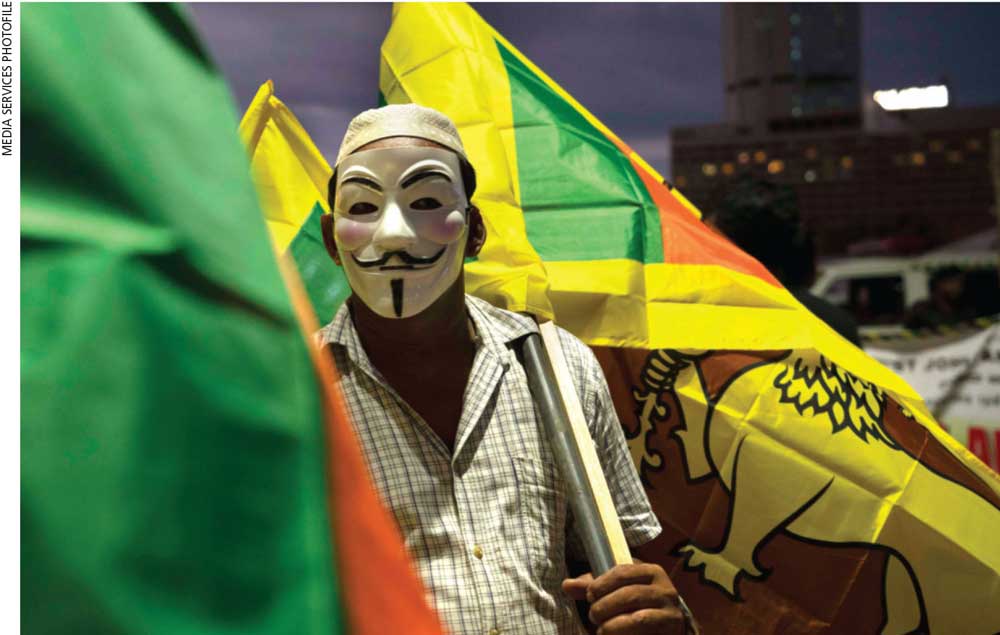
Otherwise, the law becomes a weapon rather than an impartial instrument of justice: the aragalaya is a reminder that the protests were an exercise of the right to dissent against failure and oppression.
And the protests helped end a government that had mishandled foreign borrowings and imposed a sudden ban on chemical fertiliser that devastated farmers. Yet, the arrest and prosecution of participants that followed under the successor administration have raised troubling questions about the treatment of dissent.
Violence during protests must be dealt with according to the law. But peaceful protests, criticism of government and civil disobedience can’t automatically be treated as threats to the state.
A government that came to power on a people’s movement has particular reason to guard that distinction because broad laws are blurring that difference.
The Protection of the State from Terrorism Act is now law while the Prevention of Organised Crimes Bill and the Nongovernmental (Registration and Supervision) Bill are being reworked.
Preventing terrorism, dismantling criminal networks and ensuring transparency in organisations receiving public or foreign funds are legitimate state duties, and Sri Lanka has international obligations with regard to organised crime and terrorism financing.
Meanwhile, the Human Rights Commission of Sri Lanka (HRCSL) – which is a state institution – has criticised the terrorism legislation for its broad definition of ‘terrorism,’ its potential impact on protests and trade union action, prolonged detention and weak judicial oversight.
Those concerns don’t vanish over time and must address how the law is applied. So the courts, HRCSL and civil society need to watch this situation closely.
The Organised Crimes Bill has drawn criticism over detention powers, the admissibility of confessions made to police and extensive surveillance. Meanwhile, the NGO bill raises the same issue from another side, which is that oversight of funded organisations is legitimate – but it must not become a means to pressure groups that criticise the government. The ongoing reform is the chance to fix these flaws.
Behind this lies a basic principle: the law must protect the innocent from wrongful prosecution, which is why guilt must be proved beyond reasonable doubt. Confessions made to the police are not a technicality and contribute to the reliability of convictions.
Courts must ensure that evidence supports charges, and investigators and the executive remain within the law. Independent scrutiny makes investigations credible and public confidence depends on it.
A country where criminals act with impunity can’t build trust for economic progress, nor can it advance if its citizens fear that state power may be turned on them for challenging official decisions.
The ultimate test of system change is not only whether the government can bring powerful people to justice; it’s also whether it builds safeguards that restrain it and any successor, since powers that seem safe in reforming hands can be abused by the next regime.
Draft laws should be revised wherever they fall short of constitutional and international human rights standards, and the Terrorism Act’s operation must be reviewed. A strong state enforces the law effectively while a just state knows the limits of its power – Sri Lanka needs both.
Peaceful protests, criticism of government and civil disobedience can’t automatically be treated as threats to the state