
INDUSTRY REFORM

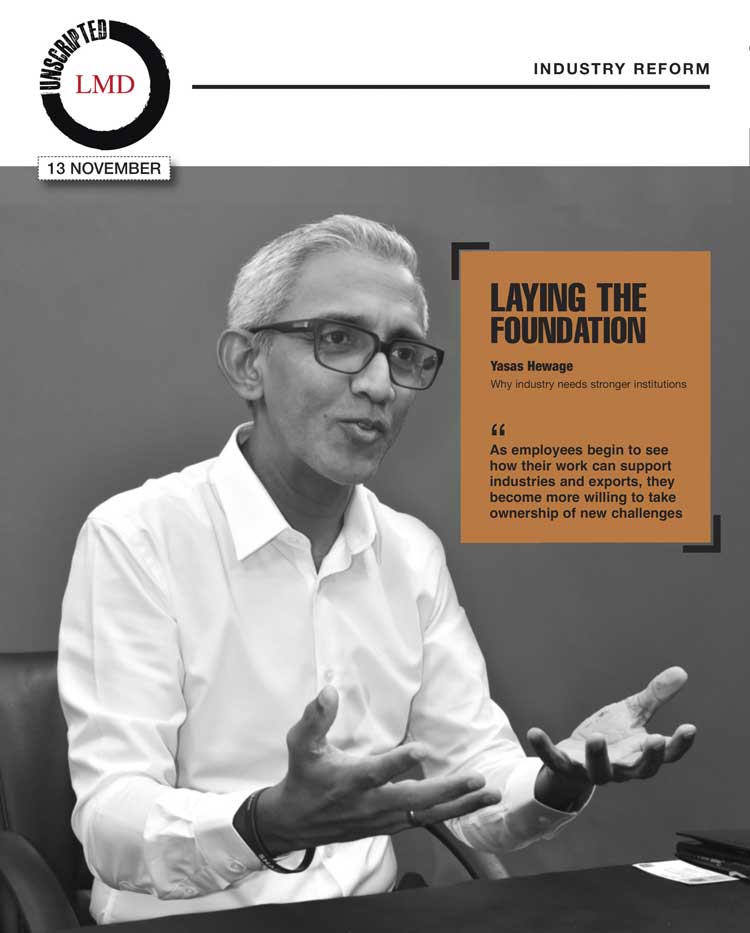
Sri Lanka has long had ambitions for its industries. For the Chairman of the Industrial Development Board (IDB) Yasas Hewage, the challenge lies in building institutions that are capable of turning those ambitions into lasting results.
That means bringing together work that has often been carried out separately while giving people a clearer understanding of how their contributions fit into the country’s industrial future.
“We have always had dreams of where the economy should go and what it should look like. But at a point, we have now understood that strategy is not the problem – we inherited structural issues,” he asserted, on a recent episode of LMD Unscripted.
Hewage is involved in plans to bring the IDB’s industrial development work together with enterprise development and export promotion under a new mandate. The aim is to garner support for entrepreneurs, manufacturers and exporters across the value chain, reducing duplication and helping businesses move from startup to scale.
He cautioned that the benefits will take time to become visible. Businesses still face high production costs, difficulty finding workers and lengthy processes to obtain land. Measures such as the credit guarantee scheme are beginning to offer support though accessing finance remains difficult for many startups.
“Can a startup go to a bank and borrow right now? The answer is that it isn’t as easy as we want it to be,” he acknowledged. For Hewage, this is why structural reform matters: entrepreneurs need a system that helps them move forward without having to navigate disconnected institutions.
Changing institutions also means working with people who may be uncertain or resistant. Hewage doesn’t see every objection as an obstacle: “If it’s not negative and there’s no resistance, you are probably doing business as usual. As leaders, we have to create that open communications climate.”.
This calls for debate across government bodies and time spent understanding how they can work together. He pointed to discussions between the IDB and the Board of Investment of Sri Lanka (BOI) on connecting industrial zones, and making better use of the opportunities they offer manufacturers.
Hewage believes such work depends on recognising talent within the public sector.
He has come across employees whose capabilities, he said, are often overlooked by those outside the government. But bringing out their best requires more than assigning tasks; they need to see the purpose of their work and have a voice in shaping it.
“The inspiration, the insight is so dispersed in organisations. I work closely on the ground, listen, talk to people and understand. As employees begin to see how their work can support industries and exports, they become more willing to take ownership of new challenges,” he explained.
He also wants Sri Lanka to strengthen its ability to build enterprises.
Entrepreneurship may attract attention, yet he argues that people need to understand the systems, processes and skills that enable an organisation to grow and endure. The IDB’s Industry 5.0 programme seeks to draw practical lessons from manufacturers and develop case studies that others can learn from.
“The fact that systems give you scale is not common knowledge,” Hewage said. He sees a need to share that knowledge more widely, so that promising ideas can develop into organisations capable of sustaining them.
His advice to leaders is simple: “Listen. Find time to sit alongside them. Magic happens.”
For Hewage, industrial transformation begins with stronger structures but it relies on people who understand their purpose and are heard as they work. He believes that connection can restore a sense of purpose to public sector roles.
As Hewage puts it, “people may have spent 10 or 20 years carrying out isolated tasks without seeing how their work contributes to a larger goal. When those connections become clear, they can see that what they do matters.”
– Transcript compiled by Tamara Rebeira