
BANGLADESH ELECTION
BONES OF CONTENTION NEED RESOLUTIONS
Saro Thiruppathy reports on the results of the recent Bangladesh election and bends in the road that the new government will need to take
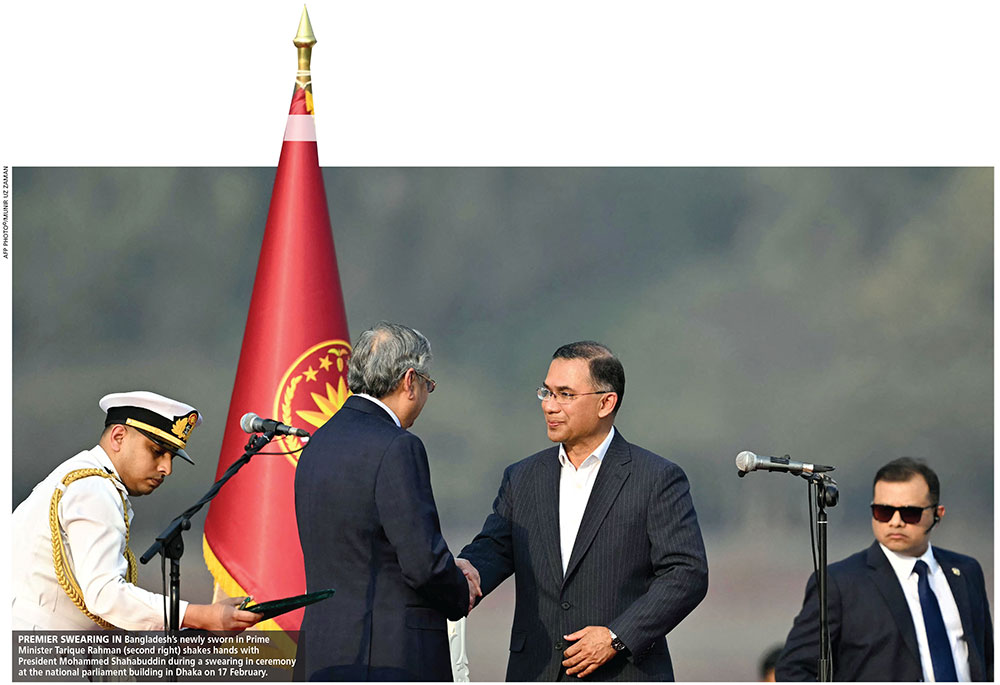
Bangladesh held its first general election in February following the ousting of former prime minister Sheikh Hasina in July 2024, after she had been in power for 15 years. The election identified members of the Jatiya Sangsad, the existing unicameral legislative body, and the proposed future senate.
NEW LEADER Prime Minister Tarique Rahman leads the Bangladesh Nationalist Party (BNP) and is the son of erstwhile prime minister Khaleda Zia and former president Ziaur Rahman.
The BNP secured 212 seats (two-thirds of the house) in parliament while the Bangladesh Jamaat-e-Islami (Jammat) won the second highest number of seats to become leader of the opposition bloc for the first time with 68 seats of its own and a total of 77 as part of a wider alliance.
Bangladesh also conducted a simultaneous constitutional referendum on the July Charter, which is based on the consensus reached between 30 political parties and the interim government that was led by Dr. Muhammad Yunus, on the reforms needed in the constitutional, electoral and administrative realms. This document was developed in response to the July uprising of 2024.
Although over 127 million Bangladeshis were eligible to go to the polls, the turnout was less than 60 percent to cast a ballot for more than 2,000 candidates who contested the 299 parliamentary seats.
Meanwhile, Hasina’s Awami League party was banned from participating in the election. As a result, the contest was between the BNP, and the alliance of 11 parties led by Jamaat and the National Citizen Party (NCP), which led the 2024 uprising.
The key issues impacting the people of Bangladesh include corruption, lack of employment, extortion, proportional representation (PR), and broken promises made to the youth and minority voters. This poll was also touted as the first Gen Z inspired election as a result of the regime change that took place in Bangladesh, and was later replicated in other countries.
JULY CHARTER Although it contained an ambitious list of proposals that included constitutional, judicial and legislative reforms – together with increased political representation of women in the legislative sphere, expanding the range of fundamental rights and the protection of judicial freedom – the first major failure was seen in the lack of women politicians in the Jamaat party.
The NCP came under heavy criticism for this monumental lapse by its political ally in spite of the support that the former had received from Bangladesh’s female population during the 2024 uprising.
When the NCP realised that its political future wasn’t as rosy as it had previously envisaged, it opted to join forces with Jamaat, which is the nation’s largest Islamic party. Jamaat has also consistently advocated for Islamic law and been extremely conservative regarding the sociopolitical rights of Bangladeshi women.
Several NCP leaders resigned in protest at the party’s decision to align itself with Jamaat, and internal problems have been evident since the ideologies of the two parties are fundamentally not in sync.
The NCP has a centrist perspective and base, and much of its leadership fears that this alliance will do more harm than good.
BNP’S BURDENS The fledgling government has a list of challenges that it needs to overcome in the near future. These include the restoration of democratic institutions and ameliorating the polarisation of Bangladesh that followed Hasina’s exit nearly two years ago.
Other issues include slow economic growth, high debt, lower levels of foreign direct investment (FDI) and a weak banking sector. Roads and infrastructure also require urgent attention to prevent traffic accidents and miscellaneous issues.
Labour problems include the protection of workers’ rights as a result of economic instability, previous political unrest and poor enforcement of labour law. Though reforms have supposedly been planned to address wage disputes, union registration, worker safety and so on, they have yet to be implemented smoothly.
Continuous labour violations are also being seen in industries such as apparel, and the ship-breaker and leather sectors, and disrupted supply chains, as well as in the enactment of the repressive Government Service (Amendment) Ordinance 2025.
FIRST FAILURE The new government abruptly replaced the governor of the country’s central bank and is facing extensive criticism, particularly regarding the credentials of the new appointee and the manner in which his predecessor was removed.
This precipitate removal of the Governor of Bangladesh Bank Dr. Ahsan Mansur, in spite of the stability achieved during his tenure, raised concerns in the country about the independence of the central bank.
Mostaqur Rahman, who replaced him, is a businessman with a finance and accounting background.
Yunus’ interim government’s efforts to rebuild Dhaka’s relationship with Islamabad and strengthen ties with Beijing caused grief in New Delhi.
Before healing rifts with India however, there are several other contentious issues that need to be resolved – such as water sharing, cross border movements, shootings along the international border, illegal economic migration and more.