ENERGY SECTOR

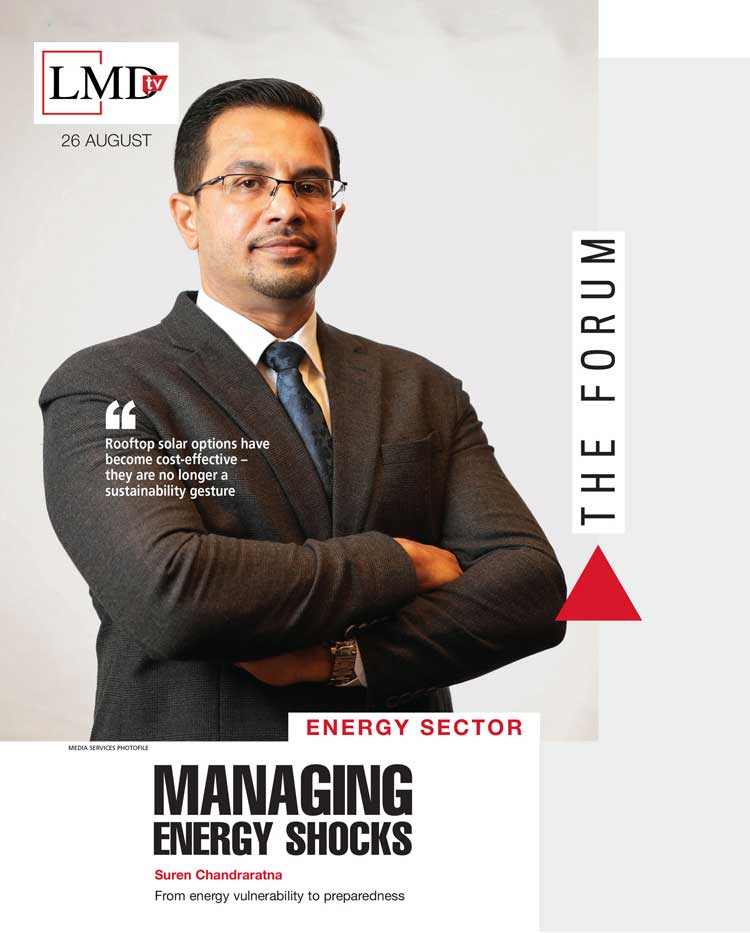
The overall macroeconomic picture for the energy sector has changed over the past couple of months due to global geopolitical tensions. Chairman of the Chamber of Lankan Entrepreneurs (COYLE) Suren Chandraratna asserts these external pressures pose challenges for Sri Lanka due to the country’s internal vulnerabilities.
In a recent interview on LMDtv, he explained that the country’s capacity to absorb external shocks remains weak as the island continues to recover from the 2022 economic crisis.
Chandraratna noted: “We are a near total oil importer – so the shock is transferred directly into our trade account and from there, into the pockets of our people and businesses. Everyone feels the pinch.”
He continued: “Between January and June, Sri Lanka spent approximately US$ 3.1 billion on fuel imports alone – that’s a 58 percent increase compared with the same period last year.”
“However, spending gradually decreased and we spent approximately 880 million dollars in April, US$ 536 million in May and 465 million dollars in June. There has been some relief but these numbers are still very high by historical standards,” Chandraratna added.
Sri Lanka also recorded some positive news in terms of its gross official revenue, which stood at around US$ 6.9 billion at the end of May. He noted that “this gives us a cushion, which we didn’t have in 2022 – and that’s an important difference. But that cushion is not a solution.”
Although prices are stable, Chandraratna warned that the risk of fresh shocks remains very real and Sri Lanka must have plans in place to combat long-term structural pressures.
The World Bank expects crude oil prices to average between US$ 86 and 115 dollars a barrel in 2026. Even at the lower end, the nation’s import bill and foreign reserves will remain under pressure. This is a price spike that cannot simply be waited out – it is a risk that must be prepared for.
“The impact on households is already clear,” he elaborated, noting the the Colombo Consumer Price Index (CCPI) has risen in recent months: “As higher energy costs are directly affecting household budgets, we need to protect low income families from the full impact of rising oil prices.”
Oil related shocks also impact businesses including SMEs, he explained: “You can’t control international prices but you can control the exposure that you have.”
According to Chandraratna, investing in renewable energy – supported by a strong grid and targeted protection – is the way to build resilience. He offered several recommendations for businesses, beginning with an energy efficiency audit – which Chandraratna described as a basic, fast and low risk way to cut costs. Many businesses are surprised at how much fuel and electricity can be saved by simply understanding consumption patterns.
Secondly, he suggested that businesses explore captive renewable energy generation, where feasible in terms of implementation and costs.
Chandraratna explained that “rooftop solar options have become cost-effective – they are no longer a sustainability gesture but sound financial planning that aligns with where the country is heading.
Sri Lanka is aiming for 70 percent of its electricity to come from renewable energy by 2030. Businesses that move early with renewable energy will be able to stay ahead of the curve instead of trying to catch up.”
Thirdly, he called on businesses to build price volatility into their financial planning. He said: “Don’t simply budget energy costs as they are today; you need to have flexibility.”
For businesses in logistics for instance, ways to reduce dependence on diesel include route optimisation, fleet modernisation or EV adoption for last mile delivery and short haul operations, he emphasised.
These are practical and achievable steps that businesses can adopt to transform Sri Lanka’s energy volatility “from something that happens to us, into something we can actually manage,” he explained.