NBFI SECTOR

SUSTAINABLE FINANCE
COMPILED BY Yamini Sequeira
SHAPING FINANCIAL INCLUSION
Rajive Dissanayake identifies risk frameworks for sustainable financing

The past few years have fundamentally reshaped the non-banking financial institutions (NBFI) sector. Among the most enduring lessons has been the recognition that profitability alone cannot define institutional strength.
“Liquidity management is as important as profitability while strong capital buffers provide the ability to absorb unexpected shocks. These principles have become central to how finance companies now approach long-term sustainability,” asserts Rajive Dissanayake.
He believes the past experiences have “reinforced the importance of maintaining underwriting discipline, governance and transparency, to maintain depositor and investor confidence.
Equally important is the growing appreciation for diversified funding structures and digital resilience.”
The ability to continue serving customers through technology during periods of disruption has demonstrated that digital capabilities are no longer optional but essential components of business continuity.
PRODUCTIVE FINANCE As macroeconomic stability gradually returns, the role of finance companies is also beginning to evolve.
“One of the sector’s greatest strengths lies in its ability to serve customer segments that remain underserved by traditional banking institutions. This places finance companies in a unique position to broaden access to capital for segments of the economy that are capable of generating employment, investment and higher productivity,” he argues.
Dissanayake goes on to state that “responsible credit expansion will therefore become increasingly important as economic confidence returns. Financing micro, small and medium entrepreneurs, agriculture, transport, tourism and other productive industries will accelerate and strengthen a broader economic recovery.”
“Increased credit availability should translate into investment, employment and productivity rather than higher consumption alone,” he explains.
This shift in emphasis reflects a broader evolution in the sector’s purpose. The focus is increasingly turning towards sectors capable of generating foreign exchange earnings, strengthening domestic production and reducing import dependence.
“The NBFI sector should move from simply financing consumption towards financing productivity, entrepreneurship and investment – a transition that positions finance companies as catalysts of sustainable economic development,” he muses.
FINANCIAL INCLUSION Dissanayake continues: “Financial inclusion remains one of the sector’s defining responsibilities. However, expanding access to finance must be balanced with prudent risk management and long-term commercial viability.”
Meanwhile, technology is transforming how underserved customers are evaluated.
“Alternative data, enhanced credit scoring models and sophisticated early warning systems are enabling finance companies to assess borrowers with limited traditional credit histories more effectively, opening opportunities for individuals and businesses previously excluded from formal finance,” he enthuses.
At the same time, digital onboarding and servicing are reducing costs while making smaller ticket lending commercially viable, creating new opportunities to design products that better reflect the realities of irregular income earners, self-employed individuals and emerging entrepreneurs.
“Financial inclusion becomes sustainable only when a customer can afford the product while the institution is able to continue to serve that customer profitably,” he emphasises.
The sector also has an important role to play in expanding opportunities for women and youth entrepreneurs, thereby ensuring that access to finance becomes a driver of inclusive economic participation.

DIGITAL FUTURE “The finance company of the future will look markedly different from the institution of the past with data playing a transformative role. By leveraging customer insights, finance companies can personalise products, offer flexible solutions and provide faster credit decisions that better reflect individual customer needs,” he avers.
Customised products delivered with speed and cost efficiency will increasingly differentiate market leaders from their competitors.
Artificial intelligence, automation and advanced analytics are set to accelerate this transformation. AI has the potential to improve credit assessment, strengthen risk prediction and identify unusual transactions that may indicate fraud.
Dissanayake says this transformation requires a more collaborative mindset.
Rather than attempting to build every capability internally, finance companies should seek partnerships with fintechs that can accelerate innovation and enhance the customer experience.
“Finance companies need to think beyond financial products and towards broader financial ecosystems, while recognising that customer experience and supporting customer journeys are becoming strategic differentiators,” he explains.
BUILDING TRUST As technology reshapes business models, governance will remain the foundation upon which sustainable growth is built. In a sector founded on confidence, trust represents an institution’s most valuable asset.
“Integrity means doing the right thing even when it is commercially difficult. This must be supported by accountability with clearly defined responsibilities at both board and management level, and reinforced through transparency in communications with customers, investors and regulators,” he adds.
A strong risk culture combined with an unwavering commitment to customer centricity and good governance creates the conditions for sustainable growth.
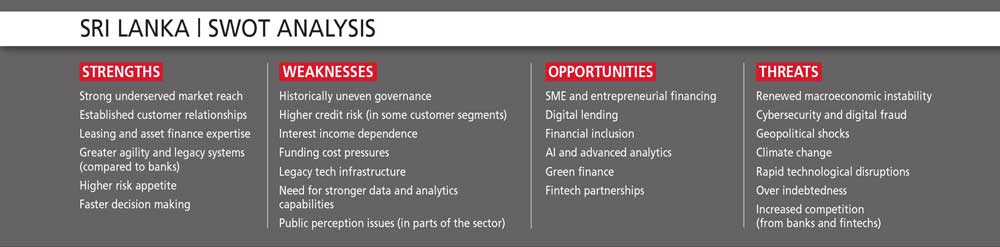
Assessing the environmental and social risks associated with financed activities, increasing support for renewable energy, energy efficiency, sustainable agriculture and climate resilient businesses, while strengthening customer protection and financial literacy, are all becoming integral to responsible finance.
NAVIGATING RISK The risks facing the financial services sector are becoming more interconnected and increasingly difficult to predict. Geopolitical uncertainty continues to influence global markets through commodity price volatility and disruptions to international trade.
At home, interest rate movements, exchange rate pressures, inflation and renewed external sector challenges remain important macroeconomic considerations.
“Technology introduces another layer of complexity.
Cyberattacks, data breaches, digital fraud and a growing dependence on third party technology providers are becoming strategic risks, which call for continuous investment and vigilance. Climate related risks are also moving rapidly up the agenda,” he cautions.
Financial inclusion becomes sustainable only when a customer can afford the product while the institution is able to continue to serve that customer profitably
To manage these interconnected risks, Dissanayake suggests “stronger governance, better data and more forward-looking risk management frameworks than ever before.”
Despite these challenges, the opportunities for the sector are considerable. SME financing, digital lending, financial inclusion, agricultural and rural finance, equipment financing and support for export oriented businesses all present avenues for sustainable growth.
“Green finance and climate related investments are expected to become increasingly important as businesses adapt to changing environmental realities, while partnerships with fintechs and digital platforms expand the sector’s reach and capabilities,” he notes.
And Dissanayake predicts that “climate resilience in particular, is expected to become a defining feature of future business models.”
Above all, maintaining consistency in economic and regulatory policy will be critical to encouraging long-term investment and innovation. And he believes that NBFIs have a real opportunity to emerge from the challenges of the past decade as a more responsible, technology driven and inclusive sector.
The interviewee is a former chairman of HNB Finance and the Executive Vice President/Head of SME & Micro Finance of Hatton National Bank.