
CLIMATE PREPAREDNESS
TIME TO SHIFT TO A WAR FOOTING
How to prepare for climate risks by Kiran Dhanapala
The Sri Lanka Climate Summit 2024 conducted by the Ceylon Chamber of Commerce highlighted the climatic risks for the island and expectations that climate induced disasters will become more frequent.
This poses a major risk to lives, livelihoods and the economy. It urged the scaling up of adaptation efforts in Sri Lanka, and environmental lawyer Dr. Lalanath de Silva called for climate adaptation to be put on a war footing.
Sadly, all the messages highlighted at the summit proved to be true in the aftermath of Cyclone Ditwah in November last year. And the outcomes aren’t only related to climate change but also governance and systemic issues that compounded the damage.
The scenario presents risks to the ongoing delicate economic recovery and exacerbates an already heavy debt burden. And it affects supply chains, business assets and infrastructure, which in turn dampen growth.
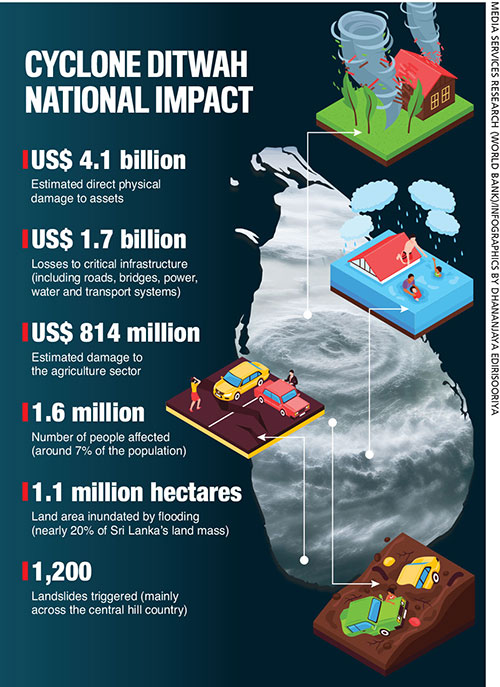
The World Bank’s Global Rapid Post-Disaster Damage Estimation (GRADE) report in 2025 provided a lower bound estimate of the damage at around four percent of Sri Lanka’s GDP or US$ 4.1 billion in direct physical damages.
Meanwhile, the Central Province – which was the hardest hit – suffered an estimated 698 million dollars in damages, mostly due to floods and landslides.
The report highlighted preexisting socioeconomic vulnerabilities and noted that they have exacerbated the impact of the weather event and slow recovery. Prior to the cyclone, the World Bank estimated climate related potential economic losses for Sri Lanka by mid-century to between 3.3 and 3.5 percent of GDP.
Chairman of the Ceylon Chamber of Commerce Krishan Balendra has noted a moderate economic impact with faster recovery than envisaged. He added that banks estimated that about one percent of their loan portfolios had been impacted by Ditwah.
Although the public’s compassion and self-help were demonstrated once again as an emergency response, people are tired of being resilient. They’re fed up with having to rebuild businesses that were affected, and bearing the burden that strong institutions and technically savvy climate adaptation initiatives should be addressing.
Climate disasters affect economic and business resilience; and as always, the smaller entities are among the most affected.
The Central Bank of Sri Lanka recognised the importance of maintaining strong macroeconomic buffers to help cushion climate risks that affect the economy. Prioritising disaster preparedness is critical when trying to ensure long-term resilience.
For Sri Lanka, investing in resilience rather than increasing aid and more debt is needed when considering a future of extreme weather events. Investment in risk financing, resilient infrastructure, strengthened governance related to land use and preparedness are mandatory.
Institutions – and their ability to plan, share data, coordinate climate hazard risks, undertake damage assessments etc. – must be strengthened.
Sri Lanka’s National Adaptation Plan (NAP) 2026-2035 was updated last year; and it is seen as a broader and more detailed document than its predecessor.
Building for the future needs to be holistic, inclusive and adaptive to rebuilding, and based on evidence and data. The World Bank says that this process must include improving rural resilience and prosperity, investing in livable cities and expanding clean domestic energy.
It advocates an integrated approach to landscape management, the use of digital solutions and mobilising private finance. Government agencies and business chambers will also need to co-design and co-develop solutions along with civil society participation.
Decentralised decision making is required with risks being monitored at various levels by local actors. Tools and information must be transparent and easily available to the public so that they have a stronger disaster prevention focus.
Business continuity will require financing and all investment vehicles must embed climate risk management. All new finance vehicles will need to mobilise capital to scale up solutions for resilience in terms of identified climate hazards. And adaptation measures will need innovative incentivisation.
Enterprises will need to develop skills that help them analyse their climate risks. And they will need access to real-time data – which includes geographically detailed risk assessments that indicate various climate hazards – to do so.
Businesses will also need to undertake assessments for specific corporate vulnerabilities due to climate risks. The Task Force on Climate Related Financial Disclosures (TCFD) was the first to conduct corporate climate risk assessments whereas financial institutions perform portfolio climate risk analysis.
Organisations should assess their specific climate risks through weather intelligent decision support tools that will enable them to make better weather and climate informed decisions.
Overall, Sri Lankan businesses need to prepare themselves for future climate battles.