TRUMP VS POPE
VIEWPOINTS
THE VATICAN IN GEOPOLITICAL CROSSFIRE
Sunera Bandara believes that tensions involving the Vatican call for a look at history as faith and geopolitics have often collided
In the 14th century, there was a little-known Western phenomenon called the ‘Avignon Papacy.’ This marked a line of pontiffs who reigned not from Rome but Avignon in France. It was a time rife with corruption, disquiet and war.
Prior to this, it was quite common for rulers to squabble with popes, often leading to significant consequences.
One can understand this better by looking at later cases such as Napoleon Bonaparte, who kidnapped Pope Pius VII in the 19th century. Western Christendom was largely defined by the authority of the Roman Catholic Church; and by and large, this rested with the seat of Peter – the papacy.
Even to this day, nations recognise not only the relevance of the papal office but also its historical significance.
In the recent past, an interesting geopolitical conflict has surfaced following a resurgence of commentary surrounding a meeting on 22 January between the former papal ambassador Cardinal Christophe Pierre and United States Under Secretary of War for Policy Elbridge Colby at the Pentagon.
This has been termed a series of political confrontations between the Holy See of Rome and the US.
Avignon was part of the Kingdom of Arles and under the Holy Roman Empire in the 14th century. It was then described as a town of no great importance.
Despite this, it has recently regained global attention following a report by the Free Press in early April, which claimed that Vatican insiders suggested that threats had been made towards the Holy See by the US War Department, veiled in rhetoric referencing the Avignon papacy.
After Pope Boniface VIII (1294-1303) extended papal authority into the political sphere, he clashed with King Philip IV of France, who was also known as ‘Philip the Fair.’
The king attacked the papal palace and was duly excommunicated. But all did not end there – King Philip ordered his arrest, and the pope was seized and attacked, though released a few days later. He died a month later, likely as a result of the trauma and his old age.
In 1309, Pope Clement V relocated the entire papal court to Avignon – a stunning and regal court in comparison to those in the Papal States at the time. This period came to be known among Catholics as the ‘Babylonian captivity.’
The French courts were known to pressure the church, causing it to organise in a similar fashion to the temporal courts of France. The Avignon Papacy therefore, became a lasting geopolitical symbol of the coercion of the papacy.
This characterisation of the meeting was strictly denied by the former papal ambassador and dismissed as false by the Holy See Press Office. The United States also rejected the claims. What was characterised as a bitter lecture circulated on social media with commentators accepting the proposition that the Trump administration had threatened the Holy See, transpired to be fake news after all.
The skirmish of words between US President Donald Trump and Pope Leo XIV has recently drawn attention and divided Catholics, especially after the latter stated publicly that he had no fear of the Trump administration and would remain focussed only on his pastoral duties of care towards the flock.
He also rebuked Trump for attacking Iran.
“I will continue to speak out loudly against war, looking to promote peace, promoting dialogue and multilateral relationships among states to find just solutions to problems,” the pope said aboard a flight to Algiers, marking the beginning of an 11 day tour of four African nations.
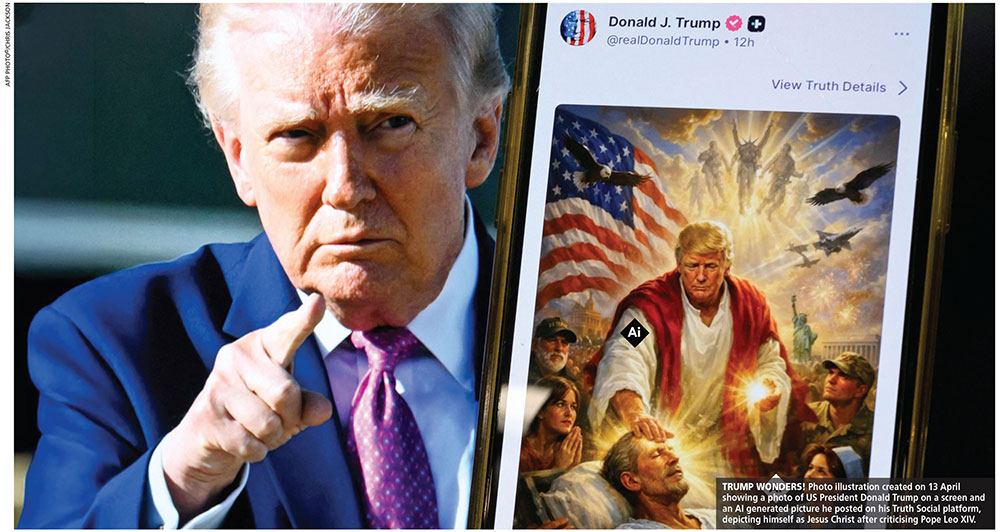
Trump responded to these criticisms by stating that he is “not a big fan of Leo,” and posted a picture of himself as Jesus healing the masses on the American social media platform Truth Social.
“I don’t want a pope who thinks it is okay for Iran to have a nuclear weapon. I don’t want a pope who thinks it’s terrible that America attacked Venezuela,” he said, when asked to comment.
According to independent investigative journalist Ken Klippenstein, the CIA has human spies working inside the Holy See bureaucracy. He claims that agencies such as the National Security Agency (NSA) and CIA seek to intercept telecommunications, emails and texts, while the FBI investigates crimes committed against and by the Vatican.
And the US State Department closely follows the ins and outs of papal diplomacy and politics.
All these agencies liaise with the Vatican’s own foreign policy, intelligence and law enforcement agencies.
The papacy itself brings about its own complexities. In terms of philosophy, one may argue that Pope Leo XIV’s decision to rebut any Trump administration claims is ultramontanist. The 19th century term denotes a Catholic viewpoint looking ‘beyond the mountains’ to Rome. Pope Leo XIV succeeded Pope Francis, who passed away in April 2025.