G7 SUMMITS
GATHERINGS OF COMRADES FOR BUSINESS?
Saro Thiruppathy wonders whether the G7 power bloc is truly committed to achieving global peace and world order in times of conflict and strife
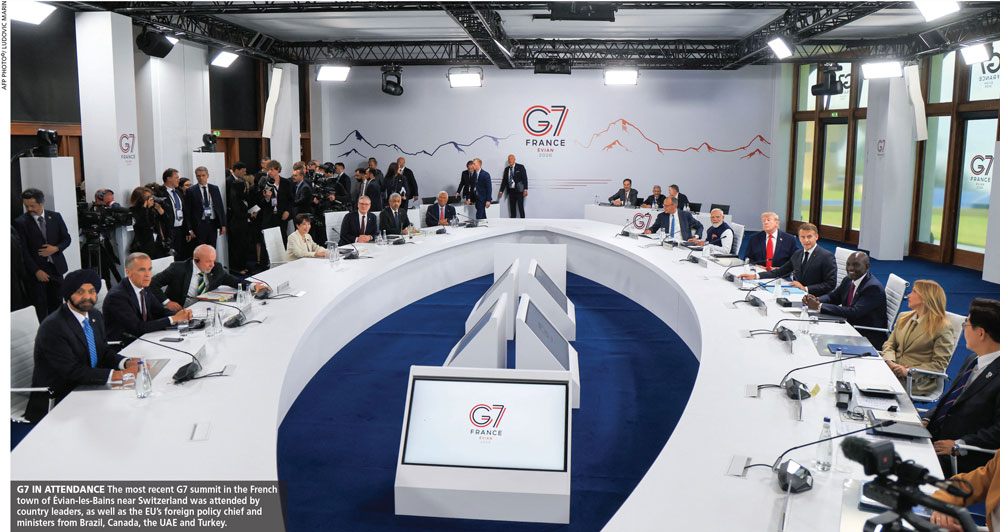
The governments of seven major developed economies comprising the US, the UK, France, Germany, Italy, Japan and Canada meet annually in opulent surroundings set in idyllic locations to discuss the issues that affect them.
The Group of Seven (G7) was established in 1975 as G6; it later became G7 in 1976, when Canada joined. Though the EU is a non-appropriated member, it participates fully in all summits.
This year’s summit was held from 15 to 17 June in Évian-les-Bains, and focussed on reducing economic imbalances in the world, promoting global peace and public health, regulating AI and controlling the smuggling of migrants.
Invitees to the summit included Brazil, Egypt, India, Qatar, South Korea, Ukraine, the UAE and Kenya.
In spite of all the pomp and pageantry seen at G7 summits, nothing much comes to fruition after the many agreements are signed and statements delivered by sundry members
The French presidency, which hosted the summit, chose to exclude South Africa from its list of invitees despite the latter having been a regular guest at previous G7 summits. Instead, France invited Kenya.
That deletion occurred due to the diplomatic tension created with Johannesburg by Washington. It was reported in the media that the US had threatened to boycott the summit if South Africa attended. This conflict is the result of Johannesburg’s genocide case against Israel in the International Court of Justice (ICJ).
SUMMIT OUTCOMES The G7’s leaders adopted many declarations, which included addressing the smuggling of migrants, fighting the trafficking of drugs, establishing secure supply chains for critical materials and creating a digital space that’s safe for minors in the era of artificial intelligence.
They also aim to help improve cancer research and provide aid to counter the recent outbreak of Ebola in Central Africa.
For the first time in the history of G7 gatherings, France invited nonmember nations such as Brazil, Egypt, India and Kenya to participate in the sessions in an effort to demonstrate that global efforts are in place to find solutions to the geopolitical and economic challenges facing the world.
But the summit served mostly as a forum to facilitate international business agreements, and succeeded in securing billions of dollars in investments for members and nonmembers alike.
With regard to Ukraine, the bloc’s leaders will continue to support Kiev in its war with Russia, and pledged more weapons deliveries that include air defence capabilities and interceptors. They also agreed to tighten sanctions against Russia – particularly on its petroleum industry.
In terms of the war that the United States and Israel launched against Iran, the G7’s leaders were impressed with the Islamabad Memorandum that would cease hostilities between Washington and Tehran at the time.
Even though the Strait of Hormuz is managed by Iran and Oman, G7 members (in a tone-deaf move) supported the establishment of an independent and defensive maritime operation led by France and the UK to guarantee secure commercial shipping through that vital body of water.
French President Emmanuel Macron was so enamoured with the contents of the MOU that he hosted US President Donald Trump to a lavish dinner so that he could sign the peace deal on 17 June at the Palace of Versailles.
The historic Treaty of Versailles was signed in 1919 to end World War I, and it seems that France was framing the US-Iran memorandum of understanding along similar lines.
GROUP FAILURES In spite of all the pomp and pageantry seen at G7 summits, nothing much comes to fruition after the many agreements are signed and statements delivered by sundry members.
The power bloc has also been criticised for not implementing global solutions, not having Global South representation except as invitees, and not acting together as a group due to the internal fissures within its membership.
Its member states are erstwhile imperialists and invitees are mostly former colonies. Though India and China are the rising powerhouses in the world, the G7 has not invited them to be members. This must surely undermine its capacity to be a global decision-making body.
In spite of all the pomp and pageantry seen at G7 summits, nothing much comes to fruition after the many agreements are signed and statements delivered by sundry members
Though much has been said about the impact of climate change on vulnerable countries and financial pledges have been made by rich nations, G7 members are being criticised for failing to meet financing targets, not committing to phasing out the use of fossil fuels and neglecting to provide aid to developing nations in distress.
The group rarely issues joint declarations because of the divergence of policies between its member states. Such rifts prevent members from agreeing on solutions during global conflicts such as the recent war in the Middle East. The G7 has also chosen to stay silent, and not exert any pressure on the US and Iran to bring about a resolution to their conflict.
So it seems that G7 summits are more akin to a gathering of comrades rather than a bloc that’s committed to ensuring global peace, harmony and equity. Nevertheless, the attendees do enjoy the bonhomie and camaraderie, as well as the photo opportunities… and many leave with lucrative investment deals tucked under their arms.