LMDtv – 1
Ever since the first airstrikes on Iran were reported on 28 February, the Middle East conflict has caused unparalleled disruptions across the world. While the world has been affected by shipping routes passing through the Strait of Hormuz being choked, countries in the Gulf region have been devastated by missile and drone strikes, which killed thousands and destroyed numerous infrastructure facilities.
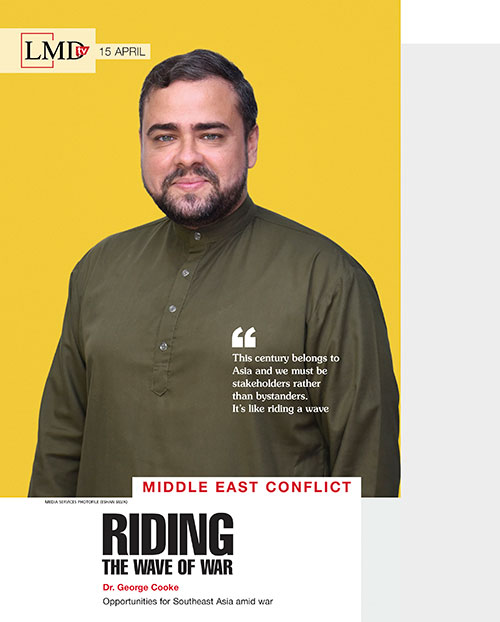
Speaking on LMDtv, Founder Chairman of Awarelogue Asian Institute Dr. George Cooke stressed that although war is not a novelty to the Gulf region, the scale is far greater this time around.
“Since the day Israel was established in 1948, there have been wars in this region. So this is not new – but the scale is much larger,” he said, citing factors such as the use of advanced technology and weapons.
He added: “This is not a problem that we are seeing an end to because some things – such as the Strait of Hormuz – that weren’t a problem before have become critical.”
“The countries in the region are facing the wrath of this conflict with people dying, being injured and infrastructure being damaged or destroyed. And as the conflict keeps worsening, the Middle East is becoming increasingly unstable,” Cooke observed.
He explained that “if you are an investor transiting through that region, you’re going to think twice. The economies of those countries also rely on exports, which they’re now unable to ship out easily. Beyond trade, the day-to-day lives of people in those countries – many of whom live in high-rise apartments – have been severely impacted.”
“People are receiving regular alerts and being told to take precautions but what do those precautions look like on a daily basis?” he asked.
The adverse impact of the conflict has spilled over to the rest of the world – mainly driven by shortages of fuel and gas. Despite the short-term challenges however, the crisis also presents opportunities especially for Asia, Cooke asserted.
It might seem insensitive to consider opportunities in the midst of a conflict. But that is the way the world turns and it’s where Asia has a significant opportunity to better understand the dynamics of this situation: “We need to ask what we should be doing, how we should evolve, who should we align ourselves with and how should we build networks?”
Cooke explained: “We shouldn’t put all our eggs in one basket – and now is the time to diversify. For instance, Sri Lanka is heavily dependent on the American economy, which is our largest export destination. This has been the case for some time but should it continue forever?”
He discussed the potential for Southeast Asia in trade, logistics and more, stressing the importance of regional countries working together.
Cooke added: “There is immense potential for Southeast Asian nations to engage with neighbouring countries – and enhance exports, imports, investments, tourism and financial dealings. It is vital to look at this part of the world and explore what more we can achieve together.”
“We are now in the second quarter of this century. Towards the end of this period, we are going to see more shifts and it is during this time that we’re witnessing the birthing of the Asian century. We are living in very trying times but these are also historic times that are unfolding before our eyes,” he averred.
He continued: “This century belongs to Asia and we must be stakeholders rather than bystanders. It’s like riding a wave – if we don’t ride it, we will be engulfed by it.
“So we must be conscious and reach out for more. We’ve got to look at reviving organisations on this side of the world, consider our contribution and identify how our countries can work more closely together,” he added.
He summed up: “At the same time, we’re not going to replace one world leader with another. We are living in an era in which multilateralism is very important; but since we’re not using it effectively, we will probably pay for that lack of effectiveness.”