NATIONAL VISION
Sitting on a gold mine
The Middle East crisis has shaken the world to its core, causing trade disruptions, energy shortages, and an overall sense of uncertainty that is affecting individuals, organisations and nations.
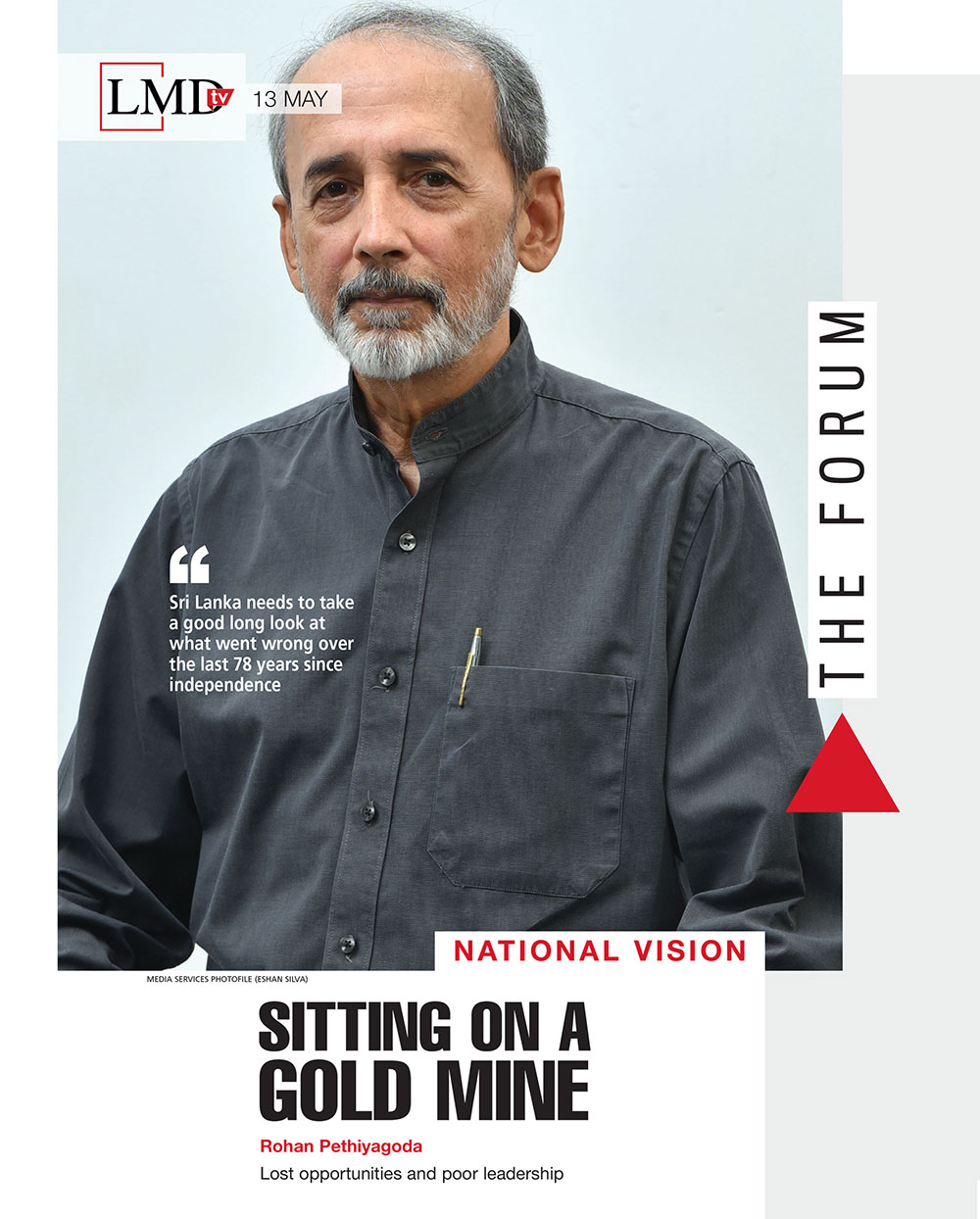
Sri Lanka has been navigating the impact of this crisis for several months and public policy advocate Rohan Pethiyagoda remains optimistic about the country’s way forward.
He believes Sri Lanka has navigated the situation extremely well and that the country has managed to remain unbiased without antagonising either the Americans or Iranians. This, he noted, is important for the continuation of trade and other partnerships with both parties.
Nevertheless, beyond crisis management, there is still much work to be done if Sri Lanka is to realise its full potential as a nation. Pethiyagoda pointed out that although the country appears to be managing its economy and standard of living, this does not attest to progress.
Sri Lanka needs to take a good long look at what went wrong over the last 78 years since independence, he noted during a recent discussion on LMDtv.
For instance, he observed that the island has too many holidays. And since Sri Lankans value these holidays, he doesn’t believe they’re fully committed to the idea of economic and national progress in the way many other countries are.
“We have to recognise that situation,” he urged.
Pethiyagoda also noted that Sri Lanka is missing out on opportunities to generate national wealth: “About 60 percent of the real estate in Sri Lanka belongs to the government, which earns zero income. Sixty percent of our most valuable asset is dead and we don’t have any plans on how to monetise this.”
He cited another example of lost opportunities in the form of Government Agent (GA) permits.
Pethiyagoda explained that “around a million people live on land allocated under what’s called a GA permit, which they can’t take to the bank to obtain a loan – and their children won’t inherit it.”
“What’s stopping any government from transforming those permits into title deeds?” he asked, adding: “You add incredible wealth to the community through that one paper transaction; because when people have titled deeds, they can monetise them by borrowing against them and investing in the land.”
He also pointed out that Sri Lanka doesn’t maintain a national wealth fund.
Pethiyagoda noted: “We have hundreds of government owned enterprises and corporations. If we list them on the stock market and put the shares into a national wealth fund, the state can make trillions of rupees…”
He continued: “We’re sitting on a gold mine of a country that has been mismanaged by leaders since independence because none of them had the vision to make Sri Lanka a truly modern, prosperous, market oriented and futuristic nation.”
And Pethiyagoda believes the government needs to step up because it’s not feasible to expect citizens to come up with solutions for the country’s crises.
“When we faced the energy problem this year, one of the first things people could have thought of doing was switching off their car air conditioners, keeping the shutters down and suffering a little while driving. Nobody did that… I’m not criticising anyone because even I didn’t do it!”
Sri Lanka needs leadership, which is why governments are elected.
“We elect leaders so that they can show us the way because they have the resources with which to think and devise solutions. They can then either invite us to follow the system voluntarily or mandate it through laws, statutes and regulations that we’re compelled to follow,” he asserted.
He continued: “I feel that we are still not united as a country – we’ve come out of a civil war without any dividends other than peace. National integration is still some distance away.”
Pethiyagoda concluded: “The grand challenge before us, both at the level of society and government, is to try and bring Sri Lankans together under a unified national identity.”