LMDtv – 2
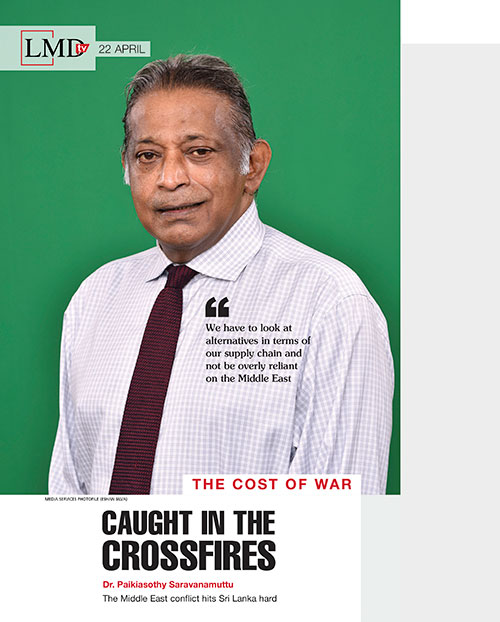
The war in the Middle East has upended trade and economic activity worldwide, causing severe repercussions. In a recent LMDtv interview, Executive Director of the Centre for Policy Alternatives (CPA) Dr. Paikiasothy Saravanamuttu shared his thoughts on the key drivers and motivators of the main players in the crisis – i.e. Israel, the US and Iran.
On the one hand, Tel Aviv sees Iran as an existential threat given that Tehran has allegedly acquired nuclear weapons that could target Israel. On the other hand, Iran is unlikely to wait to be attacked. It is a fight to the death – until suspicion is dispelled and the perceived threat is eliminated, hostility will persist.
The story is different in the United States, where both political and economic factors are driving the conflict. Iran has been anti-American since the Iranian Revolution in 1979, during which Shah Reza Pahlavi was overthrown and replaced by Ayatollah Ruhollah Khomeini, who established the Islamic Republic.
However, Saravanamuttu added: “Yet this is not the full picture.”
There is another issue with Iran’s close association with China and Russia, and this is a major concern for the US. However, there could have been many other factors that persuaded the US to wage this war, he noted.
Already burdened with a fragile economic recovery, Sri Lanka has also been impacted by recent disruptions to oil and gas supplies.
The country was drawn into the spotlight when a US submarine sank an Iranian warship in international waters off the coast of Galle in March. This prompted Sri Lanka to rescue the survivors and manage a diplomatic crisis involving a second distressed Iranian vessel.
He emphasised the stance that Sri Lanka must maintain: “We are neutral – and we need to come out with a bolder and clearer statement as to what our neutrality means because at the end of the day, we cannot be openly pulled or pushed to one side or the other.”
Saravanamuttu also pointed out that a key factor in Sri Lanka’s foreign policy is India’s stance. “Ours is an ambiguous policy since we declare our neutrality in public but have to navigate the contours of Indian foreign policy in private,” he averred.
For Sri Lanka, strengthening economic resilience is critical, as the Middle East crisis has put considerable pressure on exports and trading activities. “We have to look at alternatives in terms of our supply chain and not be overly reliant on the Middle East,” he added.
The crisis is compelling nations to move quickly in terms of decision making, making it difficult to plan ahead. Saravanamuttu emphasised the need for long-term strategies.
He explained: “We need a long-term strategy within which we can devise tactics to deal with particular situations. The challenge is to make up for the obvious financial, trade and economic deficits forced upon us by this conflict.”
“Sectors and industries such as tourism, remittances, tea and fertiliser have all been affected, and there are consequences for food prices from rising oil prices,” Saravanamuttu cautioned.
Sri Lanka must prioritise strengthening its global supply chains by seeking alternative trade routes. In addition, the country needs to look at how it can manage and reduce insurance and logistics costs to place itself in a stronger position, he said.
Caught in the crossfires, Sri Lanka will be compelled to make sacrifices.
He noted that Sri Lanka is strategically located but as far as the actual conflict is concerned, it is on the periphery as the country isn’t a big player internationally.
“The general public will have to bear the cost of the war through disruptions to electricity and rising food prices. The private sector will not be able to function as it did before and the government will not have the resources to support the sector in any way,” he argued.
In conclusion, Saravanamuttu warned that “all Sri Lankans will have to make sacrifices – there’s no escaping that.”