ART TALK
DEVOTION AND DISCOURSE
Examining the city through myth with prasad hettiarachchi By Archt. Shahdia jamaldeen
Q: What first drew you to the field of art? Could you also briefly describe your educational background leading up to your practice?
A: Art has been a part of my life for as long as I can remember. Although no one in my family came from an artistic background, they always encouraged me to pursue my interests.
My father never stopped me from drawing on walls or scribbling on paper. Instead, he gave me the freedom to explore my creativity. Even before I started school, he regularly took me to the public library. Through the books I borrowed, I gradually developed a deep appreciation for art. He also introduced me to books on ancient civilisations, which sparked my interest in archaeology. My father was a school principal and remains one of the greatest influences in my life. Without him, I would never have discovered this path.
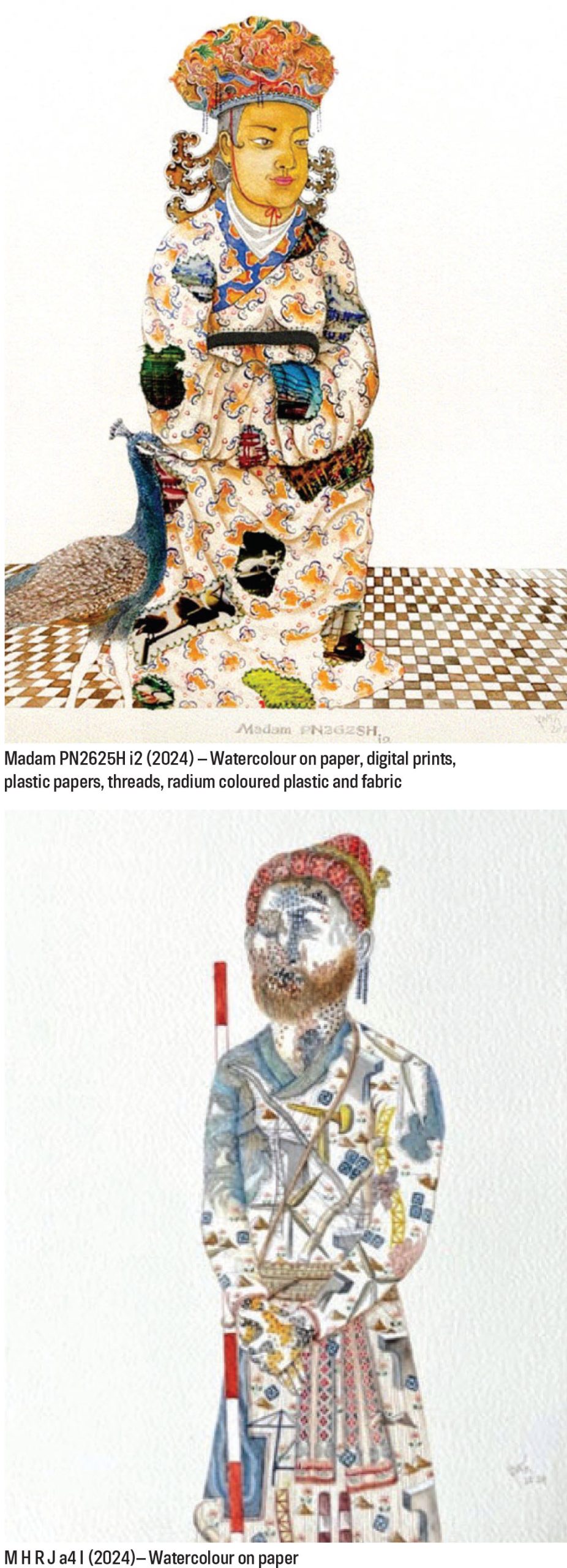
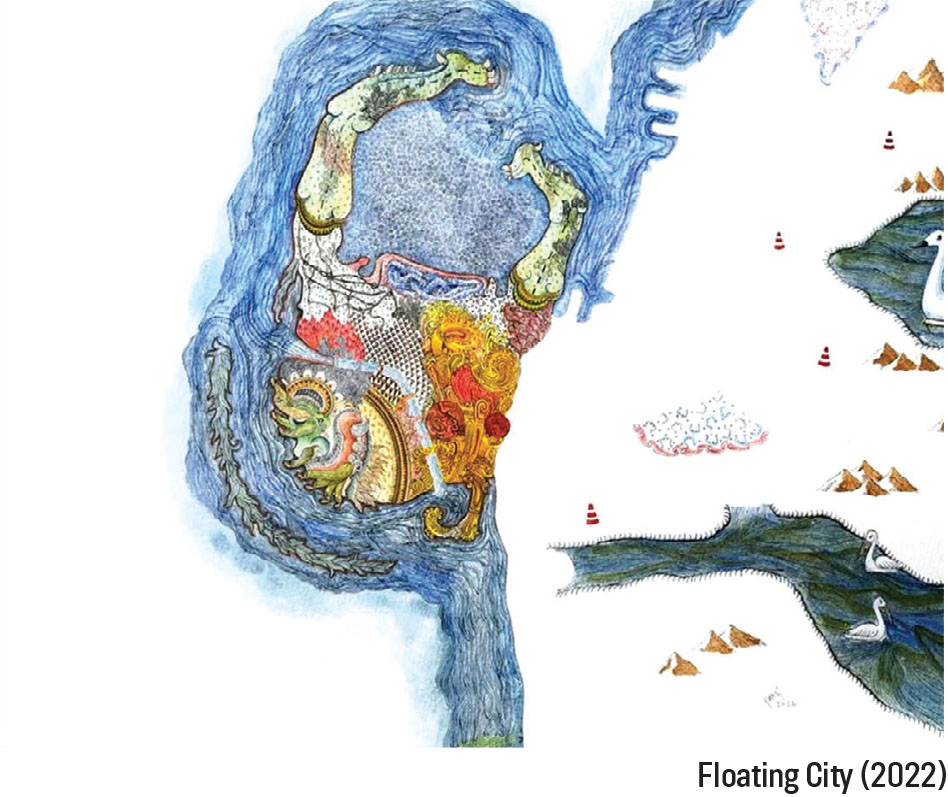
I studied art as a subject throughout my Advanced Level education and, afterwards, worked as a freelance commercial sign and outdoor advertising artist. I was also involved in creating visual material for left-wing political campaigns. Throughout this period, I remained continuously engaged in drawing and painting in one form or another.
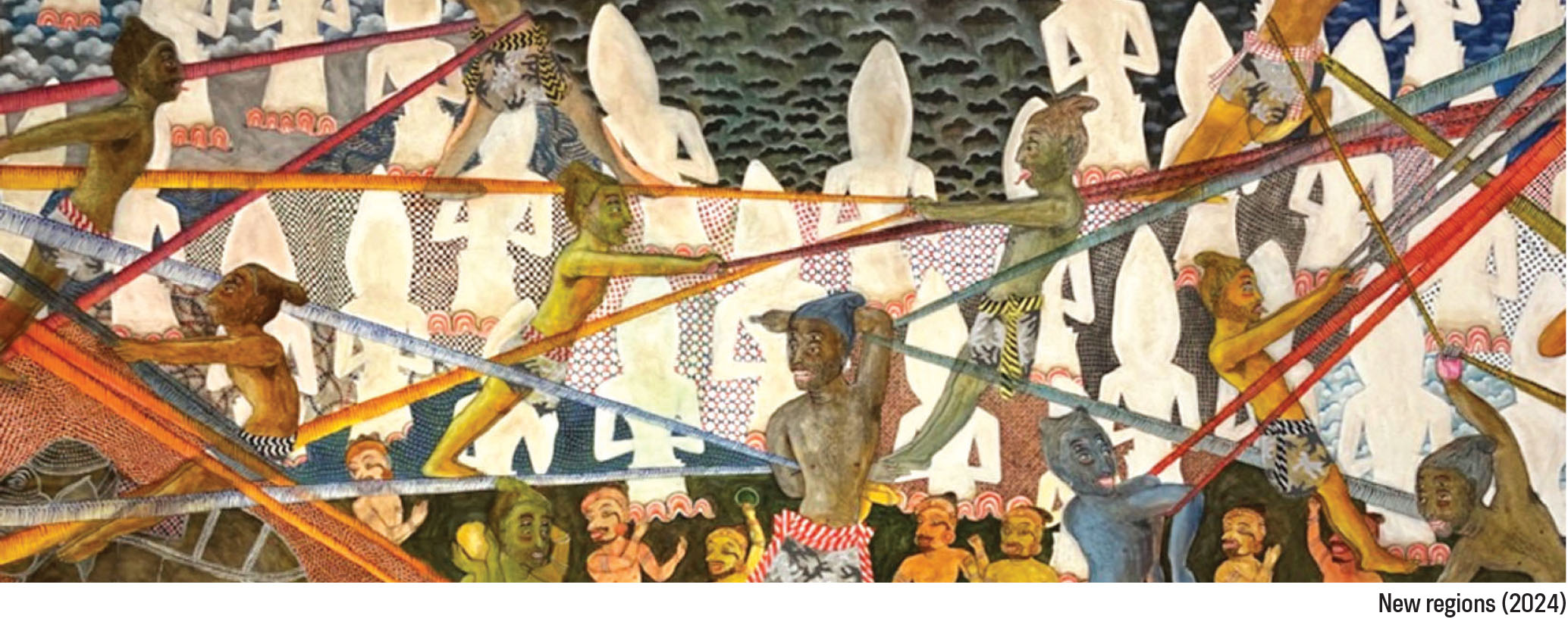
In 2014, I held my first solo exhibition. Two years later, I joined a mural conservation programme and worked as an independent mural conservator until 2021. During that time, I also participated in both solo and group exhibitions, including shows in Italy and India. Having the opportunity to practise drawing and painting across a wide range of contexts has greatly shaped my artistic approach. The experiences I gained through these different forms of practice continue to inform and influence my work as a visual artist.
Q: Your work is deeply rooted in Sri Lankan temple painting traditions while also engaging with themes of urbanism, displacement and geopolitics. How did these seemingly contrasting interests come together in your practice?
A: My journey with temple painting began through mural conservation. Working on the conservation of historic temple murals gave me the opportunity to closely study traditional techniques, symbolism and visual language. It was not simply about preserving paintings but about understanding the knowledge, philosophy and cultural memory embedded within them.
At the same time, I was living in a rapidly changing social and political environment. Urban expansion, migration, conflict and shifting identities became part of my everyday experience. Rather than seeing these as separate subjects, I began to recognise parallels between the past and the present. Many themes found in ancient narratives – power, violence, displacement, devotion and resilience – continue to exist in contemporary society, albeit in different forms.
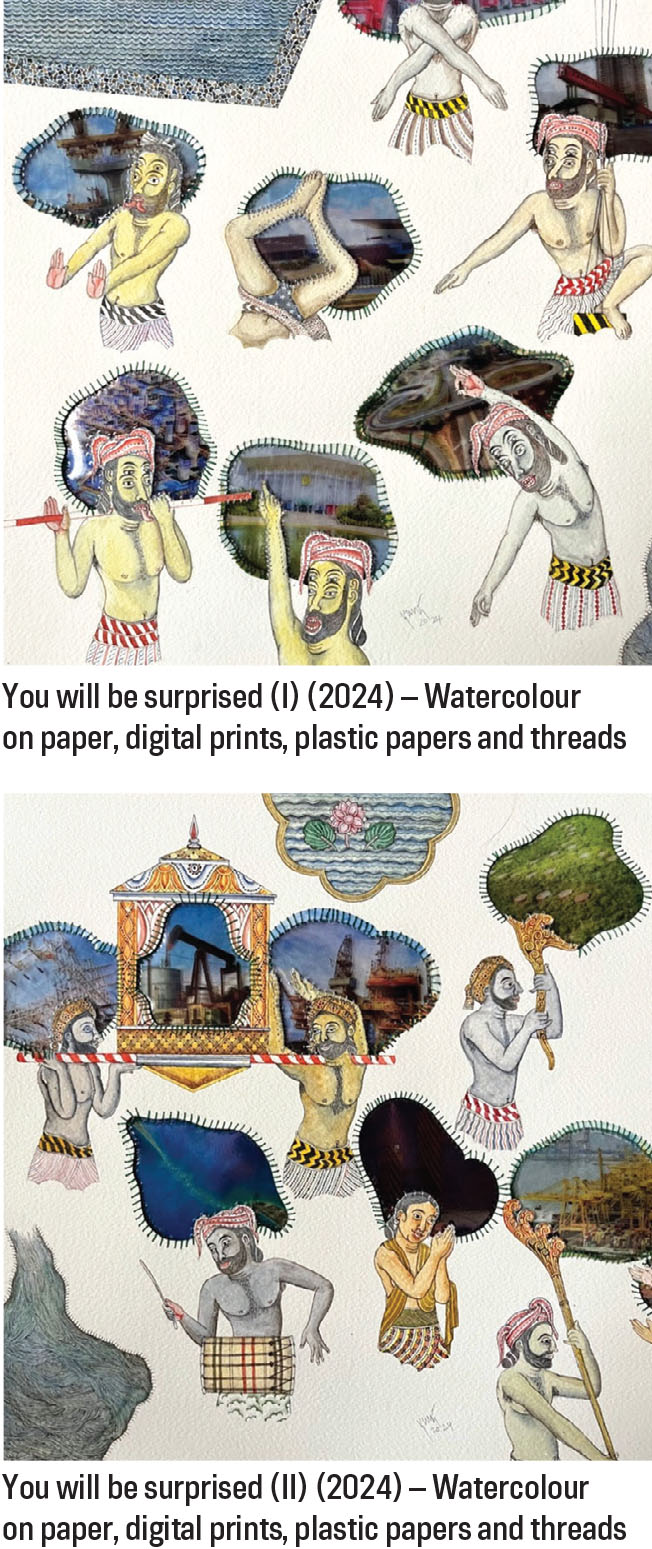
Temple paintings offered me a visual language through which I could explore these present-day realities. By drawing on its composition, symbolism and storytelling traditions, I found a way to connect historical memory with contemporary experience. My work therefore is not an attempt to recreate tradition but to use it as a framework for reflecting on the complexities of the world we live in today.
Q: What led you to focus on temple style paintings along with the theme of urbanism, displacement and geopolitics?
A: During my school years, I developed an expressive style inspired by traditional Kandyan and low country mural art. I was captivated by their unique stylistic features such as continuous narratives, profile views, two-dimensional shapes, flat colours, rhythmic linework and limited palettes.
In 2016, joining a mural conservation project allowed me to study low country temple paintings closely for several years. I analysed how regional artists utilised these forms to evoke serenity, empathy, and faith through jataka stories and myths. This experience gave me a deep structural understanding of the colours, lines and rhythms needed to restore damaged historical art.
Living in an urban environment made witnessing the displacement caused by large-scale development projects central to my personal experience. As an artist, I view urbanisation, evictions, and displacement as deeply interconnected with broader global and internal geopolitics.
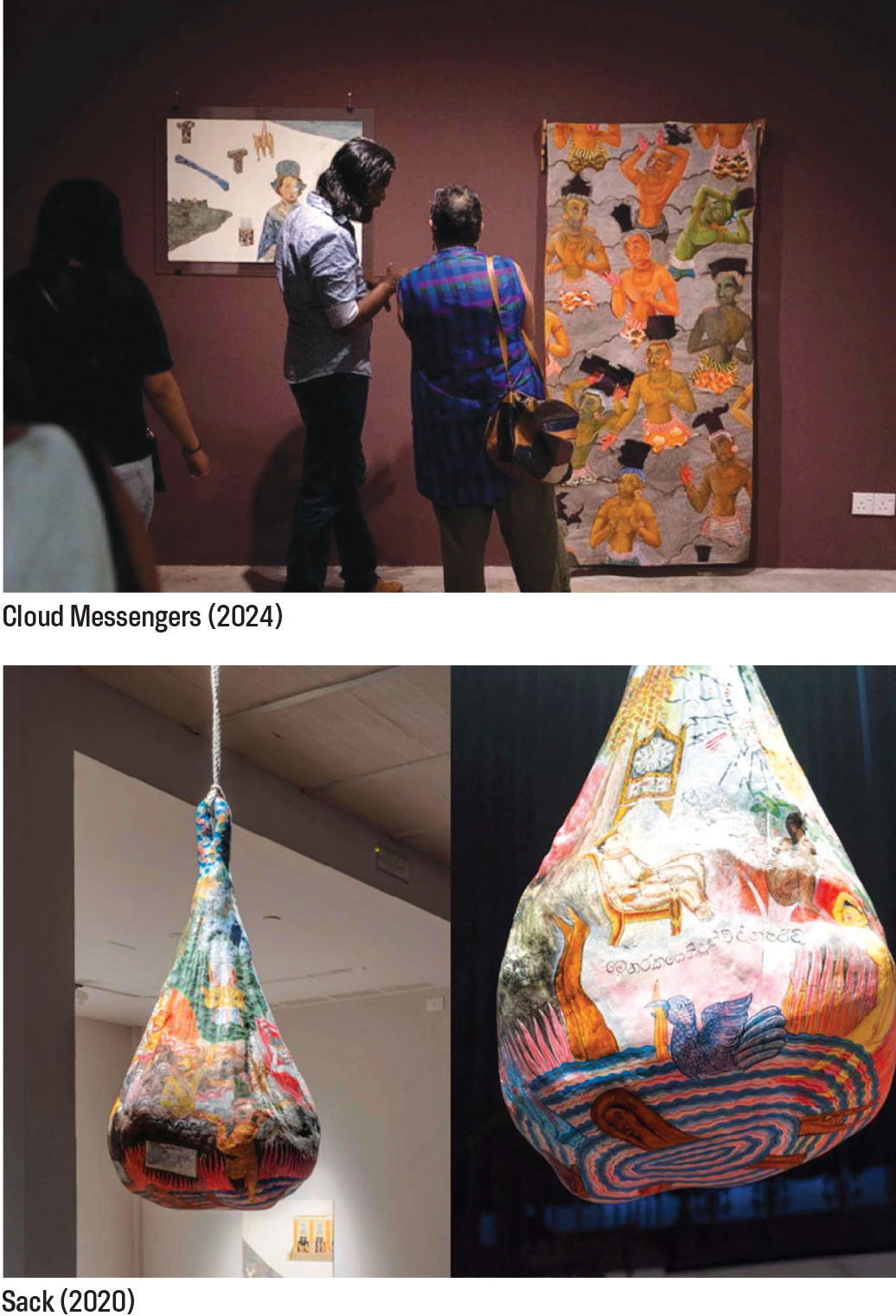
Historically, Sri Lanka was governed by colonial powers from the northern hemisphere. Today, neoliberal capitalism has shifted the nature of this control with powerful nations competing for commercially valuable land. As a result, historical landmarks are often demolished without due consideration. The rapid transformation of Colombo and other regions forms the bedrock of my work. By extracting traditional mural motifs and placing them within modern landscapes, I blend ancient mythology with current realities to provoke deeper reflection among viewers.
Q: Given that mythology plays a considerable role in your work, what draws you to mythological narratives and how do they relate to your artistic practice?
A: Temple paintings are, in many ways, visual expressions of mythological narratives. They have become one of the strongest visual traditions through which stories have been passed down across generations. These narratives are not merely religious stories – they reflect human experiences, social values, political power, morality and conflict. They continue to resonate because the fundamental aspects of human life remain unchanged, regardless of the period in history.
Even today, we witness struggles for power, displacement, violence, compassion and resilience. These are the same themes found within mythological narratives. That is why I see mythology as something that remains relevant rather than belonging only to the past. For me, mythological imagery is not only a way of revisiting history but a visual language that allows me to examine contemporary realities. Through this language, I explore how ancient narratives shape the way we understand the present.
Art should not only preserve tradition but also reinterpret it. I believe that engaging with mythology in this way allows those narratives to remain alive and meaningful in today’s world.
Q: Tell us about your experience being immersed in the recent Hampi Arts residency in India…
A: I participated in the seventh cohort of the Hampi Art residency, supported by Kala South Asia and Hampi Art Labs. Our diverse group included myself, two French artists and four Indian artists. Working across different disciplines allowed us to exchange unique technical methods and creative experiences.
Excursions around the UNESCO World Heritage site of Hampi offered profound insights into the ancient civilisation that flourished along the Tungabhadra River. We also visited traditional craft villages and historic iron production sites. Hampi Art Labs provides a remarkably peaceful, well equipped environment for deep artistic focus. Their state-of-the-art printmaking and ceramic studios, along with insightful workshops, provided invaluable knowledge that I plan to integrate into my future work.
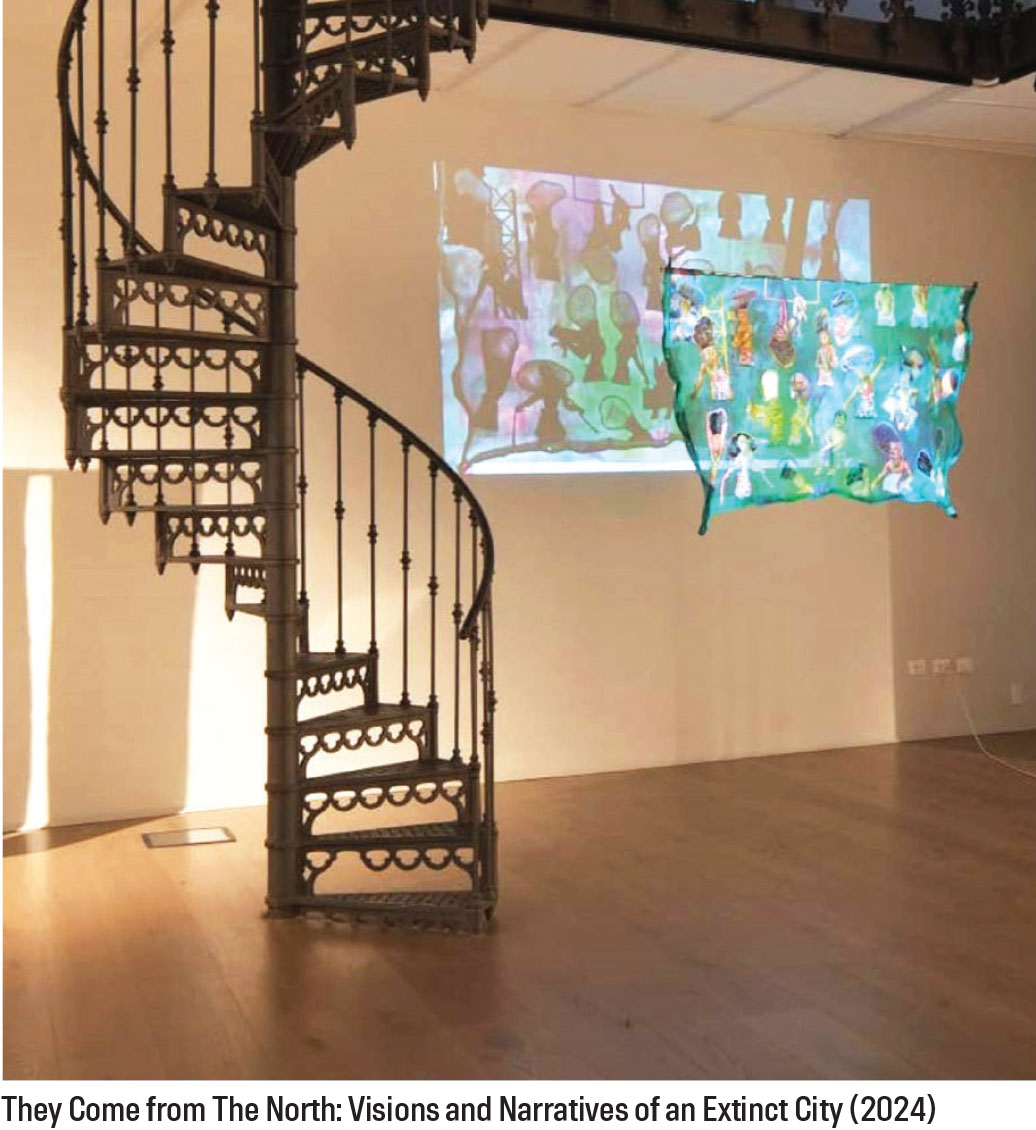
My residency project was inspired by the infrastructure development along the main Ballari highway from Toranagallu to Hampi. Observing the slow widening of the road, I witnessed the loss of farmlands, homes and properties. Using mixed media and video projection, my artwork captured the raw reactions of property owners receiving acquisition notices, juxtaposing the dual nature of state developers against the realities of the displaced. This residency marks a major turning point in my artistic journey.