COCONUT INDUSTRY
NO LONGER A TREE OF LIFE?
Janaka Perera addresses the issues facing Sri Lanka’s coconut plantations
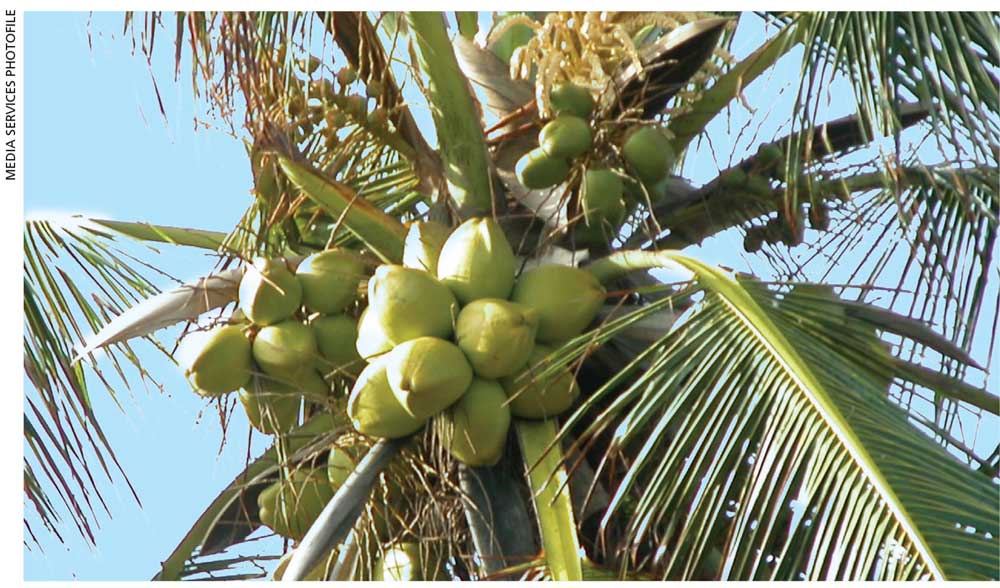
It’s well known that the coconut palm is a versatile tree, which is part of Sri Lankan living due to its many benefits. Almost every part of the coconut tree can be used to provide food, water and oil. Its leaves and husk offer fibre for weaving and construction, and the trunk offers durable timber.
The dried inner flesh is called copra, and oil can be extracted from it for cooking. And the sap of the coconut flower yields toddy, coir from the fibre is used to make ropes and mats, and the leaves are used for thatched roofs. Other uses include medicine, furniture, canoes, brooms and brushes.
The challenges facing the coconut industry today are numerous.
Chairman of the Coconut Research Institute (CRI) Prof. Ajith Jayaweera says that due to several issues faced by cultivators, the supply of coconuts is limited. That has resulted in a gap between demand and supply for this extremely useful fruit.
The local annual requirement for a variety of uses is 3,000 million coconuts. Recently however, production has fluctuated from year to year. Of the quantum required, around 1,800 million nuts are used for domestic consumption. The remainder is processed, exported or used for other commercial purposes.
This has led to a shortage of coconuts for domestic consumption. Various factors including environmental impacts and a shortage of fertiliser have contributed to this shortage.
Pests, particularly insects, severely affect cultivation. While slight changes in harvests over the past five to six years have been observed, scientists haven’t identified a specific cycle associated with coconut trees.
These fluctuations could be linked to climatic and environmental factors such as water availability, temperature, and a lack of modern technology and replanting periods.
The industry relies heavily on traditional outdated methods with insufficient investment in modern processing technology and slow progress in replanting programmes. Climatic issues such as prolonged droughts and erratic weather patterns severely affect yields in key growing regions such as Kurunegala, Puttalam and Gampaha. Environmental factors such as temperature, moisture and sunlight are crucial for coconut development.
Unfortunately, cultivators don’t irrigate coconut plants regularly and this affects the moisture levels of the soil.
Additionally, controlled temperature is essential to cultivate coconuts since excessive heat can hinder proper growth. Drought conditions can lead to the premature dropping of budding coconuts, and changes in rainfall patterns, pests and ageing trees impact yield as well.
Despite Sri Lanka being a top global exporter, production has dropped below three billion nuts due to high input costs. A 50 kilogramme bag of fertiliser costs over Rs. 8,500. Since this is only sufficient for 16 trees, it makes cultivation unsustainable for many. Further, many palms are old and under-productive.
The lack of a coherent national strategy and inefficient tracking of data by state agencies has caused severe demand-supply gaps. There’s also a shortage of skilled labour and high rates of theft on many plantations.
Almost every part of the coconut tree can be used to provide food, water and oil
Scientists are actively researching the concept of agroforestry related to coconut cultivation. This approach enables farmers to grow smaller plants and cover crops in the early stages of coconut cultivation; and as the trees mature, additional crops such as coffee can be introduced.
It enables the effective use of land, generates extra income and reduces invasions by pests through the maintenance of cover crops and improved irrigation practices. As the benefits of agroforestry outweigh those of monoculture farming, the CRI consistently advocates for the adoption of these practices.
Industry analysts attribute the slowdown to inconsistent production, volatile global demand, and competition from the Philippines and Indonesia, which are the two largest coconut producers in the world.
Although the CRI doesn’t conduct specific research on the nutritional value of coconuts, it does investigate aspects such as cholesterol levels in certain coconut products at the provincial level.
The institute proposes conducting research on aflatoxin levels in domestically produced coconut oil as it believes that these toxins can easily develop in copra. It’s also conducting research on nutritional aspects but doesn’t engage in clinical or medical studies.
Recent research indicates that certain fats and spreads such as margarine may be more harmful than coconut oil. Such findings are shared through bulletins and the relevant institutions that work closely with the CRI to raise awareness about the benefits of coconuts.
The blocking out of estates and felling of coconut trees by land sales enterprises is another crucial problem that the industry is facing today.
Overall, Sri Lanka’s coconut industry may end up facing even more serious issues in the not too distant future.