AGRICULTURE SECTOR
BROWN BIOTECH TOOL KIT
Akila Wijerathna discusses how the dry zones in Sri Lanka can be productive
Covering nearly a third of the Earth’s land surface, arid and semiarid regions are among the most challenging environments on the planet. Defined by scarce rainfall, poor soil quality, extreme temperatures and intense solar radiation, these zones have long been regarded as obstacles to productive agriculture.
Yet, a growing scientific discipline known as brown biotechnology is quietly rewriting that script. By harnessing the remarkable biology of organisms adapted to desert life, brown biotechnology is offering a tool kit for sustainable agriculture in some of the world’s harshest landscapes.
In the colour coded world of applied science, biotechnology has been segmented by domain: green for plant and crop science, blue for marine applications and red for medicine. Brown corresponds specifically to arid zone and desert biotechnology.
It’s defined as the study and application of organisms that naturally inhabit or can adapt to dry land environments by combining traditional biotechnology with emerging approaches in genomics, data science and nanotechnology.
Far from being a narrow niche, brown biotechnology addresses some of the most pressing challenges of the modern era: food security, water scarcity, energy production and climate resilience.
Agriculture in arid regions faces a fundamental paradox where the land exists but the inputs of water, organic matter and soil nutrients often don’t. Water alone accounts for roughly 80 percent of global freshwater consumption in farming; and in arid environments, every drop is critical.
Soil in these regions typically suffers from low nitrogen and phosphorus availability. And as dryness intensifies, the organic matter that drives microbial activity and nutrient cycling diminishes, leaving the soil biologically impoverished and structurally fragile.
Dry land areas that are home to nearly 40 percent of the world’s population remain among the most vulnerable to rising temperatures and shifting precipitation patterns. For communities that depend on agriculture in these zones, the stakes couldn’t be higher.
One of the most promising fronts in brown biotechnology is the exploitation of arid zone microorganisms to directly support crop production. Decades of research identified bacterial and fungal species that can fix nitrogen, make solube locked phosphorus and improve water uptake in plants without chemical fertilisers.
Mycorrhizal fungi deserve particular attention. Genera such as Glomus, Acaulospora and Paraglomus form symbiotic relationships with crop roots by extending hyphal networks deep into the soil to access water and nutrients beyond the reach of roots alone.
Studies show that mycorrhizal plants under drought conditions survive longer, recover faster and maintain higher productivity than their non-inoculated counterparts.
In lettuce, soy, millet and alfalfa, inoculation with mycorrhizal species measurably increased antioxidant enzyme activity and improved resilience to water stress.
Beyond microbial applications, brown biotechnology is advancing the genetic engineering of crops to withstand arid conditions. Over-expression of abscisic acid receptors in transgenic plants produced remarkable results by reducing transpirational water loss through rapid stomatal closure and moderating leaf senescence during severe droughts.
Tea plants engineered to express osmotin, which is a stress response protein, have demonstrated greater tolerance to water deficiency alongside higher levels of beneficial flavonoids and caffeine.
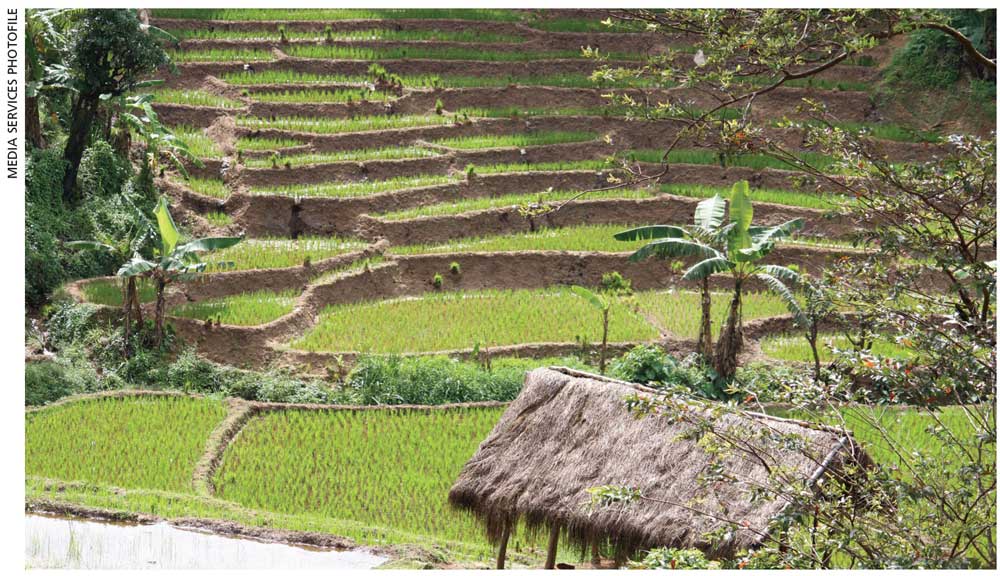
Sri Lanka’s Dry Zone, which stretches across areas in the North-Central, Northern and Eastern Provinces, and parts of the Southern Province too, covers around two-thirds of the country’s land area and supports a large proportion of its farming community.
The Dry Zone, which is characterised by an annual rainfall of between 900 and 1,750 mm – concentrated in two erratic monsoon seasons, extended dry spells, poor water retention in reddish-brown soil and low organic matter content – shares many of the defining pressures that brown biotechnology was designed to address.
Rice cultivation, which is the backbone of Dry Zone farming, historically relied on an ancient network of village tank cascade systems with interconnected reservoirs that captured and distributed rainwater with remarkable efficiency.
But intensifying drought cycles, unpredictable rainfall patterns and declining soil fertility placed these systems under growing strain.
Perhaps the most significant homegrown contribution to the principles of brown biotechnology in Sri Lanka is the development and large-scale adoption of biofilm biofertiliser.
Field trials conducted across the districts of Ampara and Polonnaruwa in the heart of the Dry Zone demonstrated that its application can reduce chemical fertiliser use by approximately 50 percent while simultaneously increasing paddy grain yields by between 20 and 24 percent.
Brown biotechnology addresses some of the most pressing challenges of the modern era