
SUSTAINABILITY FORUM
NAVIGATING THE VUCA WORLD
What it takes to garner stability and safety in uncertain times
BY Kiran Dhanapala
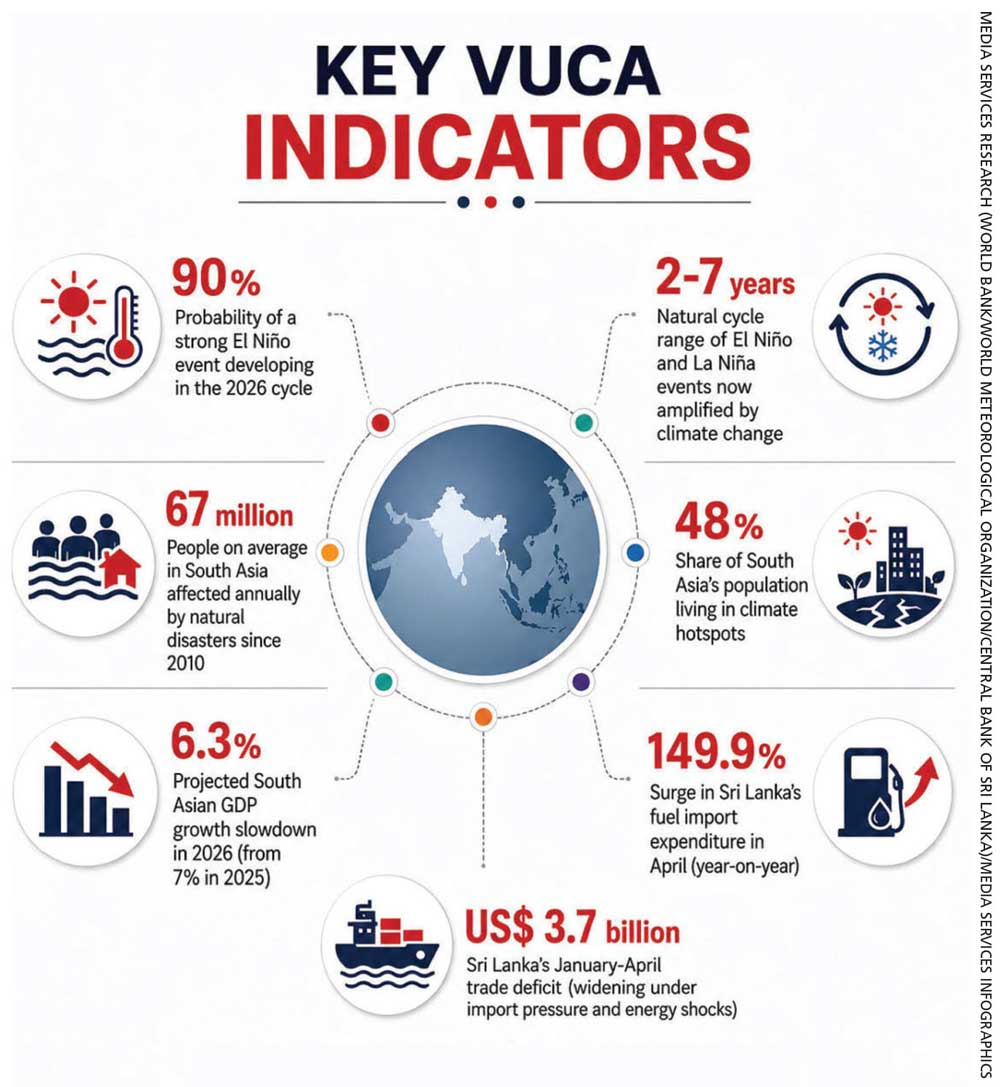
VUCA is the acronym for volatility, uncertainty, complexity and ambiguity. And it aptly encapsulates the geopolitical tensions of late as globally weakening institutions contribute to less stability, more uncertainty and increasing anxiety.
Aid cuts have devastating effects on the UN’s ability to impact world problems, employ vital skills, provide job certainty, and prevent an energy crisis, material scarcity and rising inflation. Many sustainability related laws – especially in the US – have been scaled back or scrapped.
In March, the World Meteorological Organization (WMO) warned governments that El Niño is expected this year with high temperatures. It is expected to impact Sri Lanka in July and August. Unfortunately, governments and households are still unable to absorb climate shocks that affect the planet.
There are three forces that will keep sustainability on track after this hiatus.
First, the scaling up of renewable energy (RE) is now economically viable because it has benefitted from geopolitical competition. Reducing the marginal cost of RE will see a continuation of this trend.
Second, the breaching of planetary boundaries will increase the scale of disasters due to climate change, and force us to face a messy and costly transition.
And third, sustainability based business models are proving profitable and providing a competitive advantage, which is further incentivising innovations. In Sri Lanka, donors have highlighted how sustainability can be a key differentiator for niche exports but this potential hasn’t been systematically leveraged yet.
Organisations need to be guided by the longer-term emergence of sustainability as this helps them prepare for the inevitable and cuts costs in the interim.
Companies should use purpose and shared values, such as care for the environment and future generations, to build bridges. They must focus on local approaches, solutions, collaborative partnerships and investing in the future.
Businesses should focus on dividends such as energy efficiency and staff productivity, and adapt to business relevant climate risks. They must tie sustainability to innovation and tech strategies such as circular business models to reap benefits that create value.
Enterprises must develop a resilience mindset that expects reversals or contradictions, prioritises practical approaches and adopts a sustainability led competitive advantage.
An interesting view is that uncertainty is a catalyst and not a constraint, say authors Arun Gupta and Thomas Fewer in their article titled The Mission Generation. This is because in times of uncertainty, seeking stability and safety isn’t often conducive to moving with the rapidly changing times.
In periods of uncertainty, we have to actively seek and build purpose. For individuals, purpose is not simply a job; it includes problem solving, making a living and building a life. Purpose is the only constant and a navigation tool in uncertainty.
Getting stuck in a sustainability journey in VUCA times is easy – and getting unstuck is hard. The authors argue that waiting for clarity is rare because in fast changing situations, clarity may come only when the context has changed. Therefore, action can create the clarity needed and purpose will emerge from motion.
These are some actions you can take as a sustainability champion.
So what problems feel personal today – and why? And what skills do you have to help address them?
Get specific, drill deep incrementally and stay with a problem over time.
Use the identified reasons as an anchor to navigate through change, disruption and so on. Build skills but acknowledge what you already have – and any values and personality traits that can be leveraged. Learn continuously and identify what skills you need to augment, and what can be reoriented.
The CEO of Asia’s largest network of social investors AVPN Naina Subberwal Batra recently noted that sustainability implies not only navigating uncertainty but also shaping what comes next.
It’s also a means of building resilience in an uncertain world and was the theme of the inaugural sustainability summit hosted in May by the Institute of Chartered Accountants of Sri Lanka (CA Sri Lanka).
In the case of Sri Lanka, sustainability is the potential edge for niche exports. This was noted recently by the EU’s Ambassador to Sri Lanka and the Maldives Carmen Moreno, and the Deputy Head of Mission and Acting Ambassador for the Embassy of the Kingdom of the Netherlands in Sri Lanka and the Maldives Iwan Rutjens.
It remains to be seen whether sustainability is shaping public policy consistently.
Meanwhile, the Sri Lanka Export Development Board’s (EDB) National Export Development Plan (NEDP) acts as an actionable framework, which promotes an ecosystem that’s focussed on environmental, social and governance (ESG) compliance, sustainable manufacturing and green financing for such ventures.