YOUTH FORUM
Compiled by Nicola Jayasundera
HOPE AMID UNCERTAIN TIMES
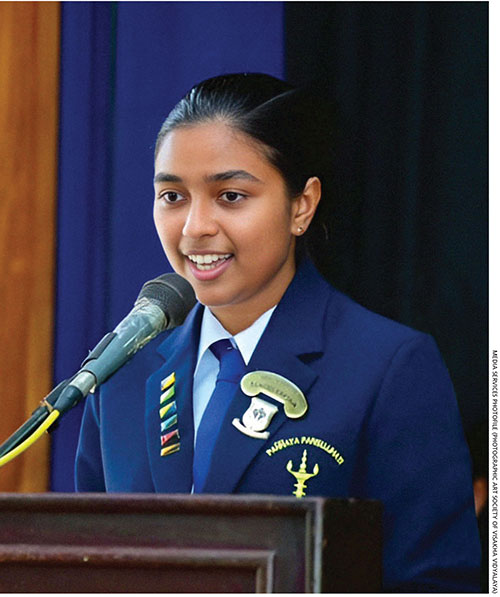
Thejanee Nawarathne explores the need for shaping today’s youth responsibly
Q: What’s the good, the bad and the ugly in Sri Lanka?
A: The positives lie in our incredible biodiversity and the resilient spirit of our people. From mist covered hills to golden shores, this tropical island is truly breathtaking. More importantly, it has a strong foundation of rich cultural values ingrained in its people.
The uniqueness of the country can be seen in the willingness of most Sri Lankans to help those in need, driven by a strong sense of community. On the downside, economic instability remains a challenge. High costs and inflation push people into survival mode, limiting opportunities for growth – especially for the youth.
What makes us ugly is the unwillingness to accept change due to a fear of suffering during a transition. What holds us back further is a reluctance to embrace change, often driven by fear of short-term discomfort, which slows progress and keeps potential unrealised.
Q: And what are the challenges facing the nation at this time?
A: Sri Lanka is confronted with a number of challenges stemming from systemic flaws and entrenched attitudes that are not conducive to development.
Firstly, the economic situation that we are currently facing has discouraged young people from aspiring for greatness and hindered the country’s progress.
Secondly, Sri Lanka suffers greatly from brain drain, as many intelligent minds have left the country due to their dissatisfaction with the prevailing environment.
Q: What are the challenges facing young people in Sri Lanka today?
A: A crisis is emerging among the younger generation, shaped by both isolation and increasingly narrow perspectives. Modern digital technologies are creating a social vacuum, disconnecting many from their cultural roots and weakening communication within families.
At the same time, many young people are drawn to niche fields that have little or no presence locally, leaving them with a difficult choice: either abandon their ambitions or seek opportunities overseas.
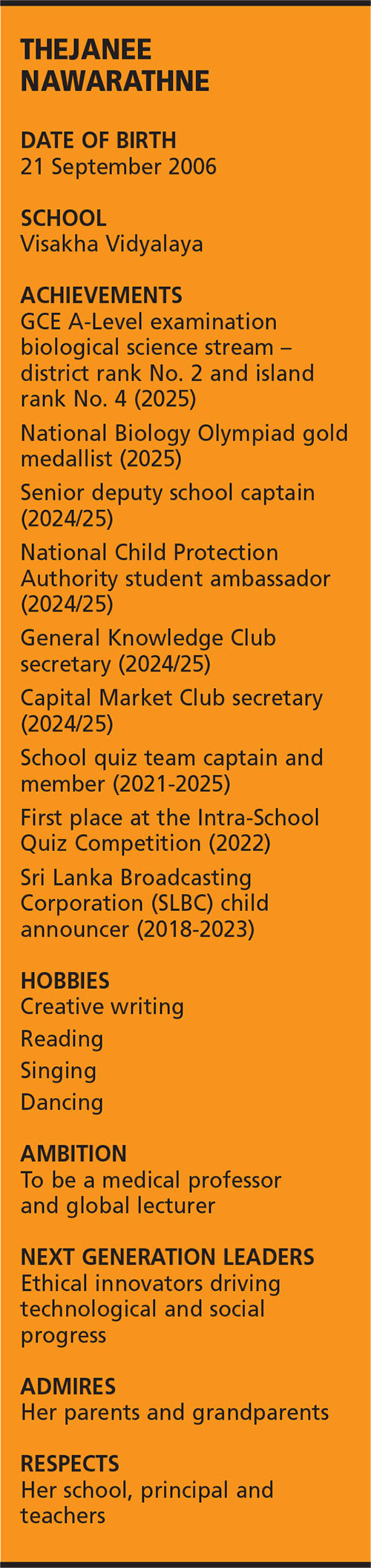
Q: How can our youth contribute to national progress?
A: Contributions begin with social integrity and scientific advancement. We must serve as a safeguard against undesirable behaviour such as drug use by emphasising self-discipline.
At the same time, we need to be at the forefront of change through research and discovery. By being inventive, we can elevate Sri Lanka’s status globally. Our aim should be to make the country known worldwide by virtue of intellectual and artistic accomplishments.
Q: What type of leadership do you think the world needs right now?
A: The world needs leaders who are both assertive and ethical. There is a need for visionary leaders who learn from history to safeguard the future through sustainable programmes.
Such leaders must give equal importance to the environment and the economy to ensure that our planet remains habitable. This generation of leaders should prioritise welfare in general, ensuring that development contributes towards a better quality of life for all.
Q: How has the advent of AI and technology shaped your view of the future?
A: Ilook to the future with guarded optimism. As a powerful tool for recognising patterns, the potential rewards of using artificial intelligence are vast when it comes to cost savings and efficiency.
However, we have to make sure that we think critically about what we’re doing in order to ensure that we don’t forget how to think for ourselves.
Q: As a young person, what are your hopes for and concerns about the future?
A: It is my wish that the world becomes one where everyone views each other as equals. My vision of an ideal future is one where caring for the environment is deeply valued, and where people live happily and safely.
Conversely, I am horrified by how destructive war has been to humanity. It is heartbreaking to see individuals continuing to destroy their own potential.
Q: And last but not least, if you could launch a project or movement in Sri Lanka, what would it be – and why?
A: My initiative would be centred on mentoring young people who belong to less privileged backgrounds.
I would aim to teach them how to lead disciplined lives and develop character in addition to imparting education. Through this, my intention is to ensure that they turn into responsible citizens in the future.