CARGILLS BANK
CARGILLS BANK’S INNOVATIVE SUPERMARKET BANKING MODEL AND COLLECTION ACCOUNT SERVICE
Q: How does Cargills Bank’s supermarket banking model differentiate it from conventional banking services?
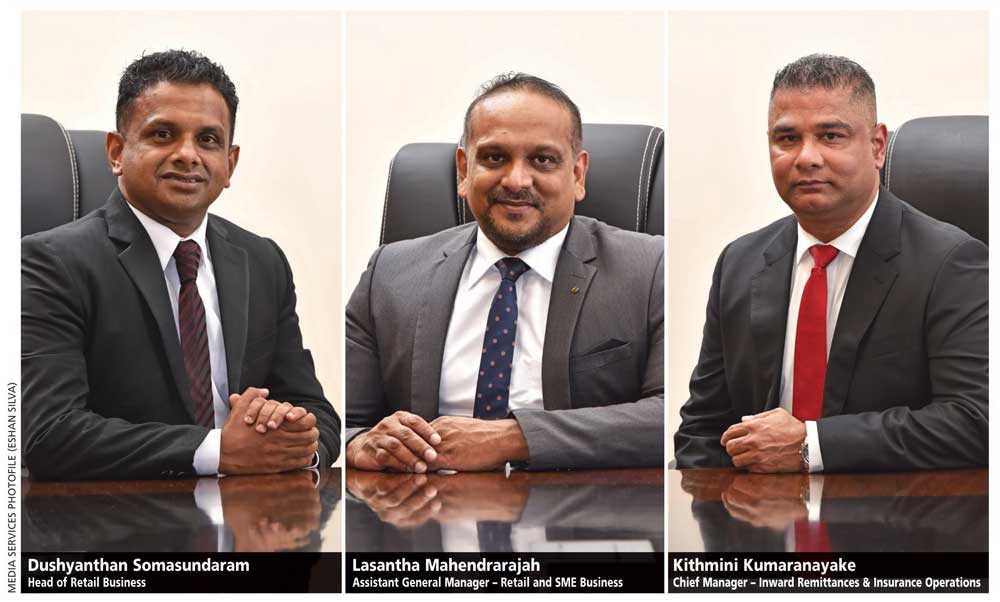
Dushyanthan Somasundaram (DS): Cargills Bank’s unique supermarket banking model integrates essential banking services into customers’ everyday shopping experience through an islandwide network of more than 500 Cargills Food City outlets. By leveraging this established retail footprint, the bank extends access to selected banking services beyond conventional branches, making routine financial transactions more accessible and convenient.
The model helps address geographical and infrastructure limitations associated with traditional branch banking. Unlike conventional banking facilities that generally operate within standard banking hours, the supermarket banking model is available 365 days a year – including weekends and public holidays – from 8 a.m. to 10 p.m.
Customers can deposit and withdraw cash, pay for grocery purchases through the Cargills Bank mobile banking app, transfer cash to third parties including non-Cargills Bank customers through a secure PIN based facility and make payments to participating companies through the collection account service, which currently supports B2B collection arrangements.
By integrating banking facilities with an established retail network, Cargills Bank extends its reach across Sri Lanka while giving customers greater flexibility in managing their everyday financial needs.
Q: How does the collection account service enable businesses to expand and streamline their payment collection operations?
Kithmini Kumaranayake (KK): The collection account service is a corporate banking solution designed to simplify payment collection for businesses including insurance companies, leasing and finance companies, distributors and other corporate entities.
Through this service, participating companies can extend their collection networks to more than 500 Cargills Food City outlets islandwide. Customers can settle insurance premiums, lease rentals, loan instalments and other applicable payments at a convenient outlet without having to visit company offices or conventional bank branches.
For partner companies, the service provides an additional collection channel supported by the bank’s systems and retail infrastructure. It also facilitates payment tracking and reconciliation with real-time transaction updates available where application programming interface (API) integration has been implemented.
This allows businesses to offer customers a more accessible payment option while improving oversight of incoming funds.
Q: What operational and cost efficiencies does the collection account service offer corporate partners?
Lasantha Mahendrarajah (LM): The service offers corporate partners several operational advantages including wider collection reach, extended operating hours and lower infrastructure costs. By accessing more than 500 Cargills Food City outlets, businesses can serve customers across a broader geographical area without establishing additional branches or dedicated collection points.
Customers can make payments from 8 a.m. to 10 p.m. throughout the year including weekends and public holidays. This flexibility provides more opportunities to settle dues on time, potentially reducing payment delays and improving collection efficiency.
The service supports transactions of up to Rs. 175,000 per transaction, subject to a daily limit of 20 million rupees. A simplified, slipless process is available for transactions below Rs. 50,000.
Technology integration further strengthens collection management. Where API integration is available, transactions can be validated against the partner’s system and payment information transmitted in real time. This helps ensure that payments are associated with valid customer references, enables prompt updates to payment records and reduces the risk of misallocated transactions.
For leasing and finance companies, these capabilities can support timely identification and recovery of outstanding dues including payments made outside conventional banking hours. Mandatory reference fields and system based transaction processing facilitate reconciliation by linking payments to the relevant customer, insurance policy, lease agreement or invoice.
Partner companies can also use Cargills Bank’s corporate internet banking facility to monitor deposits and track collections.
By leveraging Cargills Food City’s existing infrastructure, partner companies can expand their collection capabilities while reducing capital investment, staffing requirements and recurring operating costs.
Transactions are processed through the bank’s established systems and applicable security controls with customer information handled in accordance with internal policies and relevant regulatory requirements.
Q: How does technology integration enhance transaction validation, payment processing and collection management?
LM: The collection account service incorporates customer reference validation and real-time payment updates, subject to the API integration and functionality implemented for each partner.
When a customer initiates a payment, the cashier enters the relevant reference, such as a lease agreement number, vehicle registration number or insurance policy number. Where API based validation is enabled, the reference is checked against the partner’s system before the transaction proceeds, helping verify payment details and reduce errors.
Once a transaction is successfully completed, the payment information is transmitted to the partner’s system in real time, where integration is available. This enables prompt updates to collection records, improves visibility over incoming payments and supports more efficient reconciliation with less manual intervention. It also gives partner companies a clearer view of payment activity, supporting more informed collection management.
Q: What procedures do customers and cashiers follow to complete a collection account transaction?
KK: Customers visit a Cargills Food City outlet and provide the relevant partner company details and payment reference. The cashier accepts the cash and enters the transaction details into the system.
The customer then provides the depositor verification code received for the transaction to complete the required verification process. Once the payment is successfully processed, a receipt is issued. Where API integration is available, the payment details are automatically communicated to the partner company’s system in real time.
This straightforward process combines in-person payment acceptance with digital transaction records, giving customers a convenient alternative to visiting company offices while helping businesses maintain timely collection information.
Q: How does the service facilitate transaction tracking, reconciliation and the resolution of payment related queries?
DS: Each collection account transaction is assigned a unique identifier, allowing it to be traced throughout the payment and reconciliation process. The system records key details including the customer or depositor reference, transaction date and time, payment amount, relevant vehicle registration number where applicable and the Cargills Food City outlet where the transaction took place.
These records support payment verification, reconciliation and the investigation of discrepancies or customer complaints. Partner companies can also use corporate internet banking to monitor deposits and track transactions without relying solely on manually requested bank statements.
By combining an extensive retail network with digital payment visibility and transaction traceability, Cargills Bank’s collection account service helps businesses manage collections more efficiently, strengthen payment oversight and provide customers with a convenient, accessible way to meet their financial obligations.
– Compiled by Suresh Ginige
COMPANY DETAILS
- Telephone: 7640640
- Email: customersupport@cargillsbank.com
- Website: www.cargillsbank.com