BUSINESS SENTIMENT
BIZ CONFIDENCE REBOUNDS IN JULY
The unique index gains lost ground amid global risks and domestic uncertainties
Even as Sri Lanka earned recognition as the world’s best island destination to visit in 2026, the country continued to attract global attention for all the wrong reasons.
The national focus shifted to prison overcrowding and the deadly unrest in Negombo, leading to the kind of adverse publicity the country can ill afford. In fact, the damning publicity overshadowed an important milestone in Sri Lanka’s economic recovery.
Against this backdrop, the World Bank’s decision to reclassify Sri Lanka as an upper-middle income economy received comparatively little attention. Announced in its latest income classification update, the upgrade comes three years after the unprecedented economic crisis pushed it to the brink of collapse.
Sri Lanka moved out of the lower-middle income category on the back of the economy expanding by five percent last year. While describing the reclassification as a reflection of the country’s resilience, the World Bank noted that Sri Lanka only narrowly crossed the relevant income threshold.
The upgrade follows signs of an economic recovery: Sri Lanka’s economy grew by 5.1 percent year-on-year in the first quarter of 2026 with agriculture, industry and services expanding by 1.1, 7.2 and 3.4 percent respectively.
Meanwhile, both Litro and Laugfs revised LP gas prices in early July in line with declining international prices at the time. However, the anticipated fuel subsidies have yet to be implemented.
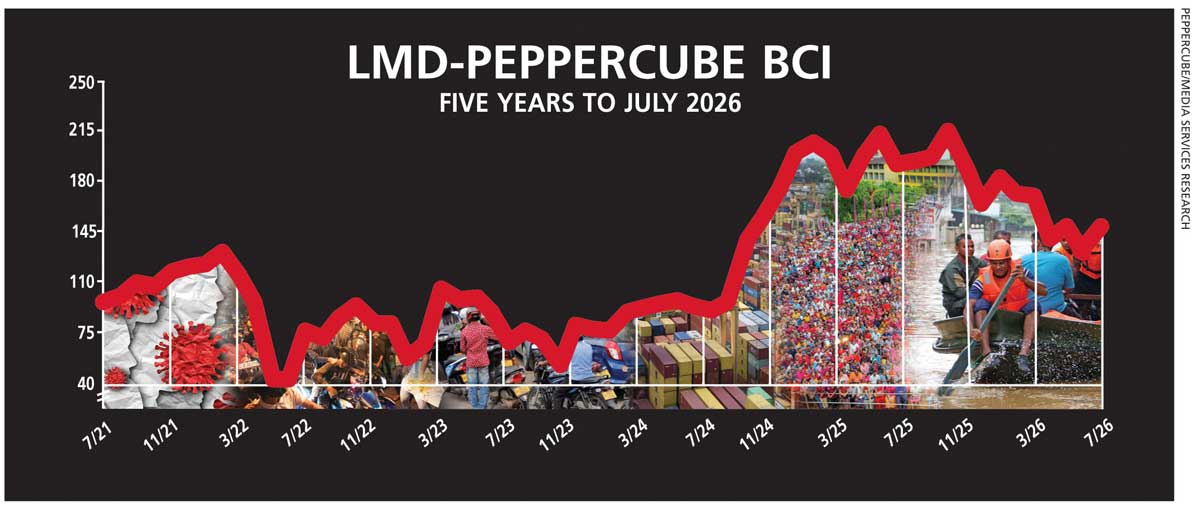
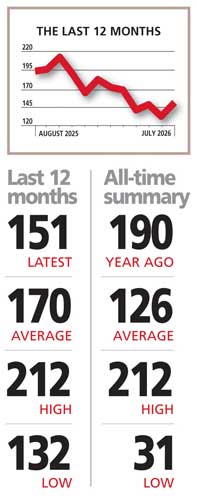
THE INDEX In July, the LMD-PEPPERCUBE Business Confidence Index (BCI) gained 19 points to register 151 – from 132 in the month prior – and reverse the free fall to a 20 month low in the preceding month.
From a broader perspective, the barometer stands 25 basis points above its historic median of 126 although it remains 19 points below the 12 month average of 170 and ominously, trails the July 2025 BCI reading of 190.
According to PepperCube Consultants, the turnaround suggests that businesses are becoming more optimistic about prevailing economic conditions, although caution continues to shape sentiment in certain areas.
It notes that maintaining this momentum will depend largely on continued stability in the wider economic environment.
However, risks to the global outlook persist: the IMF has cautioned that renewed conflict in the Middle East could intensify inflationary pressures, disrupt supply chains and unsettle financial markets – a scenario that was unfolding at the time of going to press.
Although the world economy has weathered the impact of the conflict better than initially anticipated, the threat of further hostilities remains a considerable downside risk. In its July World Economic Outlook update, the International Monetary Fund raised its global headline inflation forecast for 2026 to 4.7 percent.
PROJECTIONS Looking ahead to the rest of 2026, the trajectory of the index could depend on two factors in the main.
First, the state of play in the Middle East and second, whether the corporate mindset will shift to ‘business as usual’ in today’s ’VUCA world’ where volatility, uncertainty, complexity and ambiguity hold sway.
– LMD