
BILATERAL TRADE

TRADE GAPS CLOUD STRONGER INDIA TIES
Prashanthi Cooray delves into the Indo-Lanka trade relationship and notes that India’s role has moved beyond crisis assistance
The India-Sri Lanka relationship is deepening in some areas while progress remains elusive in others. Investment is flowing, ports and connectivity are expanding, and Indian tourists remain an important source of arrivals.
Yet, some of the mechanisms needed to turn these developments into broader commercial integration remain unfinished.
The result is a partnership in which economic ties are advancing faster than the rules designed to support them.
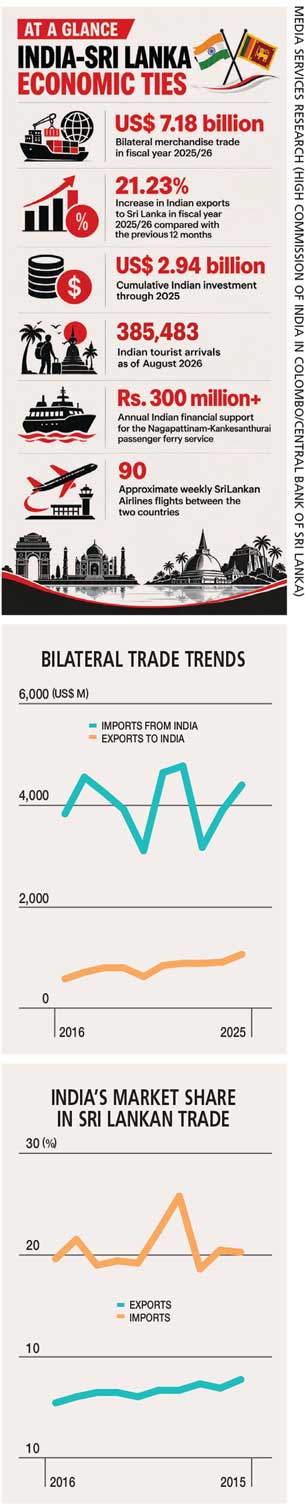
Trade data illustrate the scale of the relationship: bilateral merchandise trade reached US$ 7.18 billion in fiscal year 2025/26, comprising Indian exports of around 5.5 billion dollars and Sri Lankan exports of US$ 1.66 billion.
India is also Sri Lanka’s second largest export destination, according to the Sri Lanka Export Development Board (EDB).
And most importantly, the relationship is increasingly visible in physical assets.
The Port of Colombo remains a major point of convergence. The port handled a record 8.29 million twenty-foot equivalent units (TEUs) last year – its highest ever throughput – reinforcing its position as a major transshipment hub for the region.
Indian linked participation is sizeable here, particularly through the Colombo West International Terminal, developed by the Adani Group with John Keells Holdings (JKH) and the Sri Lanka Ports Authority (SLPA).
Investment is also becoming more structural.
India’s cumulative investment in Sri Lanka stood at US$ 2.94 billion through 2025 with investment spread across energy, hospitality, real estate, manufacturing, telecommunications, banking and financial services.
A particularly notable development came in April, when India’s Mazagon Dock Shipbuilders completed its acquisition of a 51 percent stake in Colombo Dockyard, for an investment valued at US$ 26.8 million, taking the relationship beyond infrastructure financing into strategic industrial ownership and maritime capabilities.
Tourism is another area where the relationship is already translating into healthy activity.
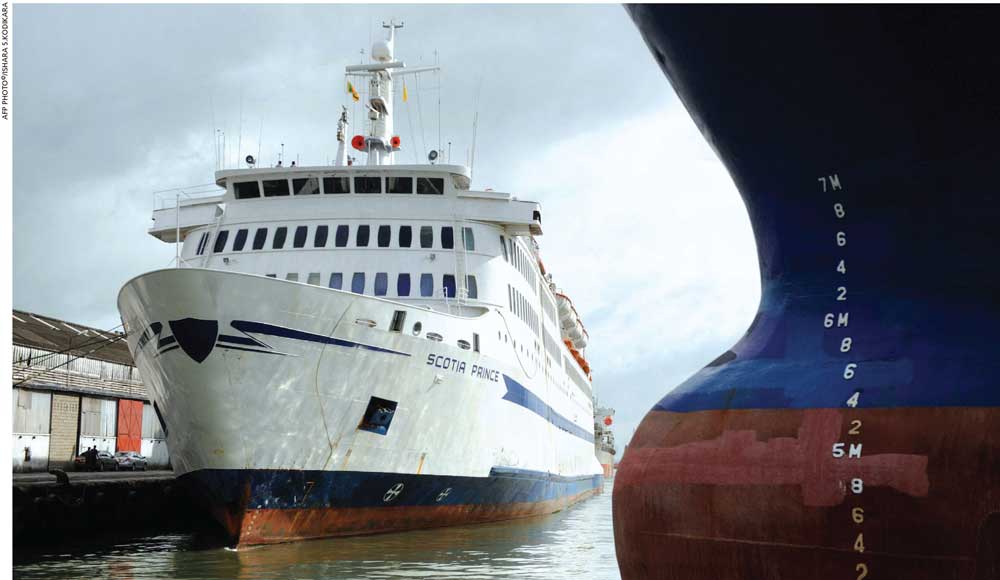
India remains Sri Lanka’s largest source market, accounting for more than 25 percent of tourist arrivals so far this year, according to the Sri Lanka Tourism Development Authority (SLTDA). Air links have expanded while the Nagapattinam-Kankesanthurai ferry has restored a maritime connection between the two countries.
Yet, the economic architecture has not kept pace with these developments.
The Economic and Technology Cooperation Agreement (ETCA) remains unfinished. Negotiations resumed in October 2023 after a five year gap with the 14th round held in July 2024. However, no subsequent round is cited in the latest official brief.
The India-Sri Lanka Free Trade Agreement (ISFTA) remains the principal framework for bilateral merchandise trade while the wider relationship has expanded into areas including services, investment and digital connectivity.
Market access remains another sticking point, with two-way trade still heavily weighted towards India.
More than 60 percent of Sri Lankan exports to India have used ISFTA benefits in recent years, compared with only about five percent of Indian exports to Sri Lanka. The numbers point to the differing use of the trade agreement by exporters in the two markets.
Meanwhile, currency settlement presents a similar picture: progress but unfinished implementation.
The two nations have moved towards greater use of the Indian Rupee (INR) in transactions. The Central Bank of Sri Lanka authorised the INR as a designated foreign currency in 2022 while making clear that it isn’t legal tender for domestic payments in the island.
Building on this, discussions in June focussed on strengthening rupee to rupee trade settlements with the aim of reducing transaction costs and currency risks. However, practical issues involving banking arrangements, foreign exchange hedging and payments for certain services remain.
Karthik Nachiappan of the Institute of South Asian Studies (ISAS) at the National University of Singapore (NUS), writing in ‘Assets Without Access: India’s Deepening Economic Stake in Sri Lanka,’ notes that India’s economic presence is deepening faster than Sri Lanka’s ability to benefit from its market.
His assessment points to the importance of market access and greater local value creation as the relationship develops.
India’s role in Sri Lanka has moved beyond crisis assistance; and the next test is whether its growing trade, investment and connectivity can translate into greater opportunities for Sri Lankan businesses.