
TECH INDUSTRY

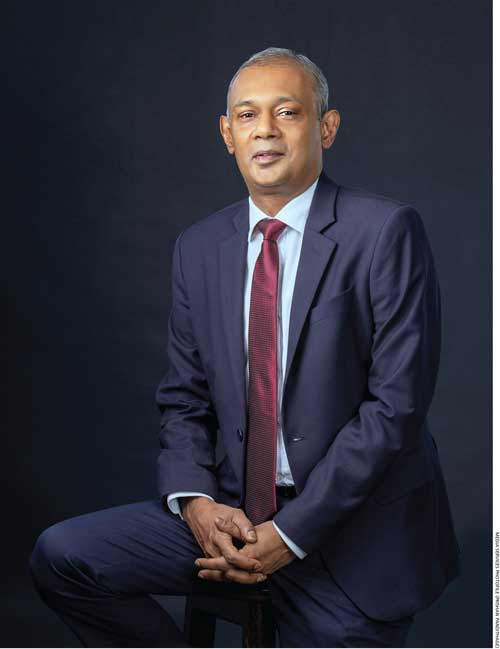
Dr. Romesh Ranawana
A SMARTER FUTURE WITH AI
Responsible AI and data innovation will shape a smarter future for Sri Lanka
Define responsible AI in today’s context
Artificial intelligence that is transparent, fair, ethical, accountable and human centred – technology that earns trust rather than assumes it.
Responsible AI as a business imperative
Because trust is the new currency – customers, regulators and investors increasingly reward organisations that deploy AI responsibly and have consequences for those who don’t.
Sri Lanka’s acceleration in its AI adoption journey
By building skills at scale, modernising data infrastructure, and fostering genuine collaboration between government, industry and academia.
The role of data in driving innovation
Data is the raw material for modern innovation – without it, AI is an engine without fuel, similar to preparing a company’s accounts using erroneous data.
Sri Lanka’s progress in becoming a data driven economy
We have promising pockets of excellence but progress must accelerate – ambition needs to be matched by investment and execution.
Main barriers to AI adoption
Talent scarcity, fragmented data, limited investment appetite and a mindset that treats artificial intelligence as an IT project rather than a business transformation.
Importance of data quality in AI success
It’s everything – brilliant algorithms trained on poor data simply produce confident mistakes at speed.
Organisational innovation sans strong data governance
They can experiment; but they cannot scale – governance is what turns promising pilots into enterprise ready production systems.
Biggest ethical risks associated with AI
Bias, opacity, privacy erosion and misinformation, compounded by the temptation to deploy first and ask questions later.
Minimising bias in AI systems
Diverse teams, representative data, rigorous testing and continuous auditing – bias mitigation is a discipline, not a checkbox.
AI regulations either encourage innovation or prioritise safeguards
That is a false choice: smart regulation does both, protecting citizens while providing innovators the clarity and confidence to build.
Sectors most ready for AI transformation
Financial services, telecommunications, healthcare, agriculture, apparel and tourism – sectors that are rich in data and hungry for productivity.
Generative artificial intelligence changing business decision making
It is collapsing the distance between question and insight, placing analytical power in the hands of every decision maker.
What separates successful AI initiatives from failed ones
A clear business problem, clean data, executive sponsorship and change management – success is 30 percent technology, and 70 percent people and process.
AI is replacing jobs or redefining them…
Redefining them – artificial intelligence automates tasks, not jobs; the real risk lies with those who refuse to adapt.
Most valuable skills in an AI driven economy
Critical thinking, creativity, data literacy and adaptability – i.e. the human capabilities that machines amplify but cannot replace.
Importance of AI literacy beyond the tech industry
Essential – AI literacy is fast becoming as fundamental as reading and arithmetic for every profession.
Can SMEs benefit from AI as much as large enterprises?
Absolutely – cloud based AI has democratised capability, providing small businesses access to tools that once demanded enterprise budgets.
Balancing innovation with privacy
Through privacy by design – build protection from day one and it becomes an enabler of trust, not an obstacle to innovation.
Government’s role in responsible AI development
Enabler first, regulator second – setting clear guardrails, investing in skills and infrastructure, and leading by example in public services.
Artificial intelligence automates tasks, not jobs; the real risk lies with those who refuse to adapt
Building trust in artificial intelligence among consumers
Through transparency, ‘explainability’ and genuine human recourse… Trust is earned in drops and lost in buckets.
Good AI governance looks like…
Clear accountability, ethics embedded in everyday workflows, human oversight of high stakes decisions and leadership that asks hard questions.
Ensuring transparency in AI driven decisions
Disclose when artificial intelligence is being used, make systems explainable and always provide a path to human review.
AI must contribute to more sustainable economic growth…
By optimising energy, agriculture and logistics – and by extending quality healthcare and education to communities that markets alone cannot reach.
A truly data driven organisation is…
One where decisions at every level are guided by evidence rather than instinct and data is treated as a strategic asset.
Dr. Romesh Ranawana is the Chief Analytics and AI Officer of Dialog Axiata.