
BUSINESS STRATEGY
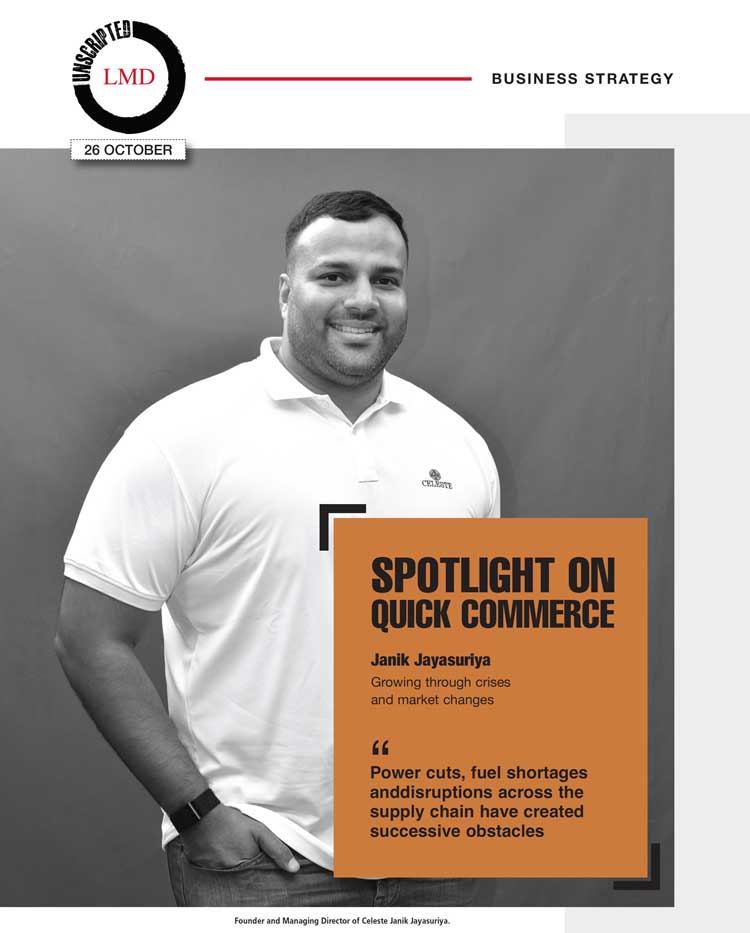
Building a business means responding to change, listening closely to customers and relying on the people around you. For Celeste’s Founder and Managing Director Janik Jayasuriya, shifting consumer habits and operational setbacks have tested his confidence and shaped how he leads.
Speaking on LMD Unscripted, Jayasuriya explained that Celeste began as a hospitality management company before pivoting to retail during the pandemic. What initially addressed an urgent need developed into a business, although its future seemed uncertain when restrictions eased and customers returned to supermarkets.
As orders declined, Jayasuriya questioned whether he had invested his savings and effort in a business that would only work during lockdowns. A friend encouraged him to reconsider his expectations: customers’ circumstances had changed, and Celeste needed to evolve with them.
“I realised that the fault was not in the market – the challenge was to offer the flexibility people now expected,” he recalled.
Celeste moved beyond fixed vegetable packs, enabling customers to purchase individual items and smaller quantities.
Jayasuriya revealed: “I examined portions from a consumer’s perspective, considering how much someone would need for a meal, or for one or two people. Smaller packs of herbs and additional product categories helped make the service more relevant.”
His confidence grew when representatives of a multinational identified Celeste’s potential within quick commerce. Their interest validated his work and encouraged him to commit fully to the business, despite the doubts that would return periodically.
One particularly difficult episode followed an ERP system migration. Operational problems disrupted service, orders fell and negative customer feedback prompted him to question his decision.
“Did I just kill what I built?” he remembered asking himself.
His team’s response helped restore Jayasuriya’s confidence, he acknowledged: “They reminded me that we had built the business together and could also overcome its problems together. After addressing the immediate issues, Celeste gradually recovered, surpassing its previous performance as the new technology began delivering benefits.”
Yet, Jayasuriya described the economic crisis as the hardest period of his entrepreneurial journey. “Power cuts, fuel shortages and disruptions across the supply chain have created successive obstacles. Generators offered little reassurance without fuel, suppliers struggled to deliver stocks and riders faced difficulties completing orders,” he explained.
Employees found practical solutions including using bicycles. However, even when supplies and operations stabilised, lower sales and strained cash flows left outstanding payments to address.
Working through those pressures reinforced the importance of persistence and collective problem solving.
Jayasuriya drew lessons from his father, brothers, fellow entrepreneurs and employees across the organisation: “Observations from support staff too can reveal overlooked problems or suggest products customers might want.”
That openness extends to customer complaints, which he regards as direct, unfiltered insights into the business. He emphasised that “we value every single customer and every order,”
He also reminds employees that each order represents a person relying on them. “A missing or poor quality item can disappoint a family, making careful picking, packing and communication essential to the customer relationship,” he stressed.
Celeste’s ambitions now extend overseas with a US operation targeting Sri Lankans seeking familiar brands. A partnership encouraged Jayasuriya to explore the market, where he saw opportunities to offer consistent access to favourite foods while enabling customers to shop for relatives in Sri Lanka.
Nevertheless, the local business remains his priority. Further expansion must complement its progress without diverting attention from customers at home.
His experience illustrates a demanding reality of entrepreneurship: confidence can falter, systems can fail and markets can change. Jayasuriya asserted that “progress depends on recognising shifts, accepting feedback and having people who will help carry the business forward.”
For Jayasuriya, that responsibility returns to earning the trust behind every order, day after day.
– Transcript compiled by Tamara Rebeira