BUILDINGS THAT REFUSE TO FINISH THEIR SENTENCE
LIMINALITY AND THE CITY BY ARCHT. ESHANA RAJARATNAM
Every city keeps a second map. It is drawn not by surveyors but by whispers: the alley you cross the street to avoid, the hospital wing nobody renovated, the half built tower that has stood scaffolded and silent since the money ran out. These are not the city’s monuments. They are its unfinished sentences and people, lacking an ending, supply their own. A figure in white asking a stranger to hold her child. A demon who crushes shoulders in the dark. A telegraph office that, 40 years on, is still said to hum with the static of the bomb that gutted it.
Urban legend does not attach itself randomly to the built environment. It attaches to a very specific kind of space: the transitional, the abandoned, the interrupted. This article asks why and what architects, planners and anyone who designs for human occupation might learn from the pattern.
The claim here is not that ruins are merely spooky. Rather, it is that liminality – a building’s state of being neither fully in use nor fully gone, neither public nor private, neither past nor future – produces a specific and measurable psychological discomfort. Folklore is simply the cultural technology people have always used to narrate that discomfort into something legible. Where architecture leaves a gap, stories fill it. And the shape of the story is rarely arbitrary: it tends to mirror the shape of the space’s interruption.
The architecture of the unfinished
Liminal space, in the original anthropological sense, describes a threshold condition – a doorway, a corridor, a stairwell – built specifically to be passed through, never occupied. The internet’s recent fascination with liminal space imagery (empty malls, fluorescent lit office corridors, motel hallways at 3 a.m.) has popularised the term but the underlying psychological mechanism predates the aesthetic by decades. Research summarised in environmental psychology coverage points to a mismatch between physical maintenance and social emptiness as the source of unease: a space that is clearly built and kept for use but currently holds no one, doesn’t register to the brain as abandoned or safe – it registers as wrong. The nervous system stays in navigation mode, scanning for a function it cannot locate.
Genuinely abandoned buildings intensify this. They occupy what one academic review terms temporal liminality – caught between a past that has visibly ended (peeling paint, a stalled clock, furniture left mid use) and a future that has not yet been decided. The Psychology Today coverage of recent neuroscience research frames this plainly: it has become cheaper to abandon malls, hospitals and entire housing blocks than to either repurpose or demolish them, producing a growing typology of buildings trapped in liminality rather than merely passing through it. This research suggests that memory itself is organised around spatial change; an environment that refuses to resolve into either ‘in use’ or ‘gone’ gives the brain nothing stable to file it under and that filing failure is experienced as dread.
This is the soil urban legend grows in. A 2024 piece in The Funambulist on contested ruins describes abandoned and partially destroyed houses as leaving “an almost haunting impression on both residents and visitors” not as a metaphor but as the documented, literal response of people living alongside undecided structures. Folklore supplies the resolution that the architecture withholds. If a building cannot tell you what it is, a story will.
A working case: Colombo’s haunted geography
Sri Lanka offers an unusually legible version of this pattern, because so much of its urban legend is explicitly tied to named, mappable buildings rather than vague settings.
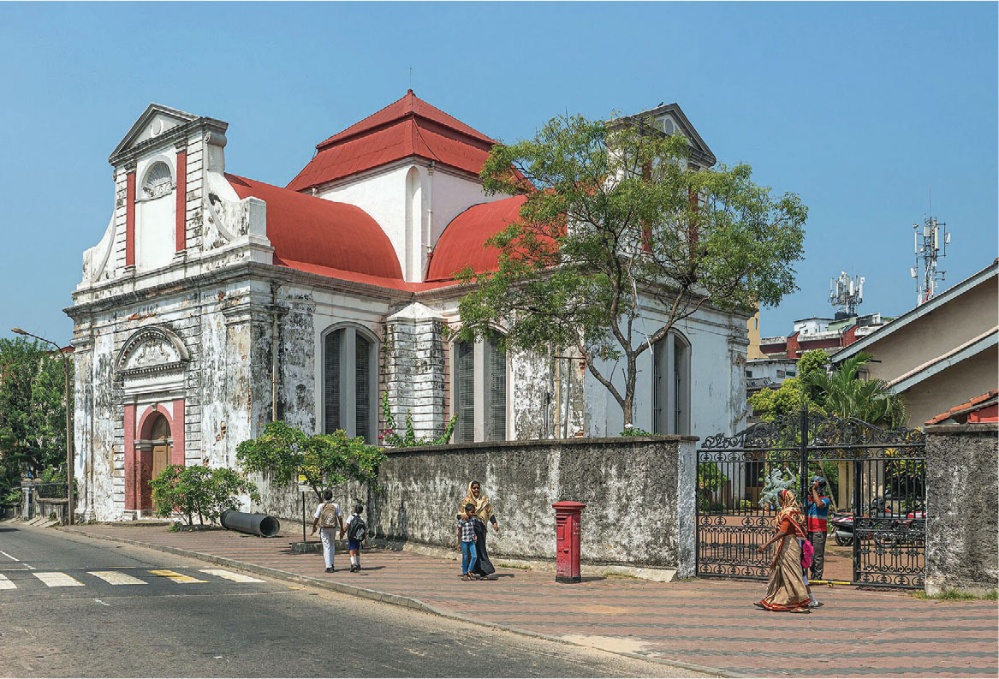
Wolvendaal Church in Colombo, said to sit on a former Dutch colonial burial ground, is the subject of persistent reports of whispers and cold spots – a haunting narrative attached directly to the unresolved question of what lies beneath a still functioning structure. Angoda’s abandoned mental hospital is described in local archives as one of the country’s most visited haunted sites, drawing thrill seekers precisely because it combines two forms of architectural abandonment: a building stripped of its institutional function and a history of confinement and suffering the city has never publicly processed. Marine Drive, a modern coastal road, generates a more contemporary strand – shadowy figures reportedly seen by drivers at night – showing that legend doesn’t require ruin at all, only the right combination of darkness, motion and unmonitored space.
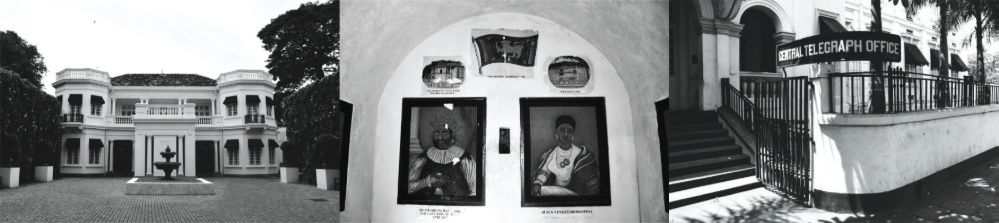
And the clearest case is the former Central Telegraph Office, bombed by the LTTE in 1989, killing 14 people. Roar Media’s archive of Colombo’s ‘grim histories’ notes that the building, now repaired and renamed the Sri Lanka Telecom Building, is still rumoured to be haunted. This is architecture absorbing trauma directly: a structure repaired on the outside while remaining, in the public imagination, unresolved on the inside. The renovation changed the building’s surface but not its narrative status. It is a useful corrective for any designer who assumes that restoring a damaged structure restores its meaning. Sometimes it only changes the cladding on the haunting.
Sri Lanka’s wider folklore catalogue follows the same architectural logic even where it isn’t tied to a single building. Mohini, the white clad spectral woman who stops travellers on desolate roads at night, is a legend of unlit, unsupervised transit space – the road as corridor, not destination. Maha Sona, the cemetery demon said to crush victims’ shoulders in graveyards and solitary places, and Kalu Kumaraya, the so-called Black Prince associated with sleep paralysis and cursed wandering after a suicide born of dynastic betrayal, both narrate the psychological weight of architecture and landscape that has been set aside from ordinary use – the burial ground, the threshold, the space outside the home at night. Even the shriek of the devil bird (ulama), widely believed by researchers to be that of the spot bellied eagle owl, demonstrates how an unexplained sensory event in unlit, undeveloped space gets folded into narrative rather than left as noise.
Ruins of war: when the interruption was violent
Spaces left over from conflict are a distinct and more politically charged category of the transitional. Scholarship on the Sri Lankan civil war describes the burned and abandoned homes of displaced Tamil communities as “phantomic reminders” of a former cohabitation the country has not publicly reckoned with – buildings that function, decades on, as involuntary monuments. The Funambulist’s reporting on the Jaffna islets is direct on this point: demolished and abandoned houses “decorate entire stretches of land,” some areas so depopulated and economically marginal that they remain, in the writer’s words, trapped in a time loop – architecture that can move neither forward into redevelopment nor backward into restoration.
What makes war damaged space distinct from ordinary abandonment is the question of authorship. As the same analysis notes, the decision to remove, replace or preserve a ruin is never neutral – it reflects whoever currently holds power over the site and whether they wish to erase a violent history or hold it up as a warning. A photo essay on Sri Lanka’s disappeared describes images of empty rooms and unoccupied beds as documents of absence, where the missing are made present precisely through architectural emptiness. The building, in these readings, isn’t a backdrop to the trauma. It is one of the only surviving witnesses to it and ghost stories are frequently the only public language available for testimony the state has not authorised.
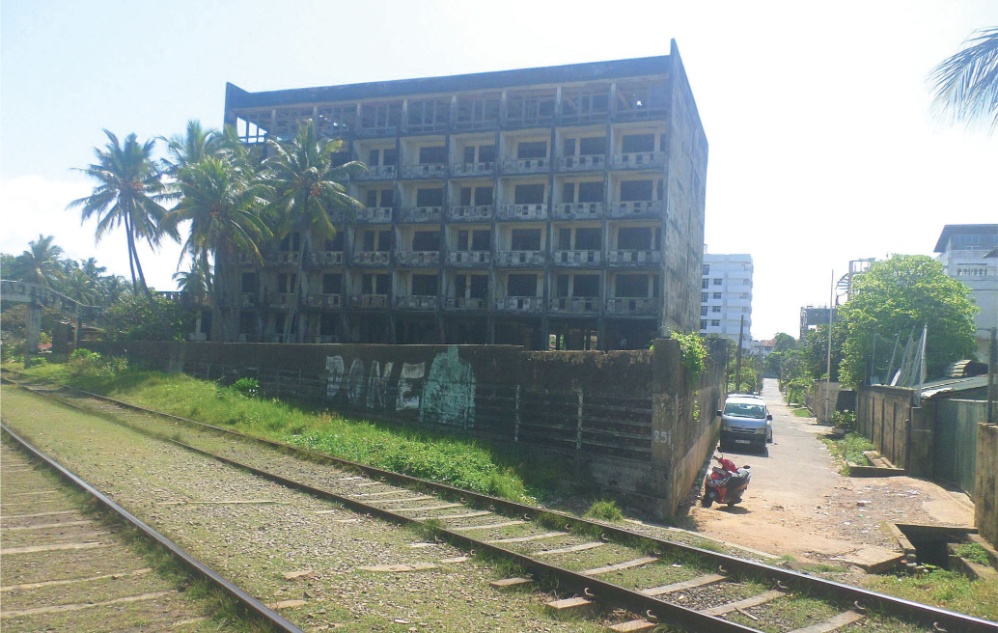
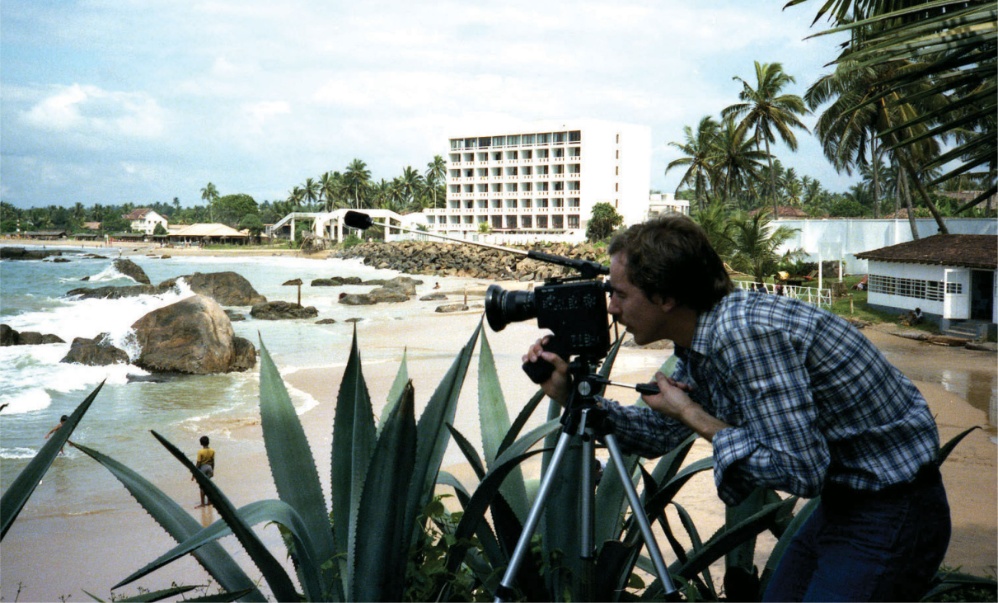
Tilly’s Beach Hotel in Mount Lavinia is this argument in its most undecorated form. Burned out during the anti-Tamil pogrom of July 1983, the hotel has stood as a gutted shell on prime coastal land for more than four decades, its ownership clouded by conflicting accounts of what happened to the Tamil businessman who once ran it. Some say he was killed; others say he survived abroad and refuses to return. Developers have repeatedly tried to claim the site and the state has just as repeatedly left it standing rather than formally resolve what it means and to whom it should belong. One local writer who has watched the building for decades suggested it might be better left exactly as it is – not renovated, not demolished but kept as a memorial to one of the country’s most shameful episodes. That is the authorship question made literal: the building’s continued ruin is, in effect, a decision, even when no one will admit to making it.
What makes Tilly’s a useful case for this article specifically is what has happened to it more recently online. The building now has a second life as a recurring subject on TikTok, where creators film themselves walking through its burned out rooms under hashtags such as ‘abandoned hotel Mount Lavinia’ and ‘haunted history.’ Some retell the 1983 fire, others simply treat it as a moody backdrop while a handful fold it into true crime style ‘cold case’ content. The building has not changed. What has changed is the audience and the medium through which the story now circulates, from word-of-mouth among Colombo residents to a global feed of strangers discovering the same unresolved structure for the first time, on a loop, indefinitely.
The new folklore engine: ‘urbex’ and the TikTok afterlife of ruins
The folklore mechanism described throughout this article – an unresolved building generating a story to compensate for what the architecture withholds – has not slowed down in the social media era. If anything, it has industrialised. ‘Urbex,’ short for urban exploration, has become one of the fastest growing genres on TikTok, where self-styled explorers film themselves climbing fences and slipping into derelict hospitals, hotels, mansions and factories, then post the footage for audiences of tens of thousands. A recent feature on the trend describes a generation of teenagers charting literal maps of thousands of abandoned sites, competing informally to find the most untouched location before anyone else gets there first.
This is folklore production with the serial numbers showing. Where Mohini or Maha Sona spread by word-of-mouth over generations, ‘urbex’ content spreads by algorithm in days but the underlying appeal is identical: a building that has stopped communicating its function invites someone to narrate it. One ‘urbexer’ interviewed for that feature said the hobby gives her a positive outlet, getting her “out of the house and moving around” and letting her see parts of the world that have been “tucked away.” That is a fairly precise restatement of the restorative side of liminality discussed earlier in this article, except now the threshold is not designed by an architect at all but discovered, claimed and broadcast by whoever gets there first.
The trend has not gone unnoticed by the people responsible for these buildings’ safety. Police forces in New York, Jersey, and the United Kingdom have all issued warnings in the past two years about ‘urbex’ influencers driving a rise in trespassing related injuries and fires, after videos of specific derelict sites prompted sudden spikes in copycat visits. The pattern is structurally familiar to anyone reading this article: a building left in architectural limbo, neither secured nor demolished, becomes more dangerous the longer it remains undecided. The legend that grows around it, now amplified by video rather than rumour, ends up drawing exactly the foot traffic the building was least equipped to survive. For architects and asset owners, the message is blunt: an unresolved building is not a passive liability that simply sits and waits. Left undecided long enough, it will eventually advertise itself.
Fiction names what architecture can’t say: The Seven Moons of Maali Almeida
Shehan Karunatilaka’s Booker Prize winning novel, The Seven Moons of Maali Almeida1 (2022) gives this whole argument a single, startlingly literal architectural image. Its protagonist, a war photographer murdered during the late 1980s conflict, wakes up dead inside what one reviewer calls ‘a celestial visa office’: a bureaucratic, office building afterlife the novel names the In Between. He is told he has seven moons to decide whether to move on or remain. The space is rendered, deliberately, as the most mundane kind of liminal architecture imaginable – long queues, disorganised signage, indifferent staff, a Department of Motor Vehicles waiting room stretched across the threshold between life and death.
This is not incidental set design. A recent academic reading of the novel, drawing on Derrida’s concept of hauntology and Avery Gordon’s sociology of haunting, argues that Karunatilaka uses spectral presence specifically to force a society to confront violence it has chosen to forget. The ghosts of war and riot victims who crowd the In Between “refuse the enforced amnesia imposed by the state,” as the analysis puts it – haunting not as a horror effect but as a structural protest against political erasure. Maali’s own afterlife bureaucracy, full of forms, queues and unhelpful officials, mirrors the institutional unresolvedness that the Funambulist and Journal of Architecture material above identify in Sri Lanka’s actual ruined and abandoned buildings: places stuck between an ended past and an undecided future, with no authority willing to issue a final form.
Read alongside the Telegraph Office or the Jaffna islets, the novel stops looking like magical realism layered onto real geography and starts looking like a fairly precise description of how Sri Lankans already talk about their built environment. The In Between is simply the country’s actual stock of unresolved, haunted, repaired but not reconciled architecture, given a queue number.
What this means for the people who live near these spaces
It would be a mistake to treat any of this as purely atmospheric. The discomfort of liminal and abandoned architecture has a measurable cost and a measurable opposite. Landscape architecture research comparing two campus greenspaces – one richly planted, one dominated by hard paving and high foot traffic recorded a 27.1 percent increase in reported relaxation and a 17.9 percent increase in reported happiness in the better planted, more enclosed space. The takeaway for designers isn’t that green space is nice; it’s that legibility and enclosure measurably change how safe and settled people feel in a given environment, in numbers large enough to matter in a design brief.
The same logic explains why abandoned buildings are not merely unloved but actively corrosive to a neighbourhood’s sense of security. A recent econometric revisiting of broken windows theory, looking at Chicago and New York, finds that abandoned structures carry a measurable criminogenic effect and, importantly, that this effect extends beyond crime statistics into residents’ perceptions of crime and safety. In other words, an unresolved building doesn’t merely sit there; it actively degrades the psychological experience of everyone who has to pass it, whether or not anything bad ever actually happens inside it. Folklore, in this light, isn’t a charming side effect of urban decay, it’s a symptom of it and a fairly reliable early indicator of where a community feels its environment has stopped making sense.
There is a more hopeful flip side. The same Psychology Today research that identifies ‘liminal spaces trapped in liminality’ as a growing architectural typology also argues that liminality can be designed deliberately, as a benefit rather than a wound. A threshold space that is intentionally built for pause rather than accidentally abandoned mid-use, can let occupants step out of constant environmental vigilance and into reflection. The research cites something as modest as a well placed bench at a decision point in a complex building as enough to shift a transitional space from threatening to restorative. The difference between a corridor that unsettles and a threshold that calms is not the absence of liminality. It’s whether that liminality was authored on purpose.
Designing for the story a space will inevitably be given
Every abandoned ward, dead mall and war scarred lot will eventually be narrated by the people who live near it, whether or not an architect is in the room. The alleyway someone avoids at night, the half occupied housing block, the bombed building re-clad but never re-explained – all of these are accurate because the built environment has left a question unanswered and people are constitutionally incapable of leaving a question unanswered for long. Mohini, Maha Sona, the whispering pews of Wolvendaal and Maali Almeida’s bureaucratic afterlife are not naive superstitions layered over neutral concrete. They are a record of where the city’s architecture stopped communicating and the collective imagination had to take over.
For architects and planners, the implication is not to fear the liminal but to stop producing it by accident. Adaptive reuse, clear sightlines, a decision about what a damaged building is now allowed to mean, a bench at the threshold instead of an empty corridor, these are not aesthetic flourishes. They are the design choices that determine whether a space resolves into memory or curdles into legend.
The ghost story, in the end, is simply what happens when nobody finishes the sentence the building started.