SIMCENTRIC TECHNOLOGIES
Q: SimCentric has over 17 years of expertise in military simulation and training technology. How would you describe the company’s journey and what have been the defining milestones in its evolution?
A: SimCentric’s journey began in 2009 with a fundamental challenge: how could military personnel be trained more effectively while reducing the risks associated with live exercises?
Our initial opportunity came through a contract supporting the Australian Defence Force (ADF), working alongside Bohemia Interactive Simulations (BISim) – now known as OneArc, which is a BAE Systems affiliated company – to develop specialised training modules using its Virtual Battlespace (VBS) platform.
We focussed on joint fires training, helping personnel understand and practise complex procedures in a simulated environment before undertaking live exercises.
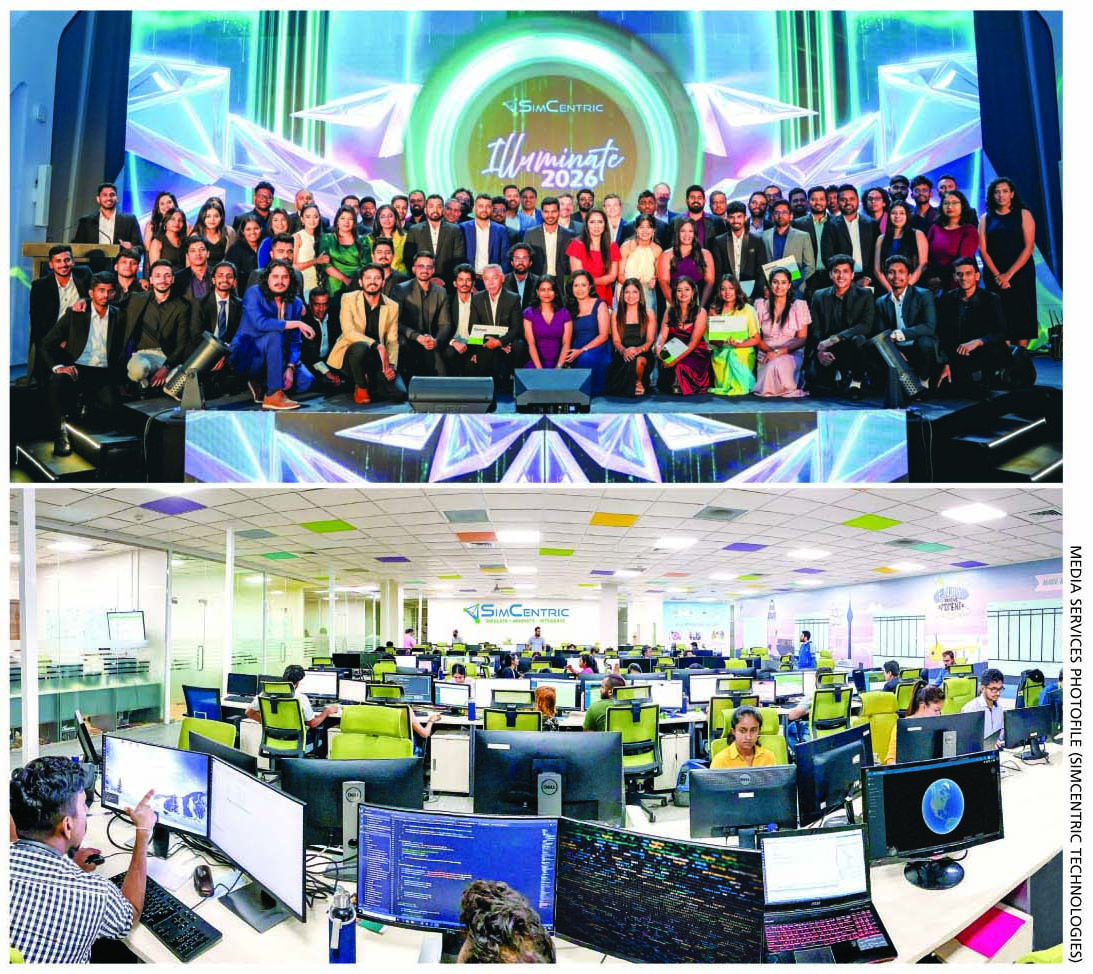
From a five person operation, we have grown into a specialised technology company with a development centre in Sri Lanka and a team of around 100 people, along with branches in a number of countries. Our solutions are now used by defence organisations and armies in the US, the UK, Australia, New Zealand and Singapore.
Another significant milestone was developing our own simulation capabilities using Unreal Engine. This allowed us to leverage a broader ecosystem of developers and technologies, moving beyond reliance on a single proprietary platform.
Q: How does a Sri Lankan founded technology company establish credibility and compete in a market characterised by stringent technical, operational and security requirements?
A: The country has a globally competitive IT talent pool. The fundamentals of software engineering are universal and our graduates possess the capabilities required to compete internationally. The challenge is to look beyond our domestic market and identify problems that need solving globally.
Defence simulation is a highly specialised sector where credibility is built through technical capability, domain knowledge and compliance. Our ISO 9001 and ISO 27001 certifications demonstrate our commitment to quality and information security, while we are working towards ISO 27701 certification to strengthen privacy management.
And our ISO 14001 certification reflects our environmental responsibility, while Great Place To Work highlights our employee centric culture and commitment to creating a workplace where people are valued, supported and empowered to grow.
Our location is another advantage. Sri Lanka’s time zone enables us to support customers across Asia-Pacific, Europe and North America, providing a practical advantage for global operations.
However, certain regulatory and import related restrictions can slow the introduction of hardware and integrated solutions. Addressing these challenges would help Sri Lankan technology companies to move further up the value chain.
Q: What are the most significant technological shifts reshaping the defence simulation industry and how is SimCentric positioning itself to respond?
A: Unmanned aerial vehicles (UAVs), particularly autonomous drones, are transforming defence operations. This creates new training requirements, from countering drone threats to integrating unmanned systems with conventional military capabilities.
The challenge is no longer limited to training personnel in individual tasks. Defence organisations increasingly need to simulate complex, coordinated operations and assess how different systems work together.
We are developing capabilities in drone related training, counter-unmanned aircraft system (C-UAS) activities and the integration of drones with existing fire support systems. This involves working with defence organisations to understand emerging operational requirements and incorporate them into training syllabuses.
At the same time, simulation is becoming increasingly immersive. Virtual, mixed and extended reality technologies are enhancing realism while more gamified interfaces are making training familiar to a generation of personnel accustomed to digital environments.
Q: What capabilities and skill sets are most critical to developing expertise in simulation, AI and defence technology, and how is SimCentric cultivating them locally?
A: Defence simulation requires considerable subject matter expertise, which is why we bring experienced military professionals and specialists from overseas to Sri Lanka to share their knowledge with our engineering teams.
Artificial intelligence is creating opportunities in both training and operational efficiency. We are developing AI enabled data analytics that can assess training performance, identify individual skill gaps and recommend subsequent training modules based on results.
AI is also helping our teams improve productivity, particularly in areas such as software development and coding, automating QA, and improving business operations and admin. We have seen productivity gains of at least 20 percent in our teams through artificial intelligence adoption.
Q: What are SimCentric’s key strategic priorities in the future, and where do you see the greatest opportunities for growth?
A: Drones and AI enabled training are two significant areas of opportunity. We are expanding our capabilities in these fields while continuing to strengthen our core defence simulation offerings.
Our ambition is to solve problems that matter globally. As a product and intellectual property led company, we see considerable opportunities in developing solutions that address complex training requirements, rather than competing primarily on cost. We are also exploring expansion, particularly across Asia and Europe. These markets present opportunities to extend our reach and build new partnerships.
The broader opportunity for Sri Lanka is the affirmation that we can develop globally relevant, specialised technology from here. SimCentric’s journey is an example of what local engineering talent can achieve when it is connected to global challenges.
– Compiled by Suresh Ginige
COMPANY DETAILS
- Telephone: 4368968
- Email: hr@simct.com
- Website: www.simct.com