GEOPOLITICAL FAULT LINES
VIEWPOINTS
CUBA: THE NEXT COLOUR REVOLUTION?
Sunera Bandara examines Cuba’s deepening economic hardships, the debate on regime change, foreign influence and the future of communist rule
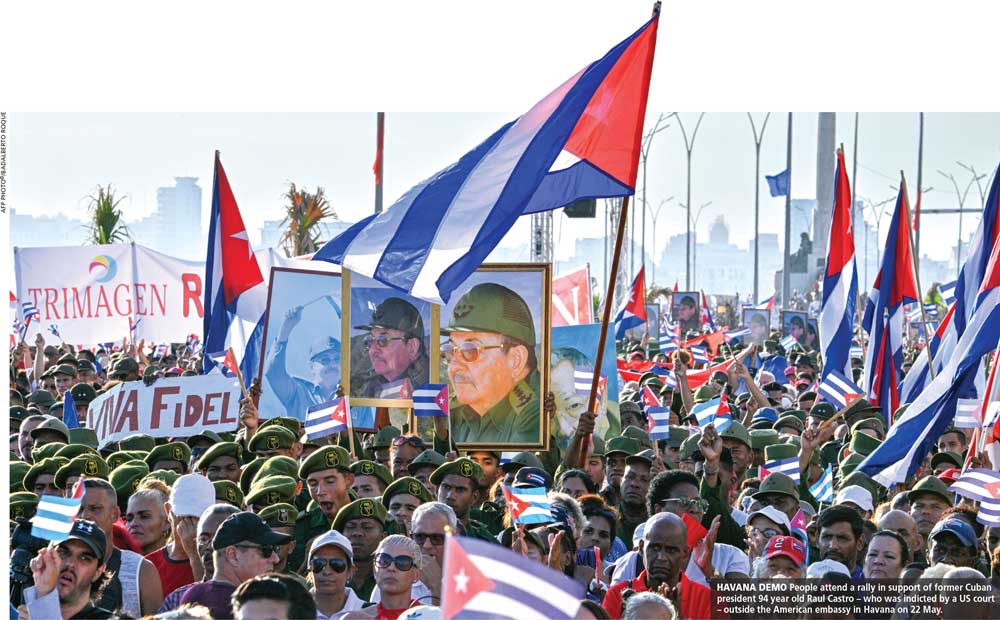
As it stands today, Cuba seems positioned to become the next potential regime change target of the Trump administration. What is a colour revolution? Experts tend to disagree on its definition, scope and reliability with the positive view of a colour revolution often taken up by liberal geopolitical thinkers who argue that democratic norms expressed by the West are preferable to dictatorial norms expressed in the East.
Russia, China and North Korea are often cited as examples of where dictatorships can go horribly wrong – although many would disagree with that assessment. Simply put, a colour revolution is a regime change within a country affected through outside influence. Examples include the Arab Spring and Ukraine’s Euromaidan revolution.
Some interlocutors have described Sri Lanka’s Aragalaya of 2022 to have been a colour revolution. Many within the country would disagree, stating that such an idea detracts from the organic nature of the Aragalaya.
In Cuba, a communist country, petrol prices have surged from US$ 1.20 to eight dollars while the average monthly salary of a Cuban stands at US$ 16. As noted by renowned communist Owen Jones, “medical staff find it increasingly unaffordable to travel to hospitals, which lack crucial medicines.” And US President Donald Trump has been blamed for Cuba’s woes.
Ukraine experienced a colour revolution but does that signal disaster for the region?
Emphatically not. The triumph of Western democracies, especially within Eastern Europe, has provided much benefits to the people of Ukraine, which has historically detested a Russian role in its political framework.
From a democratic and human rights perspective, Ukraine developed considerably despite the severe economic challenges resulting from Russia’s own attack on the Ukrainian economy through trade embargoes imposed in the Black Sea.
Many may remember the cheers and cries of victory as Nicolás Maduro was arrested. It is difficult to tell whether the same may occur among Cubans currently blaming the Trump administration. This is despite Cuba not having fully recovered from the COVID-19 pandemic – and having experienced one economic downturn after another under a continuous communist government.
Having become a communist country under the purview of Fidel Castro, it is difficult to argue that Cuba has succeeded in any positive way. The Foreign Policy newsletter published an article in May stating that many Cubans, viewing their quality of life as an endless series of diminishing returns, are leaving the country.
To date, 2.9 million Cubans have left the country since the communists took over
A similar phenomenon was recorded in Sri Lanka in the aftermath of the Aragalaya, as families and individuals who witnessed the brutality of the economic crisis and changing winds of political fortune jumped ship, and left in search of prosperity in the West.
To date, 2.9 million Cubans have left the country since the communists took over.
Some arrived by plane while others set foot by boat. A number of Cubans within the infrastructure of the West have commented negatively on communism taking root within Western institutions, viewing it as the reason for leaving Cuba in the first place.
Maduro was captured a few months ago as part of an escalating series of actions carried out by the United States.
Among these actions were the continued funding of the Israeli war machine in its continued offensive against Palestinian terrorist organisation Hamas, as well as the US’ attack of Iran, which Washington maintains posed a threat to its sovereignty.
One situational objection to Maduro’s arrest is a common idea floated through geopolitical circles. This idea, which has effectively become a meme, suggests that the United States seizes opportunities to undermine ideologically opposed governments for one simple reason: oil.
This accusation was levelled against the George W. Bush administration; and it is now levelled against the Trump regime for its actions in Venezuela. It should also be noted however, that despite Venezuela’s vast oil reserves, the oil is not useful because it’s difficult to refine.
FBI records dating back to the 1980s also indicate that the Marxist Provisional Irish Republican Army (PIRA) used known criminal gangs in the US to purchase weapons on behalf of the terrorists. Latin America – a close neighbour of the United States – has had its fair share of communist grievances and cartel violence.
Venezuela, of which Maduro was president at the time of his arrest, was alleged to have links to narco terrorist cartels – a phenomenon that has become a feature of parts of the Latin American landscape.
In countries such as Mexico, cartels are often said to exercise both explicit and implicit control over certain regions.
Experts quoted in the Los Angeles Times have stated that Trump’s claims far exceed the evidence presented in the official indictment of Maduro. But this falls short of various reports that point to a clear nexus between drug trafficking and terrorism in the 21st century.
The LTTE had been cited as one such organisation, allegedly trafficking large quantities of heroin through routes connected to the Golden Triangle in order to purchase weapons to aid them during the civil war in Sri Lanka.