
COUNTRY PROFILE
A HIGHER RUNG FOR SRI LANKA’S ECONOMY
Prashanthi Cooray examines the nation’s return to the upper-middle income category, the forces behind the shift and what it means for the future

The World Bank’s income classifications are closely watched as an indicator of a country’s economic standing. They are used by policymakers, development institutions and researchers, while also playing a role in determining access to certain concessional financing arrangements and development assistance.
Updated every July, the annual assessment places economies into four categories – low, lower middle, upper middle and high income – based on gross national income (GNI) per capita estimates.
In its 2026-2027 review, Sri Lanka moved back into the upper-middle income category alongside Jordan, Micronesia, the Philippines and Vietnam. The change comes three years after Sri Lanka faced its worst economic crisis in decades.
Since then, stabilisation measures and improved economic conditions have supported a gradual recovery. In fact, real GDP grew by five percent last year, supported by a rebound in industry, and growth in financial and tourism services, according to the World Bank.
Unlike measures based on the size of an economy, this classification considers average income levels per person. For the 2026-2027 cycle, upper-middle income economies are defined as those with gross national income per capita of US$ 4,636-14,375 under the Atlas methodology.
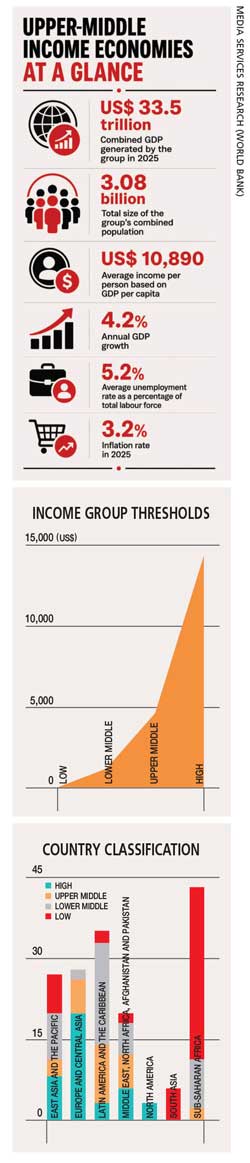
And while Sri Lanka has entered this range, it remains close to the lower boundary of the category.
The range itself is quite broad, bringing together economies with very different structures, income levels and development paths. The group includes countries such as China, Malaysia, Thailand, Brazil, Mexico, Türkiye and South Africa.
Moreover, the latest reclassifications reveal that there is no single route to higher income status.
Vietnam’s move followed years of export led growth with exports increasing by more than 15 percent in both 2024 and 2025, while GNI expanded at an average annual rate of 10 percent between 2021 and 2025. The Philippines reached the category after broad based economic expansion, recording average GDP growth of 5.8 percent over five years.
The other upgrades followed different paths…
Micronesia moved up following gradual post-pandemic recovery led by construction and agriculture, although weaker net primary income limited gains. And Jordan’s reclassification followed a revision of national accounts that showed its economy was nearly 10 percent larger than previously estimated, alongside growth of 2.8 percent in 2025.
Sri Lanka’s case differs from these examples…
The World Bank described Sri Lanka’s progress as a recovery story while noting that the country crossed the threshold by only a narrow margin. Maintaining this position will depend on whether recent improvements translate into sustained gains in productivity, investment and income growth.
A look at Sri Lanka’s position alongside India’s provides an interesting perspective on what the classification measures. Although the island nation now falls within the upper-middle income category, India remains a lower-middle income economy. However, this does not reflect the size of India’s economy, which stood at around 3.96 trillion dollars (in terms of GDP) last year.
The distinction comes down to the measure being used. GNI per capita is used as the benchmark, meaning that with a population of around 1.46 billion, India’s economic output is divided across a far larger base, keeping average income levels below the threshold for upper-middle income status.
For investors and lenders, Sri Lanka’s reclassification provides an indicator of the economy’s changing position but it does not replace broader assessments of debt sustainability, fiscal management, foreign exchange stability, productivity and policy consistency.
The ability to maintain investor confidence and strengthen economic fundamentals will remain central.
Sri Lanka’s return to the upper-middle income category therefore represents progress while also placing attention on the next stage of development, which includes expanding exports, attracting productive investments and building a more competitive economy.
The experience of other countries shows that entering this category is not the final destination. Long-term progress is essentially shaped by an economy’s ability to raise productivity, strengthen competitiveness and deliver improvements in living standards.