
SUSTAINABLE FINANCE
ESG-INVESTMENT NEXUS
Sustainable support for long-term development
BY Kiran Dhanapala
Sustainable finance integrates environmental, social and governance (ESG) criteria into investment decisions to support longer-term sustainable development. It differs from short-term commercial finance as it directs capital to benefit society and the planet, and is a rapidly developing area globally – with the exception of the US.
There are several instruments in the realm of sustainable finance including bonds (green or environment related, and blue or water related), Sustainability Linked Loans (SLLs) and impact investing.
It’s also one of the fastest growing areas and often known as GSS+ as it refers to green, social, sustainability and sustainability linked financial instruments.
Most GSS+ instruments are like general bonds, except that the issuers earmark capital for predetermined ESG benefits. Governments, financial institutions and companies sell bonds to investors, promising to pay back borrowed money with interest.
Global bonds are issued and traded simultaneously, in multiple markets and currencies. And investors include central banks, mutual and pension funds, and individual retail investors.
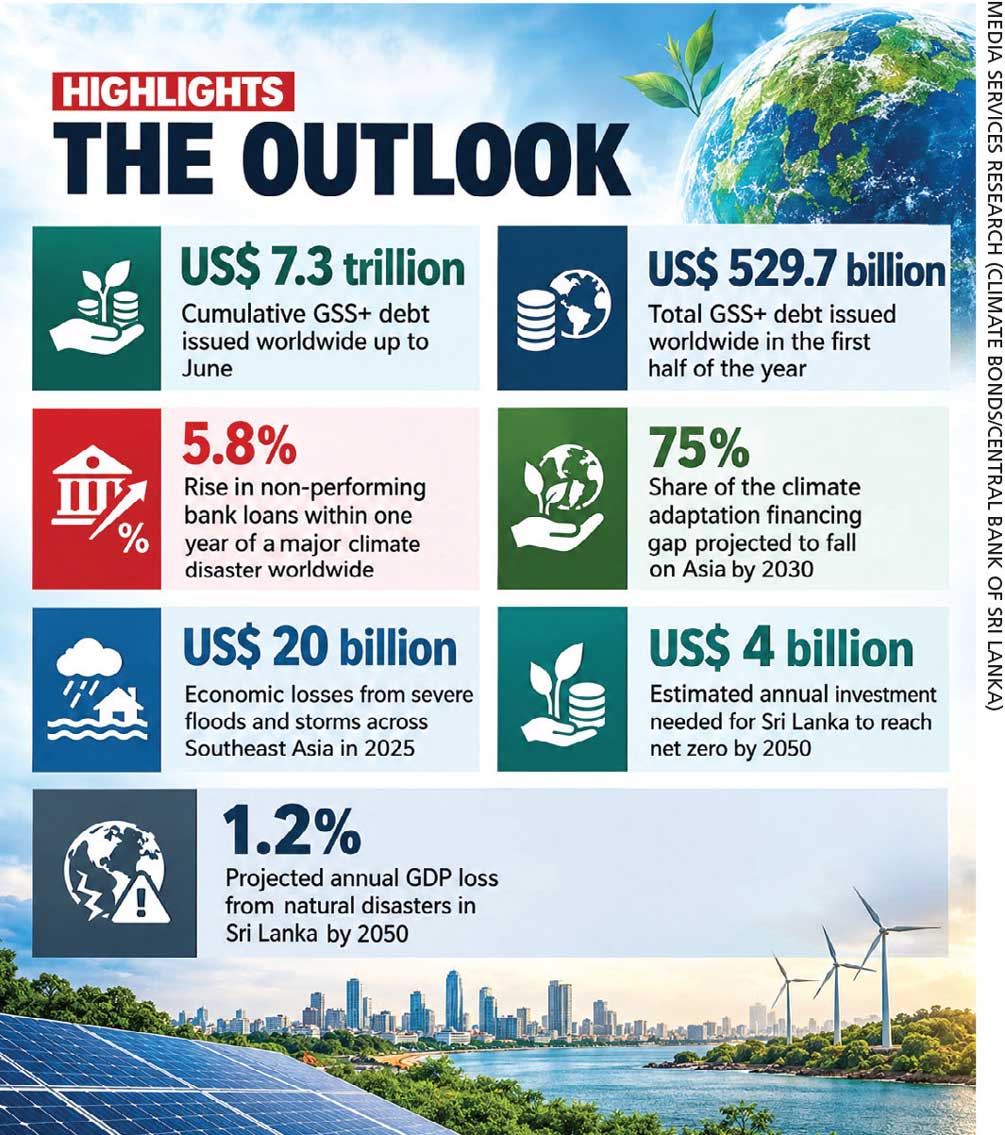
According to the Climate Bonds Initiative’s June report, 43 countries issued GSS+ instruments in the first quarter of this year with France leading volume wise, followed by Germany.
Green bonds accounted for over 60 percent of GSS+ deals in 2026. Social and sustainability bonds account for 19 percent of total deals. Green bonds dominate in Asia too, although it is gradually decreasing as issuers use a wider range of financing instruments.
Asia is the second largest sustainable bond market after the EU. China is a significant player and ASEAN countries too are increasingly engaged in this market. However, the US market is in decline.
Several Sri Lankan banks have issued various bonds in the last few years, beginning with DFCC’s Green Bond in 2024. The Central Bank of Sri Lanka has provided a Green Finance Taxonomy and guidance on priority sectors for investment.
Meanwhile, the Colombo Stock Exchange (CSE) is promoting responsible and sustainable investments within Sri Lanka’s capital market, with a CSE ESG Index being developed and independent ESG ratings on performance by companies.
And the centrality of micro, small and medium enterprises (MSMEs) and other social enterprises in Sri Lanka implies that capital must be attracted to these segments as well.
Sri Lanka can become an innovative producer of niche sustainability oriented goods and services. Some social enterprises have already displayed this. It has the potential to be branded as a sustainability standard-bearer and destination.
Being sustainability led, nimble, innovative and flexible will enable the country to take advantage of market opportunities.
This has been done to some extent in the apparel industry, and should be replicated across other industries and sectors as well. Incentives to attract capital using policy instruments into more environmentally and socially responsible, as well as impactful, economic activities are urgently needed.
Sri Lanka is at risk for increasing climate impacts from the El Niño phenomenon expected in the next 12 months or so. Impacts include decreasing fiscal space during a delicate economic recovery, as well as a further decline in disposable incomes and increasing poverty.
Finance for adapting to climate shocks, disruptions in the economy and so on is imperative, and sustainable finance – including climate finance – is vital for all sustainability development goals (SDGs) to be realised.
Climate adaptation is especially critical for Sri Lanka and ideas for projects on adaptation finance are urgently needed.
Blended finance (BF) can fill gaps for achieving the SDGs in countries. This includes the strategic use of concessional capital to mobilise private capital towards SDG and climate related goals by improving the risk-return profile or viability of transactions.
Ideally, it can reduce business costs by addressing the gap between viable projects and financial viability.
For example, with water shortages worsening, why don’t we see more demand for rainwater harvesting (RWH) despite the urgent need in the Dry Zone and predictions for urban areas?
Few consumers are aware of the cost of supplying clean water. This is fundamentally due to non-cost reflective pricing of publicly provided water. High upfront costs and unsupportive regulations mean long payback periods for RWH.
Furthermore, consumers are unaware of the impending shortages and real supply costs, and have always treated water as being nearly free. So the market fails to translate signals into action.
On the supply side, rainwater harvesting uptake in rural areas is challenged by costs and relatively fewer entities engaged in the process. In urban areas, the challenge is bulky water storage tanks, relatively high costs and so on.
And as the central bank’s Green Taxonomy doesn’t include RWH, it’s hoped that the awaited Sustainable Finance Taxonomy will address this lacuna.