MARITIME BOUNDARIES
WHO RULES OVER THE SOUTH CHINA SEA?
Saro Thiruppathy reports on regular incidents in the South China Sea between Beijing and other stakeholders in the disputed body of water
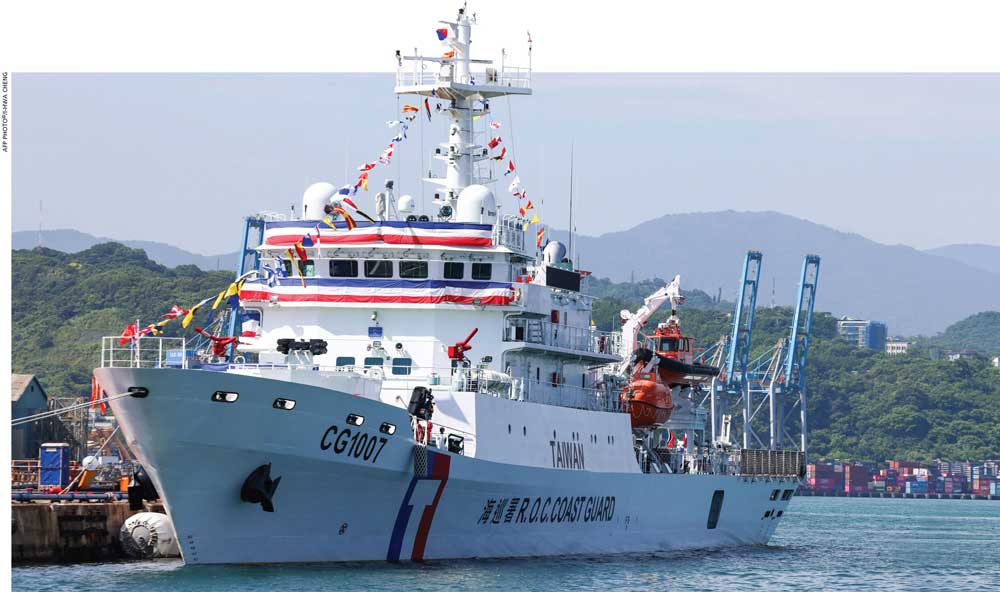
At the 59th ASEAN Foreign Ministers’ Meeting in July, Philippine Foreign Secretary Maria Theresa Lazaro complained about China’s aggression against Filipino sailors in the South China Sea.
She noted that there had been a confrontation between the Chinese coastguard and Filipino sailors on a supply ship near the Second Thomas Shoal, and added that a sailor had been injured in the skirmish that involved watercannon. This incident took place the day before the Association of Southeast Asian Nations’ summit.
Manila accused Beijing of being coercive and hostile, and declared that its actions were illegal. Meanwhile, the Chinese government accused the Philippines of orchestrating provocations with external support.
Manila has maintained a military presence on the reef since 1999, after grounding an ageing tank landing ship named the BRP Sierra Madre.
STAKEHOLDER WOES China regularly deploys its coastguard and maritime militia to surveil the area, and conduct grey zone operations. Beijing has used watercannon, ramming tactics and small boats that are armed to regularly disrupt supply missions by the Philippines.
Neighbouring nations such as Vietnam, Malaysia, Brunei, Indonesia and Taiwan are also in contention with China over this contested body of water.
The Philippines sought international arbitration in 2016 against Beijing’s nine dash line – a U-shaped map used by the People’s Republic of China (PRC) to claim around 90 percent of the South China Sea – and the Chinese blockades near the Scarborough Shoal and Spratly Islands.
Vietnam is in dispute with China over maritime boundaries, as it too claims sovereignty over the Paracel and Spratly islands. It also regularly complains about resource exploration and incursions by Chinese vessels.
Malaysia’s beef with Beijing is due to overlapping maritime and territorial claims. It is also pushing back against Chinese coastguard and naval patrols that operate illegally within its Exclusive Economic Zone (EEZ).
Brunei also lays claim to the resource rich Spratly Islands; but its protests against Chinese intrusion are conducted quietly using diplomatic channels.
As with China, Taiwan has also made sweeping historical claims to the South China Sea and faces regular naval friction.
CHINA’S POSITION Beijing is adamant that China has historic sovereignty over almost all of the South China Sea, which is now demarcated by the nine dash line. This situation has been the cause of much maritime and territorial strife between Beijing and its neighbours over the past decades.
In December 1947, China published a map compiled by its Ministry of Interior that featured a U-shaped line with 11 dashes, the purpose of which was to assert claims over various islands and stretches of water in the South China Sea.
Subsequently, China removed two dashes in the Gulf of Tonkin in a gesture of goodwill towards communist Vietnam and reduced the area to a nine dash line in 1953.
Beijing claims that it was the Chinese who discovered, named, and used the islands and reefs for millennia, adding that this makes the seas inherently Chinese territory. It uses its nine dash line to claim historical rights over this vast body of water, and its seabed, minerals, oil, natural gas and marine life.
The PRC claims that following World War II – and subsequent to the 1943 Cairo Declaration as well as the 1945 Potsdam Declaration that stripped Japan of its territories – China’s sovereignty over the South China Sea was restored.
In response to a complaint by the Philippines however, an international arbitral tribunal ruled in 2016 that China’s claims to the maritime area within the nine dash line were not considered legal under the United Nation’s Convention on the Law of the Sea.
But Beijing remains indifferent to the ruling, and has rejected it by referring to it as an illegal document that is null and void – a “worthless piece of paper” that doesn’t impact its maritime rights over the South China Sea.
OUTPOSTS AT SEA In its determination to claim much of the sea, Beijing is cleverly building artificial outposts and reclaiming land on submerged reefs. China is outfitting those locations with military facilities, radar systems and even airstrips.
The PRC is relying on its coastguard, maritime militia and fishing fleets, to enforce its control over disputed locales such as the Scarborough and Second Thomas Shoals.
In spite of all these issues, China is interested in resolving disputes in the South China Sea through direct negotiations using a regional Code of Conduct (COC). That COC builds on the 2002 Declaration on the Conduct of Parties in the South China Sea, and aims to set rules for behaviour, lower miscalculation, prevent military escalation and establish maritime cooperation guidelines.
US INTRUSION Beijing claims that although the US has no reason to be in the region – and that it is escalating tensions in the South China Sea by conducting joint defence exercises and emboldening countries such as the Philippines to act irresponsibly in areas like the Second Thomas Shoal.
American military patrols near Chinese locations are also considered ‘by the PRC as provocative actions.’