THE LEARNING CURVE
PAUSE YOUR GUT FEELINGS!
Ruwandi Perera explains why intuition isn’t always a helpful indicator
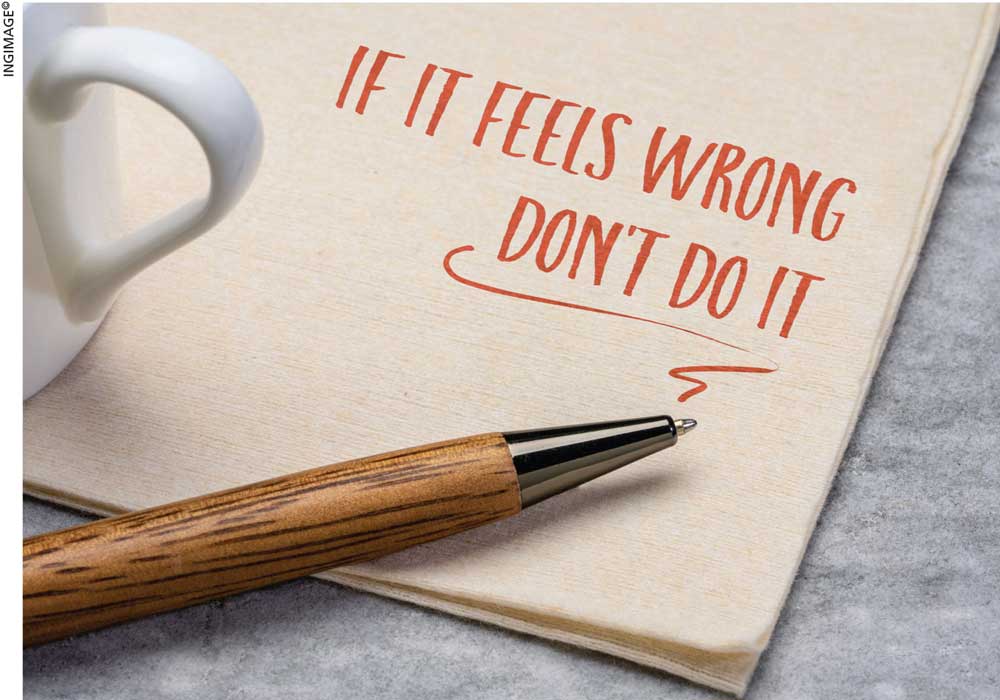
Considered to have been the defining personality trait of Steve Jobs and Albert Einstein, intuition has been historically known as a divine gift; it’s been labelled as being “more powerful than intellect,” by Jobs.
Yet, is intuition – commonly known as gut feeling – really a good trait?
It’s a form of knowledge and type of decision making that takes place inside our minds, and is devoid of deliberate and rational thinking. When faced with a complex or simple decision, our minds rapidly analyse past experiences, find patterns, map environmental cues and offer a solution.
Unlike instinct, which is a reaction, intuition is a process that happens rapidly.
First impressions, gut feelings, spidey sense, sixth sense etc. refer to human intuition. Research is being conducted on intuition – especially in military settings, where there’s no time to stop before making decisions.
Intuition makes us choose what feels right and take quick decisions without deliberating too much. Sometimes, it is what makes the right call in business and life – and generally concerns many things we do.
Though it’s uncertain how this trait is embedded in humans, it can be attributed to our caveman forefathers where survival was the name of the game. For our hunter-gatherer ancestors, instinct and intuition kept them alive since there was no time for debate and discussion – or even thinking, for that matter – when they were being chased by wild animals.
Indeed, intuition can get us out of tough situations. It has been known to perform better than logic in certain circumstances such as detecting when someone is lying. But it’s important that we treat it with caution.
The goal of intuition is to keep us safe but it judges safety by previous standards. Intuition sifts through past experiences and applies those lessons to the present. This is very good… until it’s bad.
Intuition can hold us back from trying new things.
For instance, if we didn’t have a pleasant experience with a particular dish the first time we tried it, some of us may refrain from having it again. While this will keep us safe, it’ll also keep us from gaining new experiences.
It’s also what can make us do the same thing over and over again.
For example, if recruits from one particular educational institute have performed well in an organisation, the company may perceive candidates from that institution to be better than others in future job interviews. While this can lead to recruiting the right people, it can also introduce bias that might not deliver the same results.
Moreover, intuition can stop us from taking risks – and prevent us from adapting to change.It can stall us from learning something new, especially if it doesn’t align with what we already know. And it could impede growth, simply for the sake of ensuring safety.
So how can we fight or even pause our intuition to make more logical decisions or adopt a more rational approach?
The answer is to do what intuition tries to replace: think.
Thinking – or better still, reflective thinking – occurs when we question our intuition to assess why it offered us a particular solution. It will require us to weigh the pros and cons of our intuitive thoughts, which means looking for weaknesses and biases in our own thinking, or perhaps even in our emotions.
To be successful in assessing our intuition, we need to be brutally honest with ourselves; and of course, that’s not easy.
Reflective thinking also requires us to park our intuitive thoughts and opt to gather data, evidence, facts and information, and analyse them before making conscious and deliberate decisions.
However, this isn’t as simple as it sounds…
On the one hand, thinking is hard and takes time. Finding facts is troublesome when you already have an answer in your mind. And more than anything else, saying ‘no’ to that loud persistent voice inside you that echoes your experiences and your past is difficult.
It can also be unsettling since reflective thinking pushes us to stay in the realm of uncertainty in order to be certain.
Gut feelings do save lives – but since we aren’t living in caves anymore, it would be prudent to pause, reflect and think before we act.