NOBEL PEACE PRIZE
BEACON OF LIGHT FOR TRUTH AND JUSTICE
Saro Thiruppathy describes the work of the Nobel Peace Prize 2026 winner in championing of justice for vulnerable people around the world
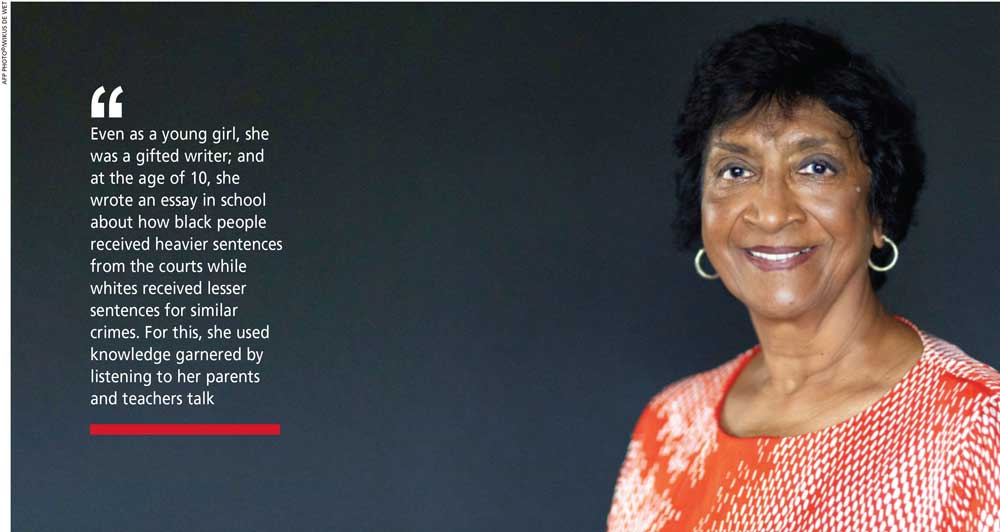
Nobel Laureate Navanethem (Navi) Pillay served as a judge in the International Criminal Court (ICC), as a United Nations High Commissioner for Human Rights, and continues to be a leading voice for justice and accountability in the world.
Pillay was honoured with the Nobel Peace Prize 2026 in October in line with its founder’s vision for this award.
The Norwegian Nobel Committee noted: “In historic international court cases, she has shown that legal measures can help prevent acts of war and violence. Navi Pillay has also contributed to strengthen the institutions of international law. Her independence, expertise and steadfastness have made her one of the most respected international jurists of our time.”
Founder Alfred Nobel wanted the eponymous prize to fund and reward concrete efforts towards global cooperation, diplomacy and international demilitarisation.
He made sure that part of his money was to be allocated for an annual prize to go to a person or institution that contributed the most effective work towards achieving his goals for global peace.
A STAR IS BORN The 85 year old jurist was born in Durban to Hindu parents of South Indian origin. Pillay’s father was a bus driver and fisherman while her mother was a homemaker to eight children.
Pillay’s grandparents came to South Africa as indentured labourers from Batlagundu (officially Vathalagundu) in the 1890s.
Though she was born to a poor family, her parents worked hard to educate their children and ensure that their daughters received the same quality of education as their sons.
Pillay’s first encounter with the courts was when she testified at the age of five after being robbed of money that her mother had wanted handed over to her father.
Even as a young girl, she was a gifted writer; and at the age of 10, she wrote an essay in school about how black people received heavier sentences from the courts while whites received lesser sentences for similar crimes. For this, she used knowledge garnered by listening to her parents and teachers talk.
Later, Pillay received a bronze medal from the Durban Chamber of Commerce and Industry when she was 14, for her essay on why South Africans should empower local commerce by buying products made in the country.
A year later, the budding rights based advocate earned an award of books from the Union of Jewish Women of South Africa (UJW) for her essay on the role of women in the installation of good values in children.
LESSONS LEARNED Since Pillay had earned the respect of the Indian community over time, its members supported her university education with donations.
In addition to the scholarship she received from the University of Natal, the citizens of Clairwood (where she lived) and the Durban City Council also assisted her.
Pillay graduated with a BA in 1963 and an LLB in 1965. Then in 1982, she earned an LLM from the Harvard Law School (HLS) and later, a Doctor of Juridical Science (SJD) in 1988. Pillay was the first South African to receive a doctorate in law from Harvard.
JURIST AT WORK Her legal career in South Africa spanned 28 years. In that time, she defended many antiapartheid activists, helped expose the torture and conditions of political detainees, and successfully prevented her husband from being subjected to unlawful methods of interrogation after he was detained in 1971 under the Terrorism Act of 1967.
Later, she won the right for Nelson Mandela and others who were imprisoned on Robben Island to have access to lawyers in 1973.
Pillay’s first encounter with the courts was when she testified at the age of five after being robbed
In 1995, she was appointed to the High Court by Mandela, after he was elected to the presidency. Under apartheid, she hadn’t been allowed to enter a judge’s chambers, and Pillay later noted that the first time she did so was when she entered her own chamber.
After a short term on the bench, she was elected to serve on the UN International Criminal Tribunal for Rwanda (ICTR) from 1999 till 2003. She will be remembered for the ruling in the landmark trial where it was established that rape and sexual assault would constitute acts of genocide, and are no longer trophies of war.
As they wanted to ensure the protection of women’s rights, the Women’s Caucus for Gender Justice (WCGJ) codified women’s rights into the ICC statute; and following its establishment, Pillay became one of the first judges to serve in it.
She also chaired the UN’s Independent International Commission of Inquiry on the Occupied Palestinian Territory including East Jerusalem and Israel (COI OPTEJI) until November 2025.
The persecution of the Rohingya of Myanmar also comes under Pillay’s jurisdiction through her work at the United Nations and international courts.
As a staunch defender of international legal principles, Pillay has been both forthright and fearless in her actions over the years, and fully deserves the reward and recognition afforded by the Nobel Peace Prize.