LMD MARCH 2026 COVER STORY

GIVE TO GAIN
“There is no limit to what we, as women, can accomplish…”
Michelle Obama
Innovation is often described as competitive – faster ideas, forward thinking and constant progress. Yet, the most meaningful innovation rarely happens alone. It grows through collaboration, shared learning and opportunity.
That’s why the International Women’s Day 2026 theme – Give to Gain – is relevant to women who embrace technology and pursue innovation. It reminds us that progress is not a race where one person’s success comes at another’s expense. When knowledge and support are shared, the entire system becomes stronger.
Tech is one of the fastest evolving industries in the world. It shapes how we learn, work, communicate, manage money and access healthcare.
And women bring perspectives shaped by different experiences, responsibilities and ways of thinking. When they are involved in designing products, leading teams or building startups, innovation becomes more balanced and relevant to wider communities.
What’s more, women have consistently demonstrated equal capability in technical fields. The real gap lies in access – to leadership opportunities, funding, networks and environments that enable long-term career growth. This is where the theme ‘give to gain’ becomes powerful.
A clear gender gap remains – even in many of the world’s largest tech companies
PROGRESS AND GAPS Census data in the US affirms that women have made notable progress in the workforce vis-à-vis science, technology, engineering and mathematics (STEM), growing from a mere eight percent of STEM employees in 1970 to around 28 percent last year.
Yet, a clear gender gap remains – even in many of the world’s largest tech companies.
Across Google, Apple, Facebook (Meta), Amazon and Microsoft, women represent 29-45 percent of employees with an overall average of about 31 percent. Representation is highest at entry level but steadily declines at mid-level and drops further when it comes to senior leadership.
Sri Lanka reflects a similar pattern, although encouraging signs suggest a gradual improvement. The country’s technology industry has taken strides with many corporate IT environments increasingly basing recruitment and performance evaluation on merit rather than gender – a meaningful shift from past workplace norms.
However, the industry remains largely male dominated, particularly in entrepreneurship. Strengthening women’s participation as technopreneurs has the potential not only to empower individuals but also to drive broader economic development. The Sri Lanka Association for Software and Services Companies (SLASSCOM), the national chamber for the knowledge and innovation industry, has set an ambitious goal to bridge this gap.
Founded in 2020, SLASSCOM’s Women Technopreneurs Forum works to foster female led tech startups and contribute to the goal of 1,000 new startups by 2030.
A joint SLASSCOM–IFC report identifies ‘technopreneurship’ as an emerging career path with 82 percent of technopreneurs under 40. In the youngest age group (under 24), men outnumber women by two to one. This mirrors global entrepreneurship trends, where participation peaks between 25 and 34 before tapering off.
Sri Lankan technopreneurs are generally well qualified with more than two-thirds holding a first degree or higher. However, the younger technopreneur landscape is largely male dominated with many men entering the field early, often as undergraduates with early ICT exposure.
By contrast, women tend to enter technopreneurship later, often with postgraduate qualifications. This may be linked to lower participation in ICT studies at earlier education stages. Mid-career is also where gaps widen more broadly.
Personal responsibilities, life transitions and rigid work structures can make it difficult for women to remain on the same trajectory.
Women in tech are not only contributing to the present; they’re shaping the future of innovation
THE FLIP SIDE ‘Give to gain’ is often framed in terms of what organisations should do for women. That is essential; but it is also a shared responsibility. Women give of their time, effort, courage and ambition. Progress often comes from stepping forward, taking risks and staying present in decision making processes.
Sri Lanka, like many countries, aims to grow as a knowledge and innovation driven economy. Women in tech are not only contributing to the present; they’re shaping the future of innovation, shifting the narrative from competition to collaboration and shared growth.
That is the heart of ‘give to gain.’ In technology, where change is constant, strong foundations are what enable innovation to last. As Serena Williams puts it, “the success of every woman should be the inspiration to another.”
– Compiled by Tamara Rebeira
Collective Momentum

Group Chief Financial Officer
Short Circuit
Q: International Women’s Day highlights collective strength. How does collaboration among women accelerate innovation?
A: Innovation is often portrayed as the result of individual brilliance – a single idea, a single disruptor. In practice, the most effective innovation I’ve seen comes from something far less dramatic: the ability to think clearly, together.
When you articulate an idea to others, not to defend it but test it, weaknesses surface early and assumptions are challenged. That process forces clarity. By bringing diverse perspectives into those conversations, the quality of decisions improves because ideas are examined not only for speed but for context, impact and sustainability.
This perspective often emerges more clearly when diverse voices are part of the discussion, particularly in complex environments. The result is not slower decision making but better judgement.
However, collaboration only works when people feel safe enough to be honest. Psychological safety is not a cultural ‘nice to have’; it is a practical requirement for innovation that actually works.
Q: What advice would you offer young women who want to lead, innovate and shape the future of technology?
A: Master your craft first. Early in my career, the technical grounding I gained through the CA Sri Lanka programme and my time at Ernst & Young gave me the confidence that no title ever could. Deep expertise creates credibility and credibility gives you a voice.
Once that foundation is in place, seek experiences that stretch you. Growth rarely comes from comfort; it comes from unfamiliar environments, failed attempts and learning how to recover with better judgement. Build your support system intentionally – find people who are willing to tell you the truth and mentors who have navigated paths you aspire to take.
And as importantly, be willing to do that for others. Impact is built through results, not visibility – visibility tends to follow substance, not the other way around.
Supportive organisational practices – flexible work models, hybrid arrangements and inclusive cultures – are not perks; they’re enablers
Q: How should organisations measure progress when it comes to gender equity in tech – and what metrics truly matter?
A: Representation numbers alone don’t tell us whether systems actually work. The metrics that matter show outcomes: retention by level, time to promotion, pay equity, and access to high-impact and visible work.
Having built a career while raising a child, I’ve seen firsthand how quickly organisational assumptions can change once women become mothers.
Supportive organisational practices – flexible work models, hybrid arrangements and inclusive cultures – are not perks; they’re enablers. Without them, even the most capable talent eventually leaves. Equity becomes real when systems allow people to perform consistently over time, not only when intentions are well articulated.
Q: How can industry, academia, and policymakers work together, to accelerate the entry and retention of women in tech?
A: This requires long-term alignment, not isolated initiatives. The pipeline challenge begins early at school level. Industry needs to work more closely with education systems to provide real world exposure through internships, mentorship and practitioners who can bridge theory and application.
I see the importance of early exposure firsthand. With my 10 year old daughter, I make a conscious effort to introduce her to global innovations and emerging trends.
She has already learned to use AI tools to create simple solutions that support her studies. This early familiarity builds confidence and curiosity, and helps children see technology not as something intimidating but a tool they can actively use and shape.
This is where policy and infrastructure matter: childcare access, safe transportation and systems that recognise non-linear career paths. When industry, academia and policymakers move in alignment, women are not only encouraged to embrace technology, they’re able to stay, grow and lead.
Inclusive Innovation

Country Director
Women in Tech Sri Lanka
Q: On International Women’s Day, conversations often centre on equality and empowerment. How does the theme ‘give to gain’ deepen that conversation?
A: The theme ‘give to gain’ deepens the conversation by shifting focus from individual advancement to collective progress.
True empowerment happens when women, organisations and societies invest time, access, knowledge and opportunity in others, especially those who have been historically excluded.
When we provide mentorship, visibility and equitable pathways, we don’t lose power; we multiply it. The gains include stronger innovation, inclusive leadership and sustainable growth that benefit everyone. The theme reminds us that equality is not a zero-sum game; it is a shared outcome built through intentional collaboration, allyship and the courage to uplift others as we rise together.
Q: Technology is often seen as a great equaliser… has it truly levelled the playing field for women?
A: Technology holds immense promise as a great equaliser but it hasn’t yet fully levelled the playing field for women. While digital access has opened doors to education, careers and entrepreneurship, systemic gaps still persist in representation, leadership, funding and decision making.
Bias, both human and algorithmic, continues to shape opportunities and outcomes. True equity in tech requires more than access to tools; it demands inclusive design, early exposure for girls, supportive policies and intentional investment in women’s talent.
Technology can be a powerful enabler but only when equity is built into the systems that create, govern and scale it.
Q: What interventions are most effective in encouraging young girls and women to pursue STEM and tech related careers?
A: The most effective interventions start early, and address both access and mindset. Exposure to STEM at school level, hands-on learning and visible female role models help girls see themselves in technology careers.
Mentorship, industry led programmes, and inclusive curricula build confidence and practical skills, while scholarships and internships
reduce structural barriers.
Equally important is creating safe, supportive environments where curiosity is encouraged and failure is normalised. For women, reskilling pathways, flexible work options and leadership development are key.
When families, schools, industry and policymakers work together, STEM becomes not an exception for girls but an expected and achievable path.
When accountability is built into performance metrics and governance, inclusion moves from a ‘nice to have’ to a business and societal imperative
Q: Do you believe that leaders should be held accountable for advancing women in innovation and technology?
A: Yes, leaders must be held accountable for advancing women in innovation and technology.
Real progress does not happen through intent alone; it requires measurable action, transparent targets and sustained commitment. Leaders shape culture, influence hiring and investment decisions, and determine who has access to opportunity and leadership pathways.
When accountability is built into performance metrics and governance, inclusion moves from a ‘nice to have’ to a business and societal imperative. Advancing women in tech is not only about fairness; it drives innovation, better decision making and long-term competitiveness.
Leadership accountability ensures that equity is embedded into systems, rather than being left to individual effort or goodwill.
Q: If we revisit this conversation in five years, what changes would you hope to see for women in tech and innovation?
A: In five years, I hope to see women fully represented across the tech and innovation ecosystem – not merely in entry level roles but as founders, investors, engineers and decision makers.
Success would mean fewer conversations about breaking barriers and more about building impact. I’d like to see equitable access to funding, inclusive AI and data systems, and workplaces designed for diverse life realities.
Importantly, seeing Sri Lanka’s education policies align to provide young girls better access to all fields – and equip them with knowledge in technology and innovation – will ensure that they can pursue any path confidently and effectively.
Shared Success
Regional Head of South Asia – Customer Engagement Solutions
ADA
Q: Innovation is often associated with competition. How does this year’s International Women’s Day theme ‘give to gain’ challenge this narrative, in your opinion?
A: For a long time, innovation has been framed as a race, faster ideas, louder disruption, and clear winners and losers. The ‘give to gain’ theme gently challenges that mindset and invites a different kind of progress.
In my experience, innovation grows when knowledge is shared, not guarded. When people invest time, insights and access in others, ideas travel and evolve faster. In an age shaped by AI, this becomes even more relevant.
Technology moves quickly but learning compounds when it is collective. Giving does not weaken advantage; it strengthens it, often in ways we cannot immediately measure.
Q: In your experience, how do women leaders approach innovation differently – particularly in terms of impact, inclusivity or long-term value creation?
A: Many women approach innovation with an instinctive sense of responsibility. There is often a pause before action – a need to understand context, consequences and people.
What is often labelled as ‘soft’ plays a critical role here.
The ability to nurture ideas, hold multiple truths at once and connect people across perspectives gives innovation depth.
Women are natural multitaskers and intuitive connectors. These are not secondary skills; they’re strategic strengths, especially in complex environments where long-term value matters more than short-term wins. This is where innovation stops being performative and starts becoming sustainable.
Q: What systemic barriers still limit women’s ability to lead innovation? And how can those barriers be broken down?
A: Today, barriers are less visible but still present. They show up in access to opportunities, exposure to emerging technology and confidence building experiences early in a career. This is also a moment of choice.
In an age of rapid technological advancement and AI, staying within familiar lanes can quietly limit growth. Moving out of comfort zones, trying new things and staying ahead of the curve has become important for everyone… but especially for women who have historically been encouraged to play safe.
AI offers a powerful entry point. It lowers the barrier to learning, experimentation and reinvention. When women engage with technology proactively, not waiting to be invited, leadership becomes less about permission and more about possibility. That shift is where barriers truly begin to loosen.
When women lift others by creating access and confidence, innovation becomes a shared legacy rather than an individual achievementWhen women lift others by creating access and confidence, innovation becomes a shared legacy rather than an individual achievement
Q: What practical steps can companies take to accelerate the advancement of women in technical and innovation driven roles?
A: Create safe spaces for learning and experimentation. Encourage curiosity without penalty. AI platforms today enable women to explore skills, test ideas and build confidence at their own pace. Beyond tools, exposure matters.
Access to meaningful projects, decision making rooms and leadership sponsorship makes a tangible difference.
Flexibility is equally important. Innovation thrives when people are allowed to integrate life and work, rather than constantly compartmentalise. When women are supported to show up fully, creativity follows naturally.
Q: In your assessment, what responsibilities do women leaders have in creating pathways for the next generation of innovators?
A: Women leaders have a responsibility to make the path clearer than it was for them. That means sharing knowledge openly, normalising exploration and leading without apology.
It also means modelling a leadership style rooted in integrity and generosity.
When women lift others by creating access and confidence, innovation becomes a shared legacy rather than an individual achievement. Progress multiplies when it is passed on – and that to me, is the true meaning of ‘give to gain.’
Creating Value

Co-Founder and Director
Hatch
Q: How do you define innovation, beyond technology or new products?
A: I define innovation as value creation that reshapes behaviour and improves lives, not simply the introduction of new tech. It starts by questioning assumptions, cutting through complexities and designing systems that serve real people, rather than idealised models or abstract frameworks.
True innovation often emerges in spaces where change is slow or uncertain. Technology can accelerate progress but its impact depends entirely on how thoughtfully it is applied.
Innovation is an ongoing process of testing, learning quickly, shifting culture and having the courage to let go of what no longer works. At its heart, innovation is both instinctive and intentional.
Q: Why is it important to have more women shaping innovation, rather than merely adopting it?
A: Innovation succeeds when it reflects reality accurately and solves real, lived problems. When decisions are shaped by a single limited perspective, solutions are often limited and fail to serve diverse segments of society they’re meant to support.
Women bring distinct experiences, insights and ways of thinking, which strengthens decision making, and expands the potential for meaningful, practical and inclusive innovation.
Q: Have you witnessed tangible differences in outcomes when women are involved at the design or decision making stage?
A: A good example of this is a healthcare platform that didn’t start by asking ‘how do we digitise healthcare? It began with ‘where does the system fail women?’
Because women defined the problem through lived experience, it focussed on fertility, pregnancy loss, postpartum mental health, menopause and care across a woman’s lifecycle.
The result was a different kind of product: outcomes based care and measurable reductions in healthcare costs. This isn’t about fairness or optics; it’s about results and building systems that actually work.
Organisations should actively support women in rethinking value chains and business models from the ground up. When they do that, they build stronger, smarter and more inclusive ecosystems.
Organisations should actively support women in rethinking value chains and business models from the ground up
Q: What’s been the most notable challenge you’ve faced as a woman innovator – and how did you overcome it?
A: One of the most striking challenges was not the technical or strategic business hurdles; it was the quiet expectations and assumptions that shape how people perceive who can lead and who can solve problems.
In many settings, courage isn’t sufficient; you also have to contend with the unspoken belief that certain roles or ideas somehow fit an expected ‘type’ of innovator or leader.
I saw this early on, when I was launching my organisation. The pushback wasn’t always a blunt ‘no’; it was a silent disbelief that someone with my background could make something bold work.
Rather than internalising those doubts, I stayed focussed on outcomes. I doubled down on defining problems clearly, aligning teams around purpose and delivering measurable impacts.
Over time, that focus shifted conversations and opened new opportunities for myself and others. Innovation thrives when we trust diverseperspectives and demonstrate what’s possible through results, not stereotypes.
Q: What needs to change to ensure that women innovators are supported, funded and heard?
A: Good intentions alone aren’t enough to support women innovators. We need to shift mindsets, rethink structures and make space for diverse voices to lead with authority.
Equally important is creating systems where women invest in and support other women.
This is what we focus on at my organisation through AccelerateHer, GRIT and HerCapital – we build pathways, resources and communities that empower women to flourish.
Balanced Progress
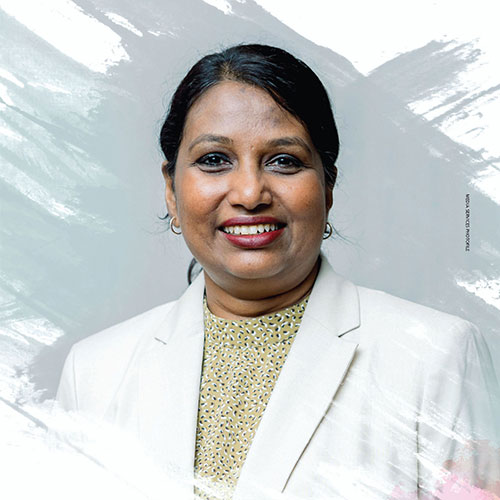
Chief Operating Officer
99X
Q: This year’s International Women’s Day theme is ‘give to gain.’ What does this mean in the context of women’s participation and leadership in the tech industry?
A: The theme is often interpreted as something organisations must do for women – i.e. better policies, safer spaces and clearer career ladders.
While essential, the idea goes deeper. It is a shared responsibility and the real gains accrue only when both sides give with intent.
From an organisational perspective, giving means creating environments where women can build long-term careers, access to leadership opportunities, flexibility across life stages and decision making spaces where diverse voices are genuinely heard. When companies invest this way, the returns are visible.
However, there is another side that we don’t talk about enough…
Women must also give time, effort, courage and ambition. Progress comes from stepping forward, taking risks and staying in the room long enough to experience outcomes. We cannot expect positive discrimination; employers must remain equal opportunity providers.
Women bring a different dimension to leadership with strong emotional intelligence, balanced risk taking and decision making, and multitasking. In my experience, many international clients actively seek female leaders, recognising the value this perspective brings to building sustainable teams.
So ‘give to gain’ is strategic. When organisations give intentionally and women give boldly, the tech industry gains through stronger leadership, better out-comes and a future that is far more inclusive by design.
Q: And where do you believe progress for women in technology has been too slow – and what urgent actions are needed to close the gaps?
A: Progress within corporate technology environments has been encouraging. In many IT companies, recruitment, performance evaluation and career progression are largely merit driven, rather than gender based. This marks a significant shift from a decade ago.
However, we still have too few women in senior leadership and technical leadership roles. Part of this stems from early pipeline issues whereby girls are often steered away from STEM even before they enter the workforce. The bigger issue is retention and progression.
Women enter tech but leave at disproportionate rates in their mid to late careers – often for personal reasons – just as they would typically move into leadership. Systems must better address this leakage.
Progress is slower in the startup ecosystem. Women founders often face greater inspection when seeking investment and market access, being asked more questions and held to different standards than their male counterparts.
The Women Technopreneur Report published by the Sri Lanka Association for Software Services Companies (SLASSCOM) and IFC highlights this gap. Closing it requires greater transparency in funding decisions, intentional support for women entrepreneurs, and clearer pathways to identify and develop high-potential women leaders early.
Women enter tech but leave at disproportionate rates in their mid to late careers – often for personal reasons
Q: How can organisations move beyond commitments and conversations to measurable action when it comes to gender equity in tech?
A: It is about creating conditions that allow people to succeed at different life stages. Flexible work models, outcome based performance measurement and structured re-entry pathways after career breaks are practical starting points.
However, progress goes beyond flexibility. It requires clear career progression frameworks, gender balanced leadership pipelines, and data driven tracking of recruitment, promotions and retention.
Organisations must also identify high-potential women early, and invest in their growth through sponsorship, leadership exposure and stretch roles.
Q: Beyond policies, what cultural shifts must organisations make to truly support women in innovation led roles?
A: One of the most important cultural shifts organisations must make is to stop treating innovation as a separate function. At 99X, innovation is part of our DNA and everyday work. It is not owned by a special team; everyone is expected to question, improve and experiment.
This creates space for more voices – including women – to contribute without competition. In such cultures, we move from ‘prove yourself’ to ‘we believe in you’ and even failures are celebrated. When organisations recognise and trust these forms of leadership, they unlock a more sustainable and innovation pipeline.