MIDDLE EAST CONFLICT
HOUTHI FORCESARE FIGHTING VALIANTLY
Saro Thiruppathy investigates the backstory to the deprivation faced by the Yemenis and Houthi aggression towards Saudi Arabia
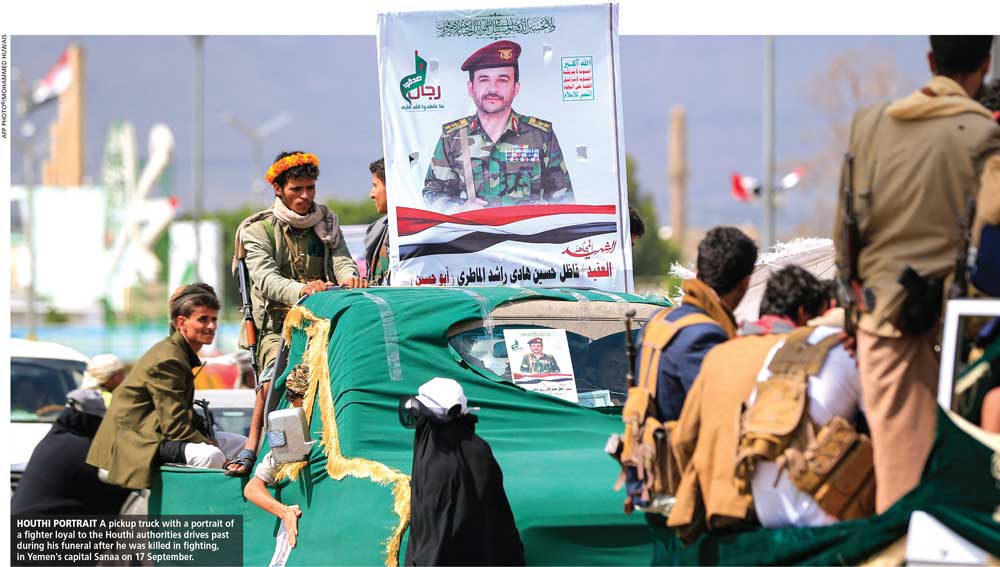
Many have heard of Yemen… but not so much about the Houthis, who have taken up cudgels against Saudi Arabia after suffering years of hardship at the hands of Riyadh and Washington.
The Houthis are officially known as Ansar Allah or Ansarullah (‘partisans of God’) and their movement, which began in the 1990s, is backed by Iran and continues to be active in Yemen’s civil war.
TAKING SANAA The Houthis gained control of Yemen’s capital Sanaa by overthrowing President Abdrabbuh Mansur Hadi in September 2014.
They forced the resignation of Prime Minister Mohammed Basindawa and after continued unrest and a rejection of the draft constitution, Ansarullah placed Hadi under house arrest, and forced him and his cabinet to resign.
All this happened by dint of a strategic alliance with forces loyal to Yemeni former president Ali Abdullah Saleh who was ousted during the Arab Spring of 2011.
That time of increasing trouble and hardship resulted in public anger and political weakness. A key issue for the Yemenis was the removal of fuel subsidies in August 2014, which caused prices to skyrocket; and as expected, people became disenchanted with the government.
In addition to that, Hadi’s government was weak, divided and struggling, and many state institutions soon collapsed.
All of this contributed to the ease with which the Houthis were able to capture Sanaa and take control of the government.
SAUDI RESPONSE Riyadh took umbrage because Hadi was an ally; and for many reasons, it wanted to see his government reinstated. One of these was that the Americans also believed Hadi was the best option to lead Yemen in the aftermath of the Arab Spring.
And like all loyal friends, Saudi Arabia intervened and blockaded Yemen in 2015, to appease the puppeteers and counter Iran’s expanding influence in the region, and its backing of the Houthi movement.
The Saudis had seen Ansarullah’s control of Sanaa as a strategic threat to its southern border and feared that Yemen would turn into a hostile state that was influenced by Tehran.
So it decided that the best way to teach the Houthis a lesson was to launch a military campaign in March 2015 together with a coalition of Gulf states. This action comprised air strikes and naval blockades, to stop Ansarullah fighters from advancing by preventing arms and supplies from reaching Yemen.
As Riyadh and Washington were best friends at the time, their collective desire to destroy the Houthis took a catastrophic turn, as the military campaign and economic blockade implemented by the Saudis and Americans devastated Yemen – rather than only the Ansarullah fighters.
And the coalition of Gulf nations led by Saudi Arabia and the UAE carried out intense bombing, which destroyed civilian sites such as homes, schools, markets and medical facilities.
Since Yemen imports most of its food, fuel and medicine, the military intervention prevented critical goods from reaching the Yemenis. This resulted in many mothers being forced to feed their starving children boiled tree leaves and wild plants to prevent starvation.
Human rights groups condemned this economic blockade and called it ‘torture in slow motion.’
The US provided intelligence and logistical assistance to the anti-Iran, anti-Houthi, pro-Saudi coalition, and sold weapons that would harm and kill the people of Yemen. America therefore, may well be complicit in the deprivation of basic needs such as food and medicines to Yemenis as it helped the coalition to continue its process of collective punishment.
THE PENDULUM Today, Ansarullah is fighting back and hitting Riyadh where it hurts most: the closure of the Bab-al Mandab Strait is particularly painful for Saudi Arabia’s oil industry since Iran has virtually shut the Strait of Hormuz.
The Houthi army going into battle wearing sandals brings to mind the fighting spirit and sheer determination of the Viet Cong and North Vietnamese soldiers. The US withdrew from Vietnam after facing a devastating defeat at the hands of the ‘flip-flop army’ that fought back valiantly despite not being decked out in combat fatigues and attendant military paraphernalia.
It’s evident these days that Riyadh is busy intercepting Houthi missiles and drones that target Saudi energy facilities and threaten critical oil export routes. As a result, global oil prices have been going through the roof with Brent crude fetching over US$ 110 at the time of writing.
Furthermore, Ansarullah also claims that it launched missile attacks on what it calls ‘sensitive targets’ in Riyadh, as well as on Saudi Aramco facilities in the city of Yanbu, which is located on the Red Sea coast. It also attacked Saudi Arabia’s East-West Pipeline and restricted oil transport by land.
So as the world turns and the pendulum swings, it appears that the victim has become the aggressor, and the sarong clad and sandal shod Houthis are fighting back valiantly against their oppressors.
It appears that the victim has become the aggressor, and the sarong clad and sandal shod Houthis are fighting back valiantly