
INSIDE THE TAX NET

Sri Lanka is collecting more taxes.
Yet, higher collections mean little for fairness if the burden continues to fall heavily on those who are already in the tax net while evasion remains difficult to tackle.
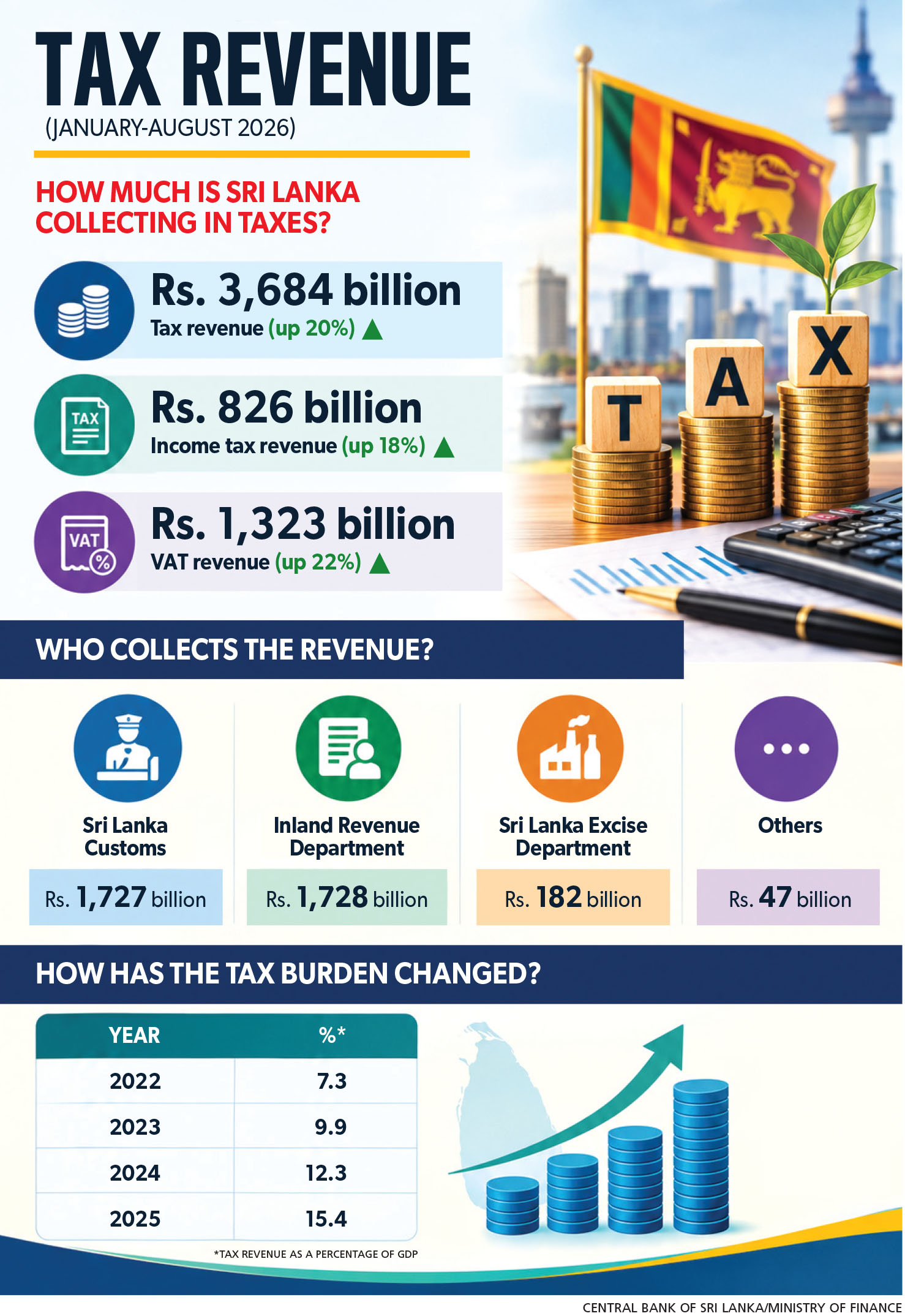
Tax revenue rose by nearly 20 percent year on year to Rs. 3,684 billion in the eight months ended 31 August, from 3,068 billion rupees a year earlier, reaching 75 percent of the full year estimate of Rs. 4,910 billion.
And income tax revenue grew by 18 percent to 826 billion rupees while VAT collections increased by 22 percent to Rs. 1,323 billion. What’s more, taxes on goods and services generated 2,367 billion rupees – up from Rs. 1,939 billion a year earlier.
Customs is producing equally striking numbers. Its revenue target for the year is 2,207 billion rupees with collections reaching Rs. 1,853 billion by the end of August – that’s 84 percent of the annual target reached in eight months.
For taxpayers already in the system however, increasing collections can look a lot like a bigger bill.
For those already paying taxes, the system is demanding more and more – more reporting, more paperwork and more proof of compliance
The Inland Revenue (Amendment) Act No. 11 of 2026 has expanded and tightened several compliance requirements.
A five percent withholding tax (WHT) applies to specified service payments to resident individuals whose monthly payments exceed 100,000 rupees – with the scope extended from 3 June to a wide range of professions including IT specialists, writers, photographers, musicians, personal trainers and beauticians.
On the other hand, there are exemptions and reliefs.
Individuals whose only income is from employment and fully subject to Advance Personal Income Tax (APIT) are generally not required to maintain an income tax file or submit returns where no quarterly or final payment is due. The relief also covers those with employment income and interest income of up to Rs. 5,000.
But the existence of some relief does not settle the wider compliance problem.
For taxpayers with straightforward affairs, where employment income is taxed through APIT and bank interest is subject to withholding, the tax is already collected at source.
Requiring taxpayers to furnish WHT certificates, and statements of interest and any other income received, reconcile the figures and reconstruct their tax liabilities should have a clear compliance benefit; otherwise, it risks becoming administration for the sake of administration.
And that is where proportionality matters…
A taxpayer who deliberately conceals income presents a very different compliance risk from an employee who is struggling to reconcile multiple certificates from banks and other financial institutions.
The answer is not weaker enforcement but sharper targeting.
But for those already paying taxes, the system is demanding more and more – more reporting, more paperwork and more proof of compliance.
A Taxpayer Identification Number (TIN) is mandatory for specified activities including opening bank accounts, registering vehicles or land, registering a business and obtaining a credit card.
Enforcement has also been given sharper teeth.
Failure to file a return, register or comply with specified requirements can lead to prosecution following a 30 day notice. A conviction can result in a fine of up to 400,000 rupees, imprisonment for up to six months or both.
But tougher penalties are not the same as tougher action against evasion. And that distinction matters.
It is straightforward to collect taxes from salaried employees, registered businesses and professionals whose income leaves a paper trail. The harder task is identifying income that doesn’t enter the system, assets that aren’t declared and businesses operating outside the formal net.
If enforcement becomes aggressive without becoming more targeted, the most visible taxpayers could simply become the easiest ones to squeeze.
Meanwhile, the tax burden is being felt far beyond income tax.

The strong growth in VAT collections also points to the wider reach of indirect taxation. For households, the impact is felt through the price of goods and services, and for businesses, it becomes another cost to absorb, pass on or cut elsewhere.
Then there’s the perennial question that taxpayers often raise: what happens to the taxes that they pay?
Government expenditure rose by around seven percent to 3,967 billion rupees in the eight months of the year. Recurrent expenditure accounted for Rs. 3,531 billion while capital and net lending amounted to only 436 billion rupees – that’s 25 percent of the full year allocation. Interest payments alone amounted Rs. 1,609 billion.
The government recorded a budget surplus of over 35 billion rupees and a primary surplus of Rs. 1,645 billion during this period.
These numbers do not necessarily suggest that public money is being wasted. But they do expose a difficult reality: a substantial amount of what the state collects is tied up in recurrent commitments and interest payments while capital expenditure – the part expected to build future productive capacity – remains relatively low.
Sri Lanka cannot escape the need for higher tax revenue. But a system that relies on taxpayers who are already visible, documented and compliant risks confusing ease of collection with fairness.
A credible tax regime should make evasion harder, compliance simpler and enforcement more evenhanded – because taxpayers are entitled to ask a basic question: if they’re being asked to pay more, where is the value in return?
Collecting taxes is not the measure of a fair system. What matters is who pays, who gets away without paying and what happens to the money once it is collected.
– Compiled by Prashanthi Cooray