COVERT CLERGY
VIEWPOINTS
FAITH AND ESPIONAGE UNDER RUSSIAN POWER
Sunera Bandara examines Soviet era infiltration, present-day intelligence links and the Russian Orthodox Church’s relationship with state power
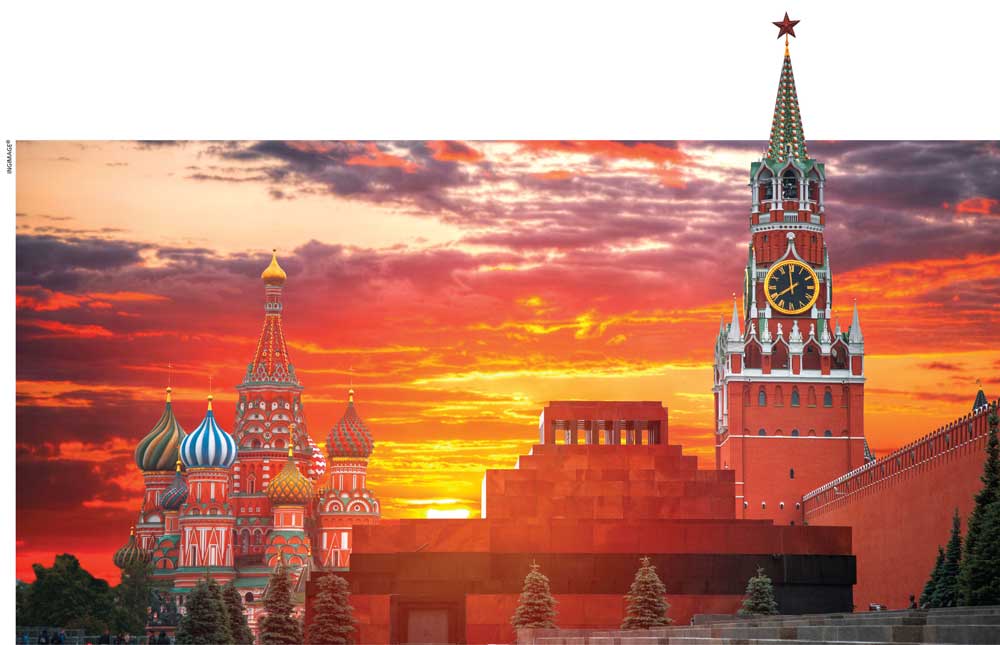
In 1979, the KGB sent an agent codenamed Mikhailov to Geneva – according to official KGB documents brought to MI6 by Vasili Mitrokhin, a Soviet defector. Agent Mikhailov became Patriarch of Moscow in 2009. And Pope Francis called him ‘Putin’s altar boy’ in 2022.
Following the October Revolution of 1917, the Bolsheviks purged the Russian Orthodox Church with politician Vladimir Lenin calling religion “unutterable vileness” – an echo of Karl Marx’s view that religion is the opium of the people.
A decree was subsequently issued separating church from state.
Red soldiers confiscated church valuables and property, a campaign that continued long afterwards and decimated the number of Orthodox parishes from over 37,000 to a few hundred in 1940. However, estimates of the death toll vary. In the first five years, 28 bishops and around 1,200 clergy were executed.
More than 8,000 were killed when famine relief was used as a prerequisite for stealing church property. The Cathedral of Christ the Saviour was dynamited in 1931. Around 168,000 or more religious figures were killed during the ‘great terror.’
Stalin later resurrected the church. This was however, a pretext for a long-range Soviet strategy. By filling the gaps left by dead priests and bishops with his own ideologues, he was able to create a new line of clergymen serving Bolshevism and communist ideals.
In the 1940’s, according to defector Vasili Mitrokhin – who helped release archival data collected over several decades while working within the KGB’s own archives – the Moscow Patriarchate was rebuilt under Stalin as an NKVD/KGB front. From there, clergy were recruited and sent abroad – the World Council of Churches, which was established in Geneva as an ecumenical project, listed 47 of the 49 KGB agents among the Orthodox clergy in Vancouver.
Ion Mihai Pacepa was a former intelligence general in Romania’s Securitate. Following his defection, he stated that there was a usurpation of these ecumenical fellowships between sectarian Christian churches by Orthodox members of the Russian Church clergy, and that they were purposefully sent to these gatherings to subvert, influence and control.
In 1975, agent Mikhailov, who became Patriarch Kirill in 2009, reportedly relayed to the KGB the words: “Now the agenda of the World Council of Churches is our agenda.”
He had joined the World Council of Churches Central Committee after being dispatched to the organisation in 1971. Four years of penetration had effectively allowed Russian intelligence access to one of the West’s most important ecumenical projects at a time when the USSR and other communist nations were actively persecuting Christians.
A July 1983 KGB report, later read by Gleb Yakunin and Lev Ponomaryov in the Fifth Chief Directorate files, regarding the Soviet invasion of Afghanistan exposed the glaring hypocrisy of the USSR in pursuing its ambitions.
Of the 49 Russian Orthodox Church representatives sent to that assembly, 47 were there to prevent two texts: a real condemnation of the Soviet war in Afghanistan and any mention of religious persecution within the USSR.
Looking to the present day, as Russia continues its invasion of the sovereign territory of Ukraine, not much appears to have changed.
In recent years, France 24 reported that 300 metres from Stockholm Västerås Airport was the Church of the Kazan Icon of the Mother of God. It was flagged as a national security risk due to its close proximity to the airport. Upon investigation, it was found that the parish priest who resided there, Pavel Makarenko, had received a SVR loyal medal – the SVR is Russia’s foreign intelligence service.
Pavel Makarenko had a 2021 conviction in Stockholm for accounting fraud, for which he received a suspended sentence and business ban. Säpo, Sweden’s security service (its equivalent of MI5) stated that the Moscow Patriarchate in Sweden was supporting Russian intelligence.
Not much has changed…
In August 2025, Archpriest Kostiantyn Kolodka of Zaporizhzhia, who ran the Holy Spirit Parish in Ukraine, was found by Ukraine’s intelligence service (the SBU) to have been running a GRU 316th Reconnaissance Center network. He was found with a Russian passport and Kalashnikov in his house.
Many would argue that while the KGB has been replaced by the FSB and there has been a disconnect from the former Bolshevik period, Vladimir Putin has changed the wheels, the gears and the toolbox – Russia sings a different song.
But then the question arises: why is there a continuation of state policy at the level of intelligence?
Why are foreign priests being recruited and why are priests connected to the foreign intelligence services still being sent? These are uncomfortable questions that fall at the feet of many admirers of Putin and present-day Russia.
They espouse a deafness when it comes to imperialism projected by Russia but are loud to decry any Western attempts to project its own ambitions and policies across the world.
Internationalism is a fact of life at this point… and no superpower seeks to be a paper tiger.