AI IN THE BOARDROOM
BOTS WRITING BOARD MINUTES
Dr. Muneer Muhamed and Ralph Ward lay out the pitfalls of overusing AI
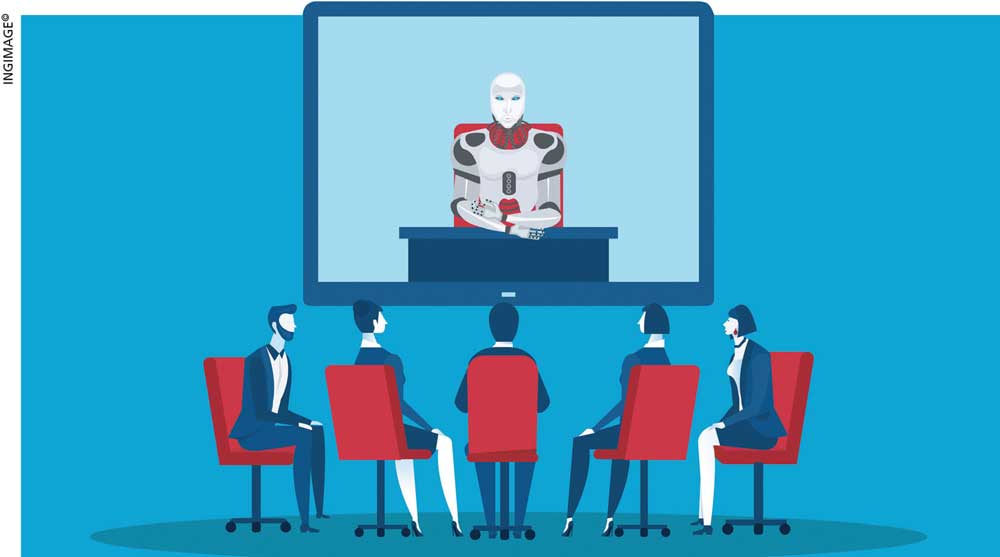
There was a time when board meetings in Sri Lanka involved lukewarm tea and a PowerPoint presentation that no one had fully read. Today, AI (or several confused conversations about it) has entered the discussion.
Understanding what artificial intelligence does for enterprise governance isn’t clear to many directors and the arrival of Generative AI (GenAI) only deepens the confusion. Many directors now nod thoughtfully whenever AI is mentioned, in the same way people do at a wine tasting event they don’t necessarily understand.
To be fair, GenAI does sound intimidating. It refers to machine learning systems capable of creating new content from existing data: text, images, code, predictions and so on. Unlike traditional software, GenAI produces – and this has thrilled boardrooms because directors always loved anything that produces stuff without requiring another committee.
Tools such as ChatGPT can summarise reports, identify governance risks, suggest strategic actions and digest mountains of corporate data in seconds. For directors who previously required three subcommittees and two awaydays to reach a conclusion about office parking, this feels revolutionary.
Globally, AI is already being used for governance and oversight.
HSBC uses it for risk management, JPMorgan Chase deploys it for fraud detection and BlackRock deploys it for portfolio governance. Somewhere in Colombo meanwhile, a director is still struggling to unmute himself on Zoom while confidently discussing digital transformation.
Banks, conglomerates, telecom companies and even family businesses are beginning to flirt with AI powered dashboards and predictive analytics. Compliance monitoring that once took weeks can now happen in real time. AI can flag suspicious transactions faster than a committee member saying that ‘this deserves further discussion.’ Risk analysis is quicker, cleaner and less dependent on anyone.
So is there anything that artificial intelligence can’t do?
The answer is ‘yes!’
AI still struggles with ethics, politics, cultural contexts and that uniquely Sri Lankan management style where nobody openly disagrees during meetings but aggressively complains afterwards in the corridor.
It can analyse patterns beautifully but can’t yet interpret the meaning of a chairperson saying ‘interesting point!’ – in a tone that clearly means ‘please never mention this again.’
But the greatest comedy that may be unfolding is taking board minutes as preparing them is an exhausting ritual. A corporate secretary takes frantic notes while directors speak in long sentences designed to avoid accountability. Meetings are recorded, notes are compiled, edits are negotiated and eventually, a polished version emerges.
Then somebody thought: ‘Why not hand the whole mess to AI?’
And thus began the age of AI generated board minutes. Recordings can now be uploaded into systems that automatically produce summaries, resolutions, action points and governance recommendations.
Corporate secretaries feel this is liberation and lawyers see a future billing opportunity because board recordings are essentially legal landmines. The more companies record meetings, the risk that someone forgets to delete them later increases. When WhatsApp voice notes mysteriously resurfaced during a family dispute, confidence in digital hygiene reduced notably.
Then there is the issue of AI hallucinations…
AI’s potential is undeniable
This is the industry term for artificial intelligence when it simply invents things. Imagine approving minutes stating that the board unanimously endorsed an acquisition strategy nobody actually discussed or discovering that AI interpreted ‘we should explore this carefully’ as ‘immediate implementation is approved.’
The real danger is subtle complacency.
Once boards become comfortable with AI generated minutes, they tend to skim over them quickly – and approve them mechanically. After all, if a machine wrote it, surely it must sound intelligent and be true?
There is also the possibility of every director generating personal AI summaries from the same meeting recording. So one meeting could produce six different versions of reality.
AI’s potential is undeniable. Used carefully, it can greatly improve governance. It can also surface risks faster, analyse trends more intelligently and free boards from mountains of administrative clutter. And indeed, companies embracing artificial intelligence thoughtfully may gain a competitive edge.
But governance was never purely about efficiency. Boards exist because judgement, ethics, context and experience matter. AI is still unable to do any of that yet.
So boardrooms in Sri Lanka now face a delicate balancing act: if you barely use artificial intelligence, you risk irrelevance; but use it too much, and your annual report may eventually contain strategic priorities written by a hallucinating algorithm with impressive grammar, which might still be clearer than some board papers today.