
ENGINEERING SERVICES

PROJECT MANAGEMENT
COMPILED BY Yamini Sequeira
TURNING PLANS INTO VALUE
Hasith Prematillake urges engineering firms to pursue disciplined execution

The engineering and project ecosystem is moving towards selective investments, with an emphasis on commercial viability, operational efficiency and long-term performance.
Hasith Prematillake asserts that successful project delivery will depend on how effectively businesses integrate technology, sustainability and sound commercial judgement into their investment decisions.
“Clients want their projects to deliver energy security, reduce operating costs and support growth. This changes the engineering brief and digital transformation – in addition to environmental, social and governance (ESG) considerations – must cover the complete asset lifecycle from design, financing, procurement and construction, to operations, maintenance and eventual decommissioning,” he states.
Commercial viability and reliable lifetime performance are also essential, Prematillake adds.
“Financing certainty is another decisive factor in project execution. Financing, procurement, approvals and timelines are an interdependent chain – they add value and affect delivery. Delayed approvals increase interest costs and postpone revenue,” he explains.
Prematillake also notes that “secured funding, critical approvals and realistic procurement schedules before mobilisation, with clear payment terms and appropriate risk allocation, are key.”
Beyond completing projects on time and within budget, organisations must demonstrate that investments deliver measurable economic benefits. Prematillake stresses the importance of linking project objectives to business strategy and tracking performance beyond commissioning.
“Every project needs a business case aligned with organisational strategy and measurable operating outcomes, such as lower energy consumption, increased production output or reduced downtime,” he maintains.
And he adds: “Governance, digitalisation and change management should be embedded throughout delivery with benefits measured against an agreed baseline. An investment succeeds when operating performance fulfils its business case.”
Prematillake believes that inefficiencies originate in management practices and coordination rather than a lack of technology or capital.
He elaborates: “Productivity suffers when people wait for decisions, materials, information or access to work fronts. Rework and poorly coordinated subcontractors further reduce output. Management must align people, processes and technology around common objectives, supported by ownership, continuous improvement and data driven decisions.”
Better planning, standard procedures and clear accountability should, in his view, precede capital investment, since expensive assets can remain underutilised when processes are inefficient.
LEADERSHIP GAPS The loss of experienced engineering professionals to overseas markets presents another challenge for the industry.
“Losing experienced engineers affects more than the headcount; it removes the judgement needed to resolve site problems, coordinate disciplines and nurture younger colleagues. Retaining talent is a strategic business imperative that sustains competitive advantage,” he muses.
Competitive remuneration, credible career progression and complex assignments are important for retention, alongside mentoring, documented engineering standards and succession planning. Overseas partnerships and returning professionals can supplement specialist expertise.
As projects become more multidisciplinary and tech driven, engineering leaders need to combine technical knowledge with commercial and people management capabilities.
“They must understand cash flow, contractual exposure and how decisions in one discipline affect another. Stakeholder negotiation, timely escalation and the ability to lead diverse teams are equally important,” Prematillake explains.
Leaders also need digital literacy to question assumptions and assess data quality, while remaining accountable for safety, quality and engineering decisions. Developing these capabilities requires collaboration between industry and education providers.

Prematillake says that universities and vocational institutions should work with employers to ensure that classroom learning translates into practical competence: “Industrial placements, practising engineers, and training in systems integration, commissioning, automation and commercial project management can prepare the workforce for complex assignments.”
“Industry bodies can reinforce competency standards while employers provide supervised experience and recognised progression pathways for technicians,” he urges.
DIGITAL INTEGRATION Digitalisation, building information modelling (BIM), AI and data analytics are reshaping project management, although adoption remains uneven.
“Software costs, skills gaps, resistance to change and fragmented information flows impede implementation,” Prematillake says.
He calls for integration across design, procurement, project management and finance systems, supported by shared data standards. Artificial intelligence can assist with analysis and documentation, provided its use is subject to competent review, traceability and information security safeguards.
“Start with operational bottlenecks and measurable targets, simplify processes, integrate systems and train employees. Clear accountability, reliable data and cybersecurity must underpin implementation with successful pilot projects scaled up once their value is established,” he recommends.
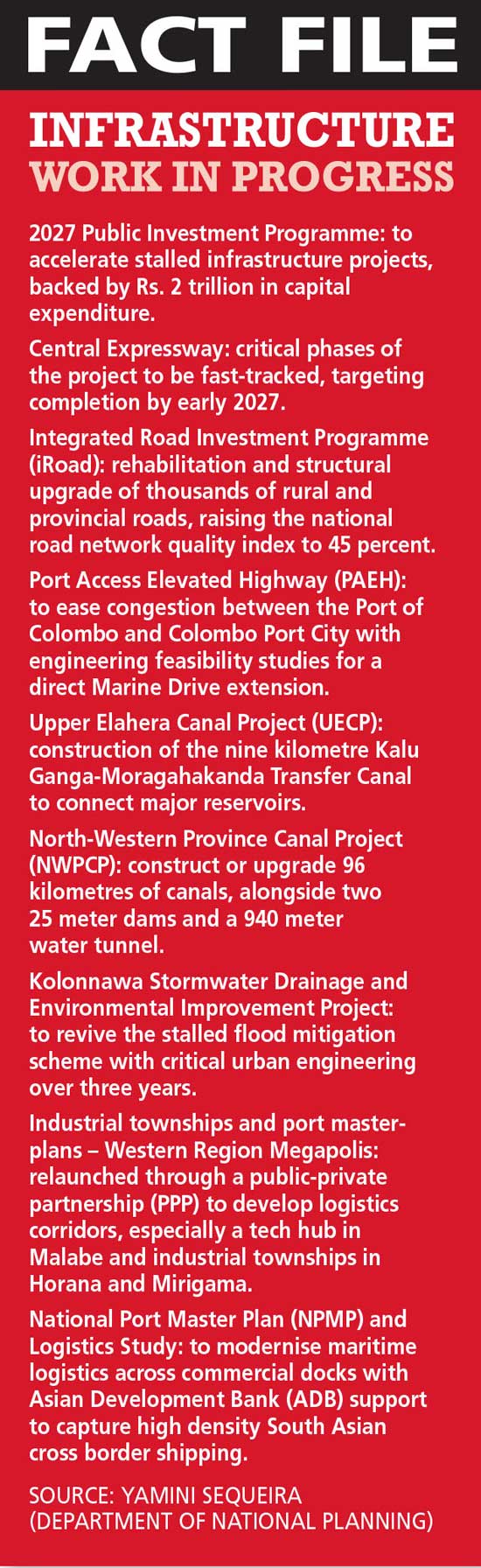
PROJECT ECONOMICS The next phase of growth will require infrastructure that removes constraints across multiple industries.
Prematillake identifies reliable electricity networks, renewable energy generation supported by storage, efficient freight connections and industrial zones with dependable utilities as priorities.
Cold chains and water infrastructure can strengthen agricultural value addition while digital connectivity could support services exports.
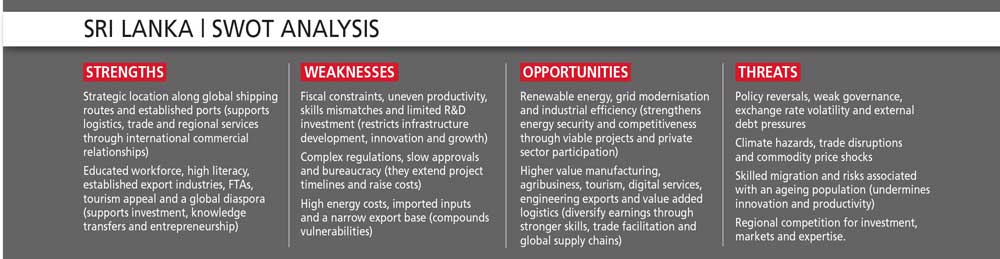
However, project economics remain under pressure from electricity costs, imported equipment and materials, financing requirements and logistical inefficiencies. And exchange rate movements expose budgets to uncertainty while approval delays tie up capital.
Prematillake advocates greater utility efficiency, competitive energy procurement, simpler customs processes and predictable approvals. Stable tax regulations and stronger contract enforcement would help investors assess risks and secure financing with greater confidence.
“Corporate leaders must balance financial performance with investments that may take years to deliver returns. They should adopt a portfolio approach, supported by strategic objectives, staged funding and measurable milestones. Essential investments in skills, technology and systems should be protected even during difficult periods,” he notes.
And sustainability must be assessed through the economics of the entire asset lifecycle.
He continues: “Evaluate the total cost of ownership including energy, maintenance, replacement and disruption risk. Efficient equipment and resilient designs can justify higher initial expenditure through lower lifetime costs, provided assumptions are tested against realistic tariffs, utilisation and financing costs.”
Climate risks should also be incorporated at the design stage with additional improvements phased in where necessary.
DISCIPLINED EXECUTION Engineering and project management can help the country move towards higher value industries, and stronger export competitiveness. Prematillake cites opportunities in process design, automation, quality control, dependable utilities and technical services that sustain operating performance.
He believes local companies can also export designs, BIM and specialist engineering services, provided they demonstrate recognised standards, reliable delivery and expertise.
“Over the next five to 10 years, disciplined execution will be essential to competing with regional and international organisations. This requires professional project governance, stronger middle management and decisions based on reliable operating data,” he underscores.
Moreover, Prematillake states that companies should benchmark output per employee, asset utilisation and quality against relevant international peers.
“National reforms must support predictable regulations, competitive utilities and industry linked education, while management incentives should reward sustained productivity and customer outcomes alongside profitability,” he sums up.
Over the next five to 10 years, disciplined execution will be essential to competing with regional and international organisations
The interviewee is the Managing Director of Hayleys Fentons.