
EXPORT SECTOR

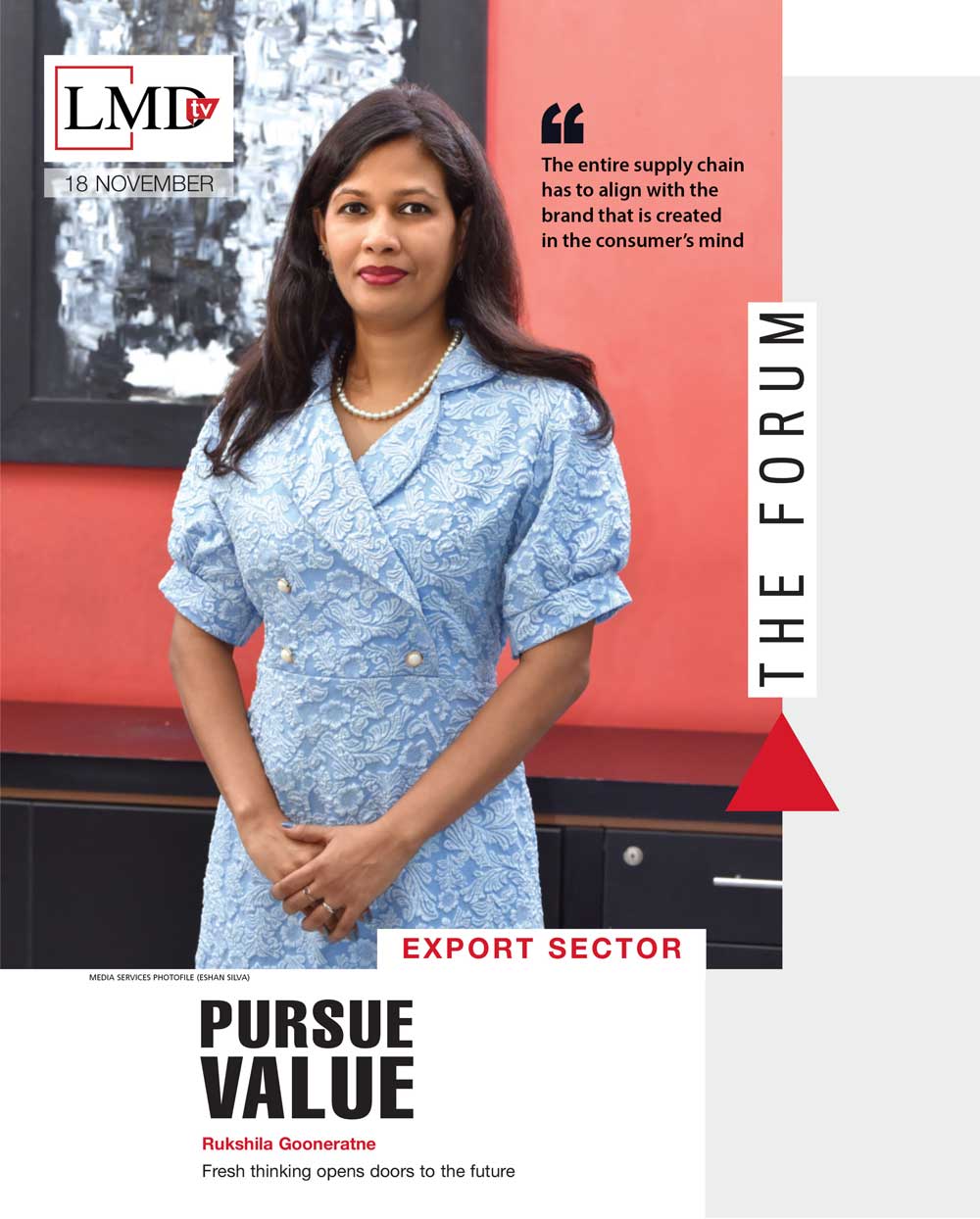
Sri Lanka’s export strategy has focussed on volume for too long. The need to adopt a value based approach is becoming increasingly urgent as the country targets US$ 36 billion in export earnings by 2030.
The target is ambitious but not unrealistic, according to the Operations Officer of the Country Management Unit of the International Finance Corporation (IFC), the private sector arm of the World Bank Group.
Speaking to LMDtv recently, Rukshila Gooneratne highlighted the need for a transformational shift in how Sri Lanka grows its exports.
“Countries that have achieved such a transformational shift in exports – and achieved and sustained double digit growth – offer three lessons: connection; competitiveness and financing,” she noted.
Connecting to global value chains is key, Gooneratne explained, adding that “producing everything locally doesn’t make sense; we cannot compete on that basis.”
This involves attracting export oriented foreign direct investment (FDI), integrating local corporates into multinational supply chains and identifying goods that the nation can import, competitively add value to and re-export, she asserted.
Gooneratne continued: “Given the geopolitical incidents that have disrupted supply chains globally, many international firms are seeking more resilient supply chains and looking for alternative locations to produce. Can Sri Lanka be one of those alternative locations?”
Improving competitiveness is another priority, she reiterated: “This means ensuring that our exporters have an enabling environment so they can effectively compete on a global scale.”
This includes ensuring that the cost of electricity is affordable, reliable and accessible to all. And it involves having predictable policies and greater operational efficiencies, including fewer delays in customs clearance.
Thirdly, ensuring that export oriented businesses have access to financing options is crucial.
Gooneratne pondered: “If an exporter has an order book of US$ 1 million but working capital finance only to the limit of 300,000 dollars, how does it bridge that gap? We need financiers who can provide supply chain finance or pre-shipment financing to help such exporters reach their global audience.”
In addition to strengthening connections, competitiveness and access to finance, it is important to ensure that the country’s services sector also delivers greater value.
“We have tourism, ports, logistics and other professional services that can contribute to Sri Lanka’s export journey,” she pointed out.
And Gooneratne elaborated: “Tourism can be transformed into high value tourism. Ports and logistics can be shifted to transform Sri Lanka from being a transhipment hub into a [maritime and] logistics hub.”
For a small island nation, the case for moving from a volume based approach to a value based approach is clear.
“The country cannot compete on volume because much larger countries have economies of scale and can compete on cost. Therefore, we must offer greater value and capture premium markets,” she maintained.
Sri Lanka has prioritised spices as a key export segment, which Gooneratne justified given the island has long been known as a destination for spices. “We have the comparative advantage and excellent products – and we need to leverage them,” she emphasised.
“We have products that we can market well; what’s required is to get these products out into the market to tell our story,” she added.
To this end, Gooneratne cited the case of Ceylon Cinnamon: “Raw cinnamon is a premium export product. If we process it to create value added products – for instance, essential oils – we then move to the next level. However, for this we need to create brands, and ensure traceability, consistent quality, sustainability, intellectual property rights and proprietary ownership.”
“We need to ensure that the entire ecosystem is aligned. The entire supply chain has to align with the brand that is created in the consumer’s mind,” she summed up.
“The country cannot compete on volume because much larger countries have economies of scale and can compete on cost”