DISASTER MANAGEMENT
REBUILDING IS A COSTLY BUSINESS
Fazmina Imamudeen assesses the rising cost of natural disasters in Sri Lanka
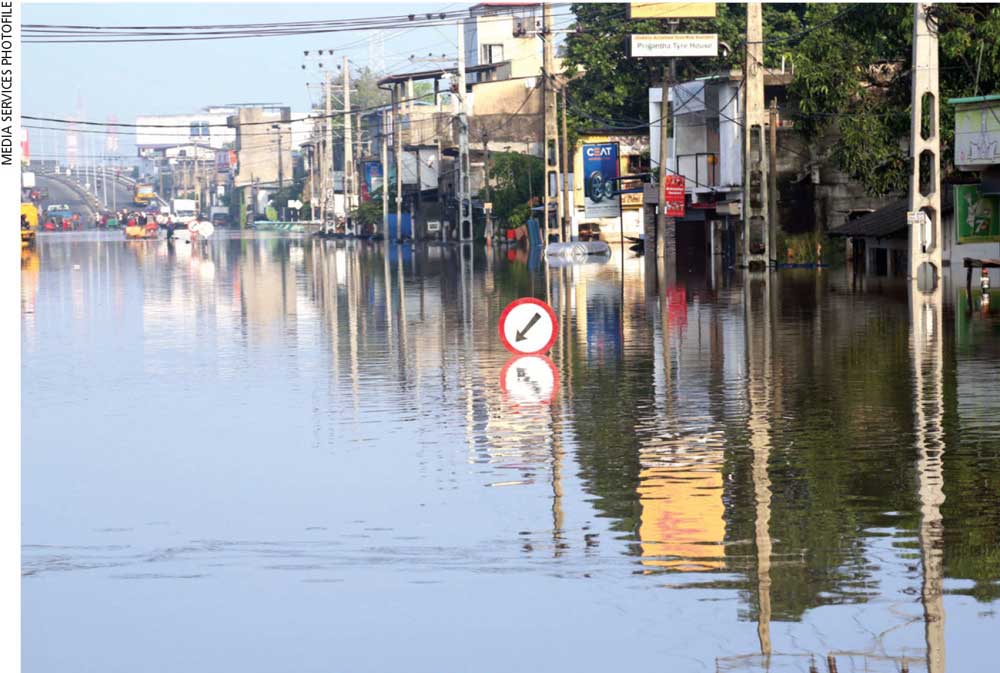
Sri Lanka’s disaster bill is becoming an increasingly important part of its economic story. Cyclone Ditwah caused an estimated US$ 4.1 billion in physical damage, equivalent to around four percent of the country’s GDP.
Yet, this figure captures only one event in a country that’s regularly affected by floods, landslides and droughts. Each disaster brings its own reconstruction price while the financial consequences of earlier events may still be unfolding.
Though the cost of damaged buildings, roads and other infrastructure can be estimated, the broader economic consequences are harder to quantify. Disruptions to agriculture, transport and business activity can reduce production and incomes with effects that may continue well beyond the initial disaster. These indirect losses add to the overall financial burden and complicate efforts to measure the full economic impact.
For Sri Lanka, the timing makes this particularly significant as it is still working to consolidate its recovery from the economic crisis of recent years.
Public finances remain under pressure and the government must meet existing obligations while responding to new demands. Disaster recovery adds another layer of expenditure to this already complex picture.
The government’s response to Cyclone Ditwah illustrates the scale of the commitment involved.
A supplementary allocation of Rs. 500 billion was made for reconstruction and recovery, alongside assistance for affected households, businesses and agricultural producers. International development partners also committed funding for recovery including infrastructure rehabilitation.
Such support is necessary to restore damaged assets and economic activity but it also demonstrates how a single disaster can require substantial financial resources within a short period.
The challenge is that this expenditure rarely occurs in isolation. So far this year, drought conditions have added further pressure on agriculture and water supplies, and created additional concerns about crop losses, irrigation and food production.
Floods and other adverse weather events continue to affect communities and infrastructure. While the nature and scale of each event differ, their financial consequences can overlap and complicate decisions about how public funds are allocated.
There is also a distinction between the cost of damage and recovery.
An estimate of physical damage measures the value of assets affected; it doesn’t necessarily represent the amount required to restore them fully or compensate for wider economic losses.
Reconstruction may involve replacing infrastructure to higher standards, restoring livelihoods and supporting affected sectors. Consequently, the total financial requirement can differ considerably from initial damage estimates.
Moreover, the amount allocated for recovery doesn’t necessarily reflect actual spending or progress. Funds must be translated into completed projects while the financial and economic impacts of disasters can persist for years.
The longer-term concern is the cumulative burden.
Resources used to repair damage can’t simultaneously be directed towards every other development priority. At the same time, leaving damaged infrastructure and disrupted livelihoods unaddressed can prolong economic losses.
Therefore, reconstruction and prevention exist within the same financial equation, competing for resources while serving different purposes.
Disasters are often treated as exceptional events, which are followed by emergency relief and a period of rebuilding. For Sri Lanka, their recurrence makes that distinction increasingly difficult to sustain. The cost of any single event matters but so does the frequency with which the country must absorb such costs.
The central question is no longer limited to how much a disaster destroys; it’s also about how repeated losses affect a nation’s ability to finance a recovery while continuing to meet its wider economic needs.
As Sri Lanka rebuilds after one event and faces the consequences of another, the financial burden of disasters is becoming part of the broader challenge of achieving a stable and sustainable recovery.
Resources used to repair damage can’t simultaneously be directed towards every other development priority