
MAINTAINING CONFIDENCE

and any bank could be next
Sanath Manatunge
Q: Recent financial fraud and cyber related incidents may be des-cribed as isolated by some but they can undermine confidence in the entire banking system. How concerned are you about the reputational impact on the sector – and how does one measure the risk of recurrences?
A: The concern is warranted. Banking runs on trust and that trust is shared across the entire sector.
When an incident makes headlines, customers and the public don’t separate one bank from another. Public concern is therefore understandable and we take the reputational impact seriously.
However, perceptions must be separated from fundamentals. The sector remains well capitalised, liquid and closely supervised. The recent incidents did not reveal a systemic failure and posed no threat to customer deposits or the integrity of the financial system.
And the amounts involved are not substantial compared to the sector’s capital buffers and asset base.
‘Isolated’ is not a reason for complacency. The term describes the nature and scale of these incidents, not their importance. Every incident is a lesson for the sector as a whole. Banks are actively strengthening their defences against emerging threats through investments in advanced fraud risk management systems, more rigorous monitoring protocols and independent forensic audits.
When a peer institution suffers a serious incident, the right response is solidarity and collective vigilance, not opportunistic marketing
While banks continue to strengthen their controls, customers also have an important part to play. Many phishing related incidents succeed despite strong controls because the safeguards are bypassed through a customer’s own actions.
Customer vigilance therefore, remains an essential line of defence alongside a bank’s safeguards.

Misinformation can do as much damage as the incidents themselves. Inaccurate and false social media content often spreads faster than the facts, so prompt and factual communication is essential to protect confidence.
The shift is from reactive to predictive. No single metric captures the risk of recurrence. Rather than relying solely on counts of past incidents, banks can consider predictive risk intelligence that combines several indicators.
Forward-looking indicators include tracking incidents by type and frequency over time so that growing trends become visible early rather than after the fact, and monitoring the growing sophistication of phishing and social engineering campaigns, both locally and globally.
Other measures include stress testing digital infrastructure against emerging global threat vectors and using cyber risk quantification to express potential cyber losses in financial terms.

Assurance indicators include the time taken to detect and contain cyber incidents, as well as findings from penetration tests, red team exercises and audits. The aim is to anticipate the next threat, not simply to counter the last one.
Q: When a serious lapse occurs at one institution, what responsi-bility do other banks have to re-assure the public without appearing to downplay the potential repercussion of such incidents?
A: Loss events and the threat landscape should not be areas of competition in the banking sector. Overall risk management, good governance, cybersecurity and related matters are shared concerns across the sector as a whole.
When a peer institution suffers a serious incident, the right response is solidarity and collective vigilance, not opportunistic marketing. A loss of confidence rarely stays in one place and any bank could be next.
Public reassurance works best at sector and industry level. The public should hear one consistent voice. Through bodies such as the Sri Lanka Banks’ Association (SLBA), working with the Central Bank of Sri Lanka, the sector should deliver a clear, factual and coordinated message rather than competing messages to maintain public trust.
Credibility depends on candour. Acknowledging the seriousness of an incident makes reassurance more believable, not less. No bank should present itself as being immune to such risks, as every institution faces the same evolving threats.
Each bank also has its own part to play: reviewing its controls against what happened elsewhere, closing any similar gaps and being ready to explain its safeguards clearly to customers.

Such incidents also provide an opportunity to reinforce customer awareness of safe digital banking practices. In simple terms, as a sector, we should implement controls based on ‘lessons learnt.’
Reassurance must rest on facts, and point to concrete protections such as multifactor authentication, fraud monitoring and strict regulatory oversight.
Q: How much information should a bank disclose following a fraud or cyber incident, particularly when investigations are ongoing and premature disclosure could create further risks?
A: This is one of the hardest judgements in crisis management and there is no rule or formula.
Customer trust is earned through how we respond. No institution can guarantee that it will never face an incident. What customers judge is whether the response is swift, transparent and responsible.
One guiding principle is that customers should hear about an incident from their bank first. They should not learn about it from social media or other third parties, and nothing the bank says should later prove to be untrue.
Banks compete fiercely on products, pricing and service but there is broad agreement across the sector that we do not compete on security
However, achieving this every time presents challenges.
When an incident occurs, a bank must establish the facts, assess the impact and weigh legal, operational and regulatory considerations while ensuring its communication informs customers without causing unnecessary panic.
Balancing speed with accuracy and transparency with responsibility is never easy.
In a digital environment, news can sometimes travel faster than the process allows. When this happens, our focus is to communicate quickly, factually and consistently, so that customers know what’s happened and what they need to do.
Banks should promptly disclose what is known with confidence – i.e. the nature of the incident, whether customer funds or data are affected, the actions being taken and what customers should do.
Where facts are still being established, banks should say so plainly and avoid speculation. A brief, timely and factual statement followed by regular updates is better than a perfect statement that arrives too late.
However, operational details should be held back while investigations are ongoing. These include how an attack or fraud was carried out, the bank’s detection capabilities and the direction of the investigation. Revealing these details can help attackers, compromise evidence or encourage similar attacks.
And preparation makes this possible. Getting disclosure right under pressure depends on work done in advance – for example, rehearsed crisis communication plans, pre-approved disclosure templates and clear feedback channels to listen to customers, respond to their concerns and rebuild trust.
In addition to customer disclosures, banks must strictly adhere to Central Bank regulations, which mandate the reporting of IT and cybersecurity incidents to the regulator within defined timelines.
Q: Do local banks share enough information about emerging fraud patterns, compromised accounts and cyber threats – or does institu-tional competition stand in the way of collective protection?
A: Competition hasn’t been the main barrier. Banks compete fiercely on products, pricing and service but there is broad agreement across the sector that we do not compete on security.
Historically, there was some hesitance to share information, driven more by reputational concerns than rivalry. That mindset has fundamentally shifted.
Defined channels for sharing threat intelligence now exist through the Central Bank and Sri Lanka Financial Sector Computer Security Incident Response Team (FinCSIRT). There is also sector collaboration through SLBA, the Bank CIO Forum and the Bank CISO Forum, alongside informal networks between bank security and compliance teams.

However, more can be done and faster – and the key gaps are speed and detail. Cybercriminal syndicates are becoming more agile and funds now move in minutes through multiple mule accounts across several banks.
Instead of relying mainly on post-incident reports, banks need to exchange live, actionable signals so that transfers can be stopped before funds disappear. These include suspicious accounts and beneficiary details; indicators of compromise such as suspicious IP addresses, phishing domains and malware signatures; and emerging patterns of attack.
Other countries including India, Malaysia, Singapore, Australia and the UK have already moved in this direction. Sri Lanka should follow with the regulator and sector designing the framework together.
Q: As customers are encouraged to migrate to digital channels, what obligation do banks have to ensure that convenience does not come at the expense of security, accessibility or recourse?
A: Convenience must be built on trust. As we champion digital migration, our fundamental obligation is to ensure that our platforms are secure, accessible and accountable, not merely convenient.
Digital platforms must be secure by design with strong authentication controls and device binding, sensible transaction limits, cooling off periods for new beneficiaries, continuous monitoring for unusual behaviour, and clear and timely alerts.

The best security is often invisible. Wherever possible, banks should deploy frictionless layers of protection, such as behavioural biometrics and dynamic transaction limits. These protect customers without adding cumbersome steps to everyday banking while additional checks are reserved for higher risk transactions.
A safe ecosystem is a shared responsibility: banks are responsible for securing their infrastructure and we continuously educate customers on their role in this partnership.
This includes never sharing PINs, passwords or one-time passwords (OTPs), paying attention to security alerts, checking links before clicking, avoiding unofficial channels and using only the bank’s official verified apps. Strong institutional safeguards work best when complemented by vigilant, well-informed customers.
Digital migration must also remain accessible and mustn’t exclude vulnerable customers. The Central Bank’s Financial Consumer Protection Regulations require fair and equitable treatment of all customers, with special attention to the elderly, people with disabilities and those with lower financial literacy.
Intuitive, easy to use digital interfaces and trilingual support can help bridge the digital divide. Assisted digital channels and in-person guidance allow customers to transition at their own pace, ensuring that the push for efficiency does not alienate those who need additional support.
Customers must also be given a choice: those who are not ready to move must not be left behind, so branches and human support remain essential.
Recourse is where trust is really tested.

A seamless digital experience with difficult recourse is a failure. When something goes wrong, customers must be able to reach a real person promptly, at any hour, freeze accounts or cards immediately, and receive a clear, timely and fair resolution in line with the Financial Consumer Protection Regulations.
Q: You have observed that many phishing related incidents do not originate from vulnerabilities within banks. But if individuals exploit the banking system to receive, move or withdraw proceeds, where does the bank’s res-ponsibility begin… and end?
A: Phishing incidents mostly originate outside the banking system.
The initial compromise typically occurs through cloned websites, malicious apps or social engineering that are well outside the bank’s own systems.
Most succeed despite the controls already in place. Fraud usually occurs because these safeguards are bypassed through customer’s own actions. Examples include sharing OTPs sent to their registered mobile number or email addresses, disclosing PINs or passwords to fraudsters, clicking unverified links in unsolicited messages, downloading apps from unofficial sources and ignoring security alerts.
Strong institutional safeguards work best when complemented by vigilant, well-informed customers
No security control can fully protect an account once a customer has shared the credentials that unlock their digital apps. Banks consistently remind customers never to share their PINs, passwords or OTPs with anyone, including people claiming to be from the bank.
Banks nevertheless play a vital role in disrupting the flow of stolen funds. Although the fraud starts elsewhere, criminals usually depend on the banking network to move the proceeds and banks must act firmly to stop them.
This begins with onboarding through robust know your customer (KYC) checks to prevent criminals from opening accounts and disrupt mule recruitment. Monitoring focusses on accounts that suddenly receive and forward funds, unusual cash withdrawals and behaviour that does not match a customer’s profile.
The response involves freezing funds quickly, coordinating with other banks and the authorities, and working to recover money for victims. Banks also file suspicious transaction reports with the Financial Intelligence Unit (FIU) and support law enforcement.
Bank vigilance can never end. Criminal networks constantly change their methods; therefore, protecting customers requires banks to continually refine their defences in response to the latest criminal tactics.
Q: As digital transactions become the norm, should the standard of protection be that a customer doesn’t need specialist knowled-ge to use digital banking safely?
A: Yes, that should be the standard.
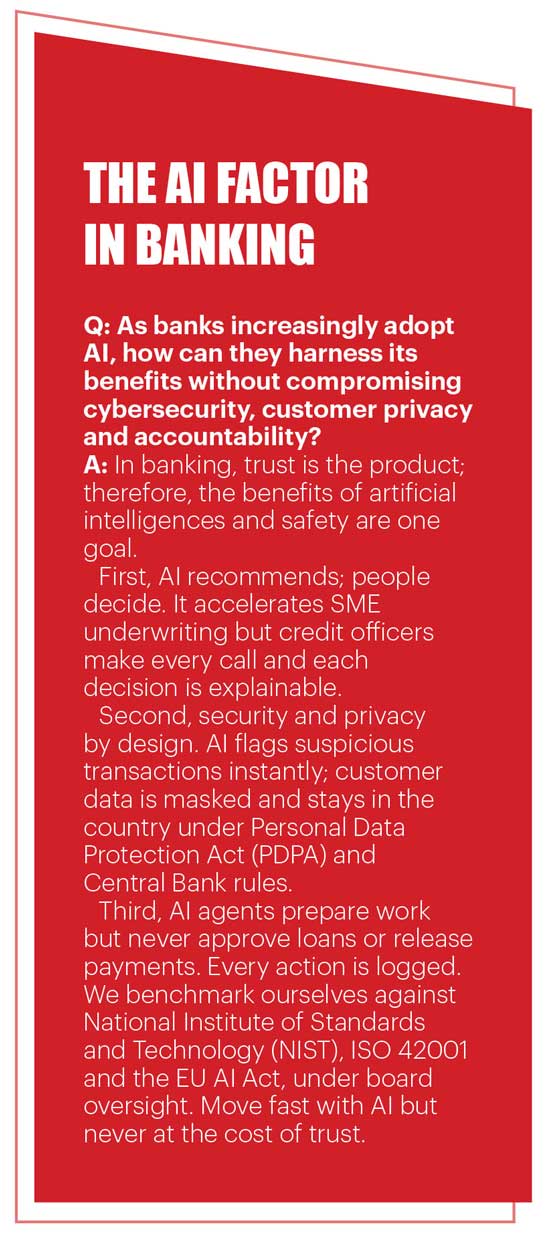
Using digital banking safely should not require specialist knowledge. Safety should be engineered in. Drivers don’t need to understand the science behind brake systems to drive safely because safety is built into the car. Digital banking should work the same way.
No security control can fully protect an account once a customer has shared the credentials that
unlock their digital apps
The bank’s fundamental obligation is security by design: digital platforms must protect customers by default, detecting and as far as possible, preventing suspicious activity before a loss occurs.
However, ‘no specialist knowledge’ does not mean ‘no responsibility.’ Customers still need a few basic habits such as never sharing PINs, passwords or OTPs and staying alert to suspicious messages.
Awareness is a collective responsibility across the sector. Banks and the regulator must work together to make these habits simple, widely understood and regularly reinforced through continuous public awareness campaigns.