CAPITAL MARKET

INVESTMENT FORUM
COMPILED BY Yamini Sequeira
FINANCING FUTURE GROWTH
Harshana Jayaweera calls for an environment that encourages sustained capital investments
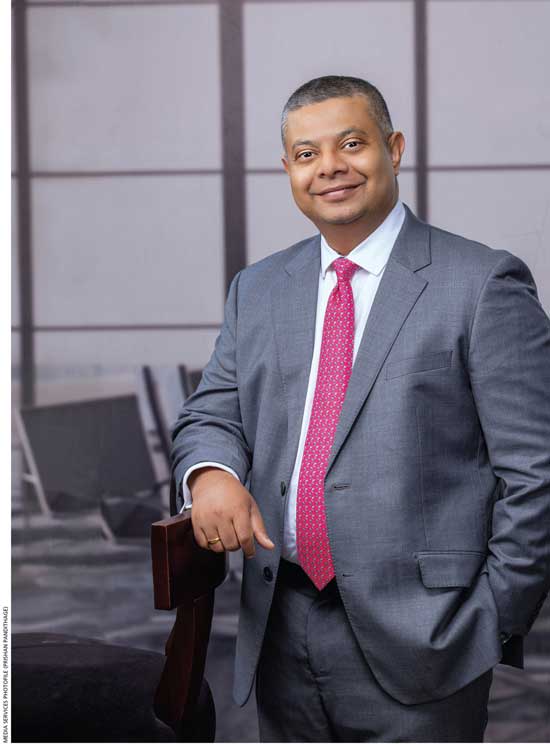
Sri Lanka’s economic recovery is creating fresh opportunities for businesses and investors, although sustaining that momentum requires more than improving economic indicators.
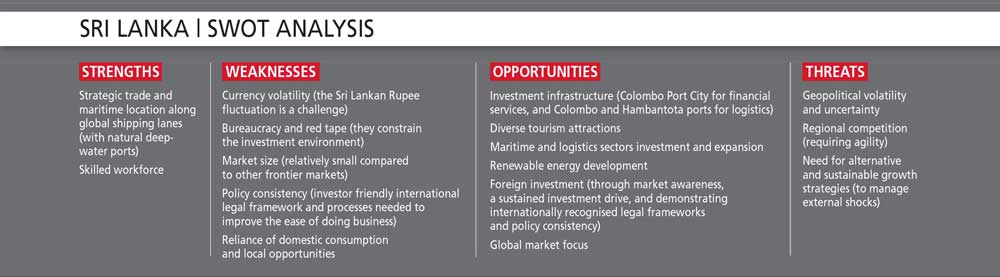
“Resilience, policy consistency, private investment and access to diverse sources of capital will be critical in the next growth phase. The ability to meet debt restructuring obligations from 2028 onwards remains a key domestic consideration,” Harshana Jayaweera cautions.
He continues: “Taking adequate measures to diversify our sources of currency inflows is also paramount to absorbing external volatility such as the uncertainties stemming from the Middle East.”
Nevertheless, he expresses cautious optimism from a capital market and investment banking perspective, pointing out that “many businesses are gradually becoming active in capital markets by raising both debt and equity, as well as mergers and acquisitions.”
INVESTOR CONFIDENCE “Economic fundamentals are only part of the equation for investors. Confidence in the investment environment and policy framework is equally important,” he adds.
Jayaweera commends the steps taken by the government, regulators and relevant authorities, to improve transparency, minimise pilferage and engage actively with investors. However, he believes more needs to be done to create an environment that encourages sustained investment.
“Investors require a cleaner, leaner investment environment and policy stability to sustain confidence. Interest rates are another key consideration for businesses planning investments and expansion. The last 100 basis point increase in the overnight policy rate (OPR) had a cascading impact on capital markets with many institutions revisiting their future growth plans,” he notes.

Jayaweera explains: “Low interest rates are preferred to stimulate growth as external factors such as global energy prices act as a direct catalyst for domestic inflationary pressures. From an investor’s perspective, capital can always be secured but the determining factor will be at what opportunity cost. Therefore, a stable interest rate regime is essential for corporate investments and expansion to thrive.
Private investments will be central to the country’s next growth cycle. Jayaweera identifies technology, infrastructure, manufacturing and energy as key investment pillars capable of providing a foundation for wider economic activity.
“In a frontier economy poised for growth, these pillars can offer attractive propositions for capital deployment, since these sectors provide a solid foundation for pursuing other opportunities,” he asserts.
Jayaweera notes that “Vietnam attracts US$ 150-200 billion in investments, of which over 90 percent is attributable to these investment pillars.”
Within Sri Lanka, the financial sector and large conglomerates are expected to remain relatively strong long-term investment propositions. But opportunities extend beyond these traditional areas.
He elaborates: “Within the previously mentioned investment pillars, sectors such as healthcare, education, technology, tourism and service exports can play a vital role.”
However, he notes that “one key drawback in securing foreign direct investments (FDI) is that the majority of opportunities are purely domestically focussed. Building scale is always a challenge in an economy with a population of approximately 23 million. Domestic scalability is very different for a country such as India with a population of nearly 1.5 billion.”
“As a country, we need to focus on sectors and services in high demand globally while creating a robust investment friendly environment that enables us to cater to multiple global trade partners,” he says.
People remain an important competitive advantage, he emphasises, adding: “Sri Lanka has a highly valued and skilled labour force that can compete with any other country. Addressing these areas can make a world of difference in attracting FDI in the future.”
CAPITAL BASE Sri Lankan businesses have traditionally relied heavily on bank financing. That model is gradually evolving as companies gain access to a wider range of funding options.
“Historically bank financing was the ‘go to’ for corporates and still is in some cases. Sri Lanka has around 30 licensed commercial and specialised banks competing for business from a finite pool of corporates, making it predominantly a borrowers’ market,” he states.
However, regulatory measures are encouraging corporates to explore alternatives.
“With prudent regulatory measures in place, corporates are actively guided towards other sources of capital such as corporate bonds and public equity offerings, as well as structured private debt and equity,” he says.
Jayaweera continues: “This is beneficial in multiple folds. It eases the risk pressure on banks related to single borrower limit requirements, diversifies the lender base and provides access to alternative capital. It also requires stronger governance, accountability and financial self-discipline when public capital is involved.”
For investors, he adds, this creates “risk diversification, price discovery and much needed liquidity.”
GLOBAL SHIFTS Geopolitical tensions, evolving trade relationships, supply chain realignments and technology are rapidly reshaping the global investment landscape. For local businesses, adapting to these shifts will be essential.
“While geopolitical changes are not directly within our control, businesses should be agile to these changes to capture new opportunities stemming from these shifts, especially in the services sector,” Jayaweera urges.
While geopolitical changes are not directly within our control, businesses should be agile to these changes to capture new opportunities stemming from these shifts
What’s more, he notes that “the use of technology and investments in new business avenues will be key differentiators in attracting offshore capital. Armed with these exploring new markets, digital expansion, trade and supply chain diversification will provide an edge for businesses in future.”
Emphasising the role of technology in improving competitiveness, Jayaweera asserts that “what we need to embrace is that efficiency improvements through technology will allow us to expand our businesses, which in turn enables employment growth as well.”
Prudent use of technology will provide businesses with the opportunity and time to think beyond borders, and attract investment by showcasing a compelling strategy for efficient growth.
CAPITAL MARKET As for the capital market itself, Jayaweera sees product diversification as an important next step.
“Traditionally, we’re stuck within a loop covering loans, debentures, and initial and secondary public offerings as capital raising avenues. Therefore, product diversification is a must to create a more vibrant and deeper capital market in Sri Lanka,” he stresses, pointing to credit linked notes, structured products – including yield enhancing and capital guaranteed products – and private listings as potential additions.
He avers that to support new products, relevant stakeholders, regulators, policymakers and legislators need to provide the necessary infrastructure, including adopting international legal frameworks, best practices and market awareness.
“Some gradual progress is being made in introducing a few new products, which is encouraging but there is always room for continuous improvement,” he concludes.
The interviewee is the Chief Executive Officer of NDB Investment Bank.