
ENERGY SECTOR

TAKING THE PLUNGE ON MANNAR’S PROMISE
Prashanthi Cooray examines Sri Lanka’s latest offshore push – and what it could mean for energy security investment
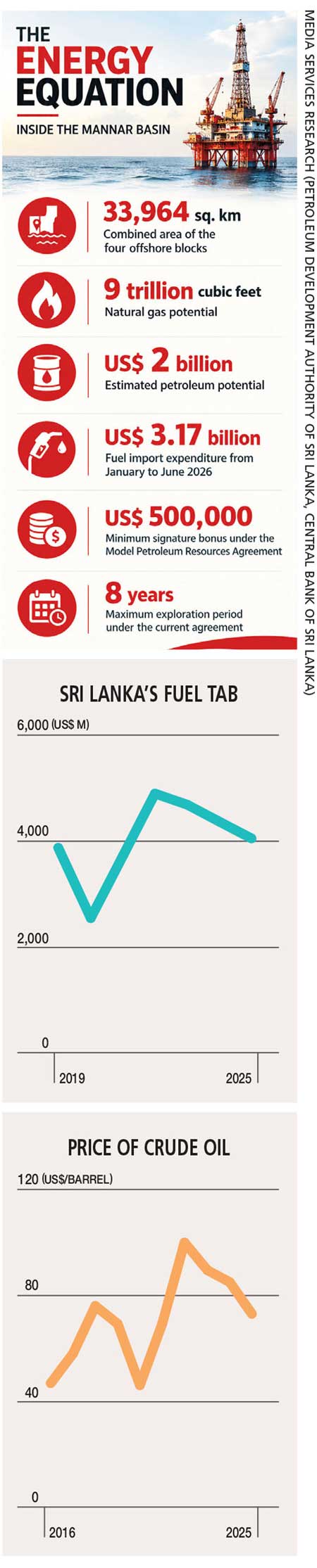
Beneath the waters of the Mannar Basin lies a resource that could reshape Sri Lanka’s energy landscape if exploration confirms its commercial potential. The government recently opened four offshore blocks to international energy companies, covering approximately 33,964 square kilometres and spanning water depths of between 100 and 3,000 metres.
And the numbers attached to the basin are interesting…
Existing geological data indicates potential for around two billion barrels of petroleum and nine trillion cubic feet of natural gas. These figures are estimates of what the basin could hold rather than proven reserves, meaning their eventual value will depend on what can be commercially recovered and produced.
Sri Lanka’s offshore petroleum exploration dates back decades. So although the country has yet to develop commercial oil or gas production, the Mannar Basin has already yielded important findings.
During Cairn Lanka’s exploration programme between 2011 and 2013, four wells were drilled with the Dorado and Barracuda wells encountering gas and condensate. The discoveries provided evidence of a working petroleum system while leaving questions about the scale of the wider basin.
Cairn subsequently exited the Mannar Basin and commercial production did not materialise. The challenges included the technical complexity of deepwater extraction, the absence of domestic gas infrastructure and changing conditions of the international energy market.
The latest licensing round is not a discovery of oil wealth but another attempt to find out whether Sri Lanka’s geological potential can become an investable resource.
For the record, the four blocks range between 5,689 and 11,728 sq. km, with prospective investors able to access geological and geophysical information through the licensing round data room. The bid process closes on 2 February 2027, giving investors a defined window to assess the opportunity and submit their proposals.
The timing is noteworthy from an energy security perspective.
Fuel imports remain a huge drain on Sri Lanka’s external finances. According to the Central Bank of Sri Lanka, fuel imports accounted for around 20 percent of the country’s import bill on average over the past decade.
And cumulative expenditure on fuel imports reached nearly US$ 3.6 billion during the first seven months of the year, up 59.9 percent year on year. In July alone, fuel import expenditure rose by 68 percent year on year to 453 million dollars.
If commercially viable petroleum resources are found, domestic production could have implications well beyond the energy sector. It could reduce imports, improve energy security, generate state revenue. and create demand for supporting services and infrastructure.
The wider economic benefits however, would depend on how much is actually recoverable and the terms under which investors develop it.
There is also the question of how a discovery would feed into Sri Lanka’s energy system.
Given that earlier Mannar discoveries were predominantly natural gas, any commercial find would need to be assessed, developed and connected to the right processing, transport and end-use infrastructure before it could replace imported energy.
How quickly and cost-effectively that infrastructure can be put in place will also matter.
Sri Lanka’s regulatory framework has also changed since the earlier exploration rounds. The Petroleum Resources Act No. 21 of 2021 established the Petroleum Development Authority of Sri Lanka (PDASL) as the country’s upstream petroleum regulator. The legislation also sets out the terms for petroleum resources agreements including how revenue is shared between contractors and the state.
The current round is designed to bring international expertise and capital into that framework.
If commercially viable petroleum resources are found, domestic production could have implications well beyond the energy sector
The bigger question then, is not whether Sri Lanka has oil and gas potential. The evidence suggests that it does. The question is whether that potential can withstand the much harder test of commercial extraction.
For the time being, the Mannar Basin represents an opportunity rather than an economic windfall.
Turning that geological promise into real economic benefits will require successful exploration, investment, viable production, the right infrastructure, and terms that work for both investors and the country.
The four block licensing round is the next step in finding out whether those pieces can come together.