
Sporting LIFE
Farveez Maharoof
READING THE GAME
Natalie Seneviratne traces an evolving journey across cricket, commentary and changing professional roles

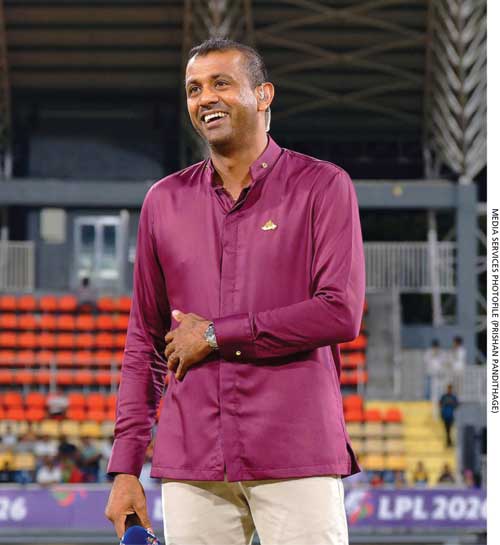
From international cricketer to commentator, Farveez Maharoof has built a second chapter in the sport, bringing his experience on the pitch to the microphone. And before the microphone, the match analysis and familiar voice on international broadcasts, there was a young cricketer learning to find his place in the game.
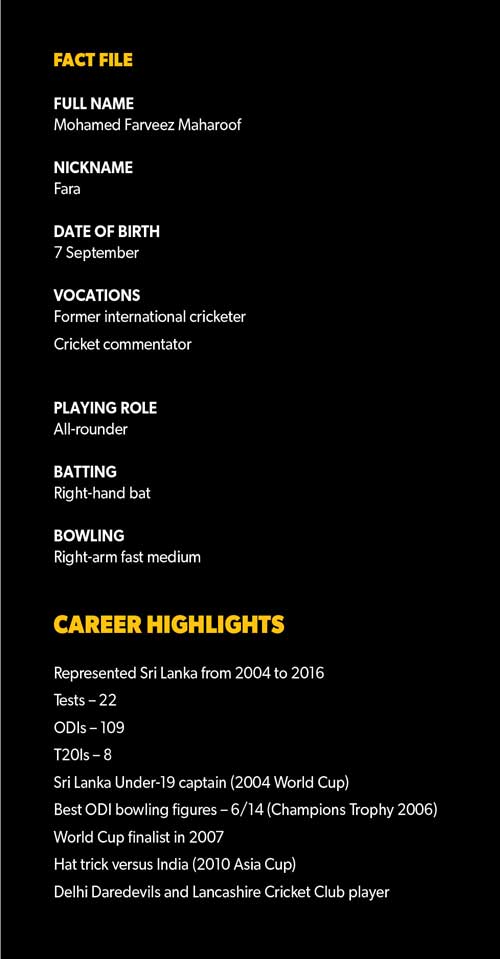
For Maharoof, cricket was never a straight path. He began as a wicketkeeper and batsman before an unexpected six wicket haul at Under 13 level changed the direction of his game and led him towards pace bowling.
From Sri Lanka’s Under-15 and Under-17 sides to captaining the Under-19 team, he worked his way through every representative level before making his senior debut in 2004.
His rise was shaped by more than natural ability.
Growing up, Maharoof describes an upbringing that demanded independence and resilience. After school, he would return home, wash his clothes and prepare for the next day. At 18, a scholarship took him to England, where he lived alone for five months, played club cricket, and worked at the ground as a cleaner, groundsman and barman.
“I went through the grind – and that made me mentally tough,” he says.
And that toughness soon became visible on the field…

At the 2004 Under-19 World Cup, he grabbed 14 wickets in six matches and captained Sri Lanka. His senior breakthrough followed quickly with a five wicket haul on his first tour of Zimbabwe and a Test debut 10 days later.
As an all-rounder, Maharoof developed into a valuable limited overs player. He produced one of the most economical One Day International (ODI) spells against the West Indies in 2005, conceding only nine runs from 10 overs, before recording career best ODI figures of six for 14 against the same side in the 2006 Champions Trophy.
He also took a hat trick against India in the 2010 Asia Cup and became the first Sri Lankan to claim four wickets on a World Cup debut – that was when he returned figures of 4/23 against Bermuda in 2007.
Across an international career from 2004 to 2016, Maharoof played 22 Test matches, 109 ODIs and eight T20Is, while also playing franchise and county cricket with Indian Premier League (IPL) team Delhi Daredevils and Lancashire Cricket Club.
He was also part of the Sri Lankan side that reached the 2007 World Cup final.
Yet, a sporting career is rarely defined only by its high points. Injuries and changes in the national side eventually pushed Maharoof away from the international stage. Rather than viewing that chapter as an ending, he found another way to remain connected to the game.
The transition into commentary began quietly. Encouraged to try expert analysis, he spent around a year and a half providing cricket analysis before moving into school matches, and then club and provincial cricket.
He worked his way through the system again, learning through experience and listening to feedback from friends and critics. “I started from the bottom – all my life, I’ve done the same,” he adds.
That second climb has taken him into international broadcasting, where his experience as a former all-rounder gives him an understanding of the game that goes beyond the scorecard. He was brought in as an expert commentator for Australia’s 2021 tour of Bangladesh, an opportunity that established his presence in international cricket broadcasting.
But the challenge is different when the team on the field is your own.
Maharoof reveals: “When I comment on Sri Lankan matches, my heart and soul is there.”
To Maharoof, professionalism means learning to separate emotion from analysis. He had to adjust to speaking about Sri Lanka rather than saying ‘we’ or ‘us,’ while also learning the demands of facing the camera, delivering pitch reports and building a voice for television.
Today, his role in cricket extends beyond commentary. He has also worked with Sri Lanka Cricket (SLC) in administrative and development roles while remaining passionate about giving back to the game that shaped his life.
“Cricket has given me everything,” he stresses.
It is perhaps why his second chapter feels less like a career change and more like a continuation. The player who once learned to read conditions, adapt to opponents and make decisions under pressure now reads the game from a different vantage point.
And for Farveez Maharoof, the game is still teaching him – except that today, he is helping others understand it too.
I went through the grind – and that made me mentally tough