YOUTH FORUM
Compiled by Nicola Jayasundera
COURAGE IS IRREPLACEABLE
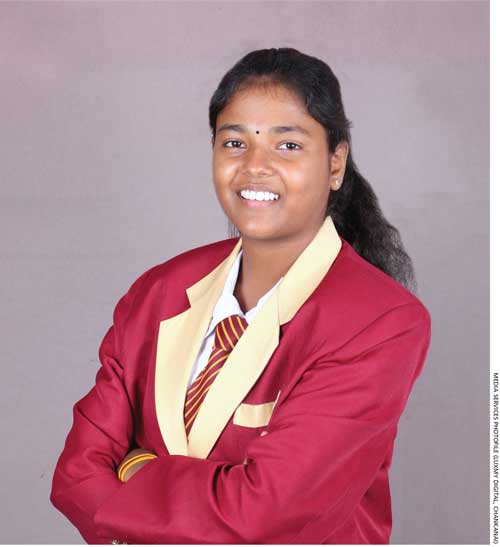
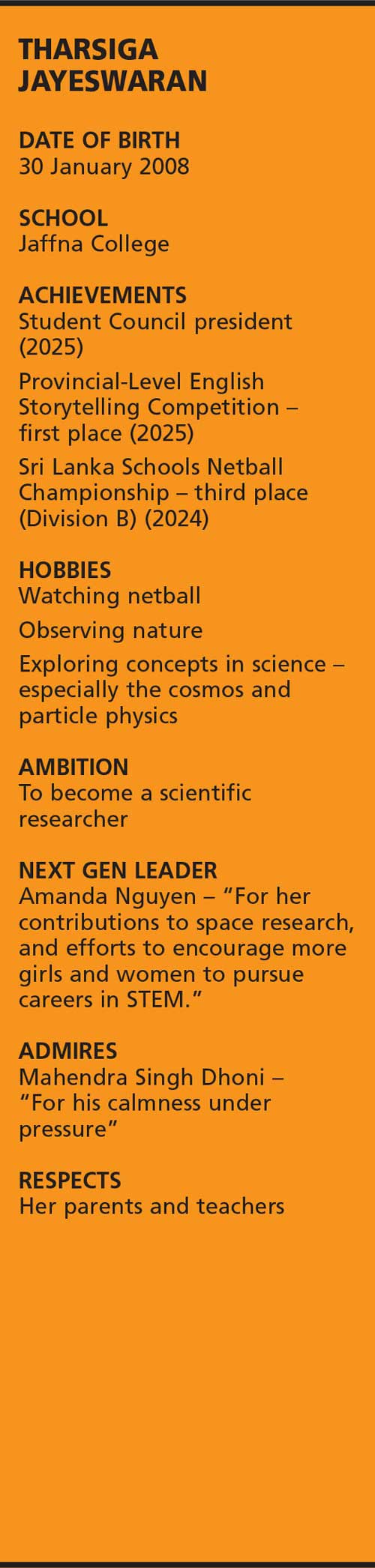
Tharsiga Jayeswaran reflects on challenges and hopes vis-à-vis the future
Q: What’s the good, the bad and the ugly in Sri Lanka?
A: What is good about the country is its breathtaking natural beauty and tourism industry. Even in times of economic crisis, tourism has consistently brought in vital foreign currency, helping to stabilise the country.
The bad is economic instability, rising inflation and debt, all of which affect everyday life.
And the ugly is poor waste management especially in rural areas where garbage accumulates on open land, creating unpleasant odours, pollution and health risks.
Q: And what are the challenges facing the nation at this time?
A: The main long-term challenge is climate unpredictability, driven by the tug-of-war between El Niño and the Indian Ocean Dipole (IOD). These shifting patterns intensify droughts and floods, threatening agriculture and livelihoods.
Another major challenge is economic instability, which disrupts daily life and creates uncertainty. Rising inflation, debt and limited opportunities leave many feeling hopeless, as their dreams of stability and progress are delayed.
As a result, the future feels uncertain for countless families.
Q: What are the challenges facing young people in Sri Lanka today?
A: One challenge facing young people is the overwhelming use of social media. Many spend so much time sharing their daily lives online that they lose focus on their personal goals and ambitions.
Instead of developing skills or pursuing personal growth, they become distracted and their potential remains untapped, leaving many unable to fully pursue educational or professional growth.
Drug addiction is another serious challenge. Some youth turn to substances to escape stress or hopelessness, further derailing their potential. Without proper intervention, it becomes harder to break the cycle and build a positive future.
Q: So how can our youth contribute to national progress?
A: Young people are driving progress through specific strengths. Courage pushes young entrepreneurs to use digital platforms to start e-commerce businesses, taking Sri Lankan products to global markets.
Their curiosity about technology enables them to create solutions. And their optimism and willingness to experiment are essential as Sri Lanka builds a knowledge based economy and forward-thinking society.
Sports has a wide reach among young people, making them a powerful platform for positive change. When youth represent their country at major sporting events such as a world cup, it sparks national pride. Seeing their team succeed on the world stage renews their connection to the nation and motivates them to contribute to its growth.
Q: What type of leadership do you think the world needs right now?
A: The world needs leadership that is truly inclusive – one that draws out the best in each person by valuing their unique skills, experiences and perspectives.
When leaders create an environment where everyone’s contribution is recognised, it unleashes collective potential. By building trust, this leadership empowers each person to play a vital role so that the nation can achieve progress that is broad, sustainable and built on the strength of every individual.
Q: How has the advent of AI and technology shaped your view of the future?
A: Artificial intelligence and technology have expanded my view of what’s possible. They connect me to global knowledge, enabling me to learn and innovate in ways that weren’t imaginable before.
At the same time, they remind me that we must use these tools responsibly, ensuring that technology bridges gaps rather than deepens them. I’m hopeful but also aware of the need for ethical leadership in the future.
Q: As a young person, what are your hopes for and concerns about the future?
A: I’m really hopeful because the Ministry of Education is introducing major reforms from this year, focussing on a new curriculum that emphasises science, technology, engineering, and mathematics (STEM), entrepreneurship and global awareness.
These changes will help students like me gain critical skills and tools for a better future.
My concern is that young people may lose their potential through distractions and missed opportunities. But I’m hoping to use technology wisely, continue learning and work together, to build a healthier and more sustainable Sri Lanka.
Q: And last but not least, if you could launch a project or movement in Sri Lanka, what would it be – and why?
A: It would be one that promotes scientific literacy and environmental responsibility among people so that they naturally make better decisions about their health, environment and communities.
When science becomes part of everyday thinking rather than simply a school subject, small individual actions can create meaningful national change.
When leaders create an environment where everyone’s contribution is recognised, it unleashes collective potential