CORPORATE SUSTAINABILITY
Compiled by Suresh Ginige
LMD EXCLUSIVE LEADERSHIP IS A CONTINUOUS JOURNEY
Sanda Ojiambo explains that a willingness to diversify risk is the hallmark of astute leadership
Q: Leadership is being tested unlike ever before. In your view, what qualities define resilient leaders in an era shaped by uncertainty, disruption and accelerating change?
A: Resilient leaders understand how to respond to adversity, and incorporate this into their business planning, strategy, cost benefit analyses and balance sheets. The world is at such a precarious point that no business can grow infinitely without forward planning. Natural resources, human resource capacity and market certainty are all subject to upheaval.
The first step is understanding risks, incorporating them into strategy and pricing them so they can be better managed. Resilient leaders also know how to diversify and mitigate risk, through different sources of inputs and markets.
They also understand the value sustainability brings to business.
Q: You have worked closely with many CEOs across the world. What differentiates leaders who merely respond to crises from those who build organisations that are capable of thriving through them?
A: Leadership is a continuous journey – even the most astute leaders can face significant challenges. What differentiates resilient organisations is forward thinking, an appreciation of how interconnected the world has become and a willingness to diversify risk.
Businesses must recognise that shocks in one part of the world can affect others, particularly through vulnerable supply chains. They must also look after their workers and supply chains, by means of living wages and responsible environmental management.
Sustainability is increasingly part of the solution. In our annual survey of CEOs, 99 percent said that sustainability makes business sense and is the best way to address global challenges.
Q: Integrity is often spoken about as a personal value. How can CEOs embed integrity into the organisational culture so that it becomes a strategic advantage rather than simply an ethical aspiration?
A: Integrity starts as a personal value but it must become an institutional value. Businesses operate within an ecosystem where they work with many other entities. Individual integrity is important but an entire system is needed for integrity to flourish.
The UN Global Compact’s 10th principle focusses on anticorruption and anti-bribery. Integrity is fundamentally about trust, and is an essential quality for businesses and leaders to engage successfully with customers and suppliers.
Therefore, integrity is essential not only to human interaction but also to protecting value and the public good.
Q: Increasingly, companies are judged not only by what they achieve but how they achieve it. How has stakeholder trust become one of the most valuable assets a business can possess?
A: Stakeholder trust is increasingly reflected in the products and brands companies offer.
Consumers are becoming more active and increasingly ‘vote with their wallet.’ In today’s digital environment, one customer complaint can quickly change perceptions.
This is particularly relevant to industries such as apparel and textiles, where working conditions, how products are sold and fast fashion can influence consumer trust. Businesses need to demonstrate that their operations are ethical and sustainable, that waste is managed responsibly and that workers are fairly compensated.
Trust is also critical in technology. As we adopt rapidly evolving technologies, companies must demonstrate that these are being used for good and not to create harm, bias or divisions.
Q: Looking ahead to the next decade, what leadership mindset will distinguish companies that remain relevant from those that struggle to adapt?
A: Leaders must be progressive and recognise that the value of a business is not confined to its domestic market. Companies must consider what they can produce at scale and who their potential customers could be internationally.
Collaboration will also be essential. Businesses cannot do everything themselves, so building strong supply and value chains is critical.
What differentiates resilient organisations is forward thinking, an appreciation of how interconnected the world has become and a willingness to diversify risk
Leaders must recognise that the private sector has an important role alongside governments and the UN, in creating jobs, supporting SMEs, creating opportunities for women and young people, reducing environmental impacts, and advancing responsible technology.
Ultimately, businesses cannot succeed when society is failing and leaders must contribute to the broader society in which they operate.
Q: If you could leave one message with CEOs across the Asia-Pacific, what would it be?
A: The Asia-Pacific has demonstrated its ability to bounce back from adversity, despite economic disruption, cyclones, heatwaves and other shocks. Its interconnectedness presents enormous opportunities for businesses.
CEOs should leverage regional trade, talent, technology and innovation rather than viewing a country as their only market.
They should also look at their balance sheets not simply as reflections of profit and loss but tools that can drive sustainable business and investment. Digital technology, innovation, sustainable investment and viewing the region as a market are key opportunities.
Sustainable business and profitability are not separate objectives. When sustainability is considered early, it can lead to a more robust workforce, innovative products, stronger market share, resilient supply chains and an improved bottom line.
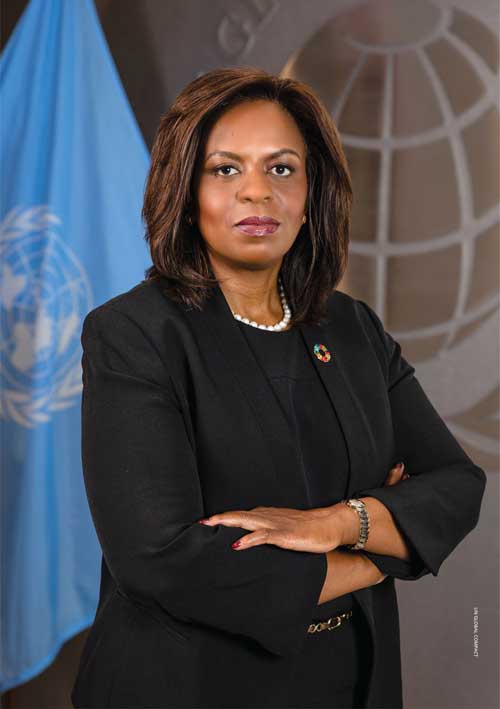
The interviewee is the Assistant Secretary-General of the United Nations, and CEO and Executive Director of the UN Global Compact.