CORPORATE LEADERSHIP
BEYOND THE COMFORT ZONE
Dilmini Weragama
How and why courage shapes growth
You can work as hard as you want but if you’re not working smart, you’re not really getting where you want to go
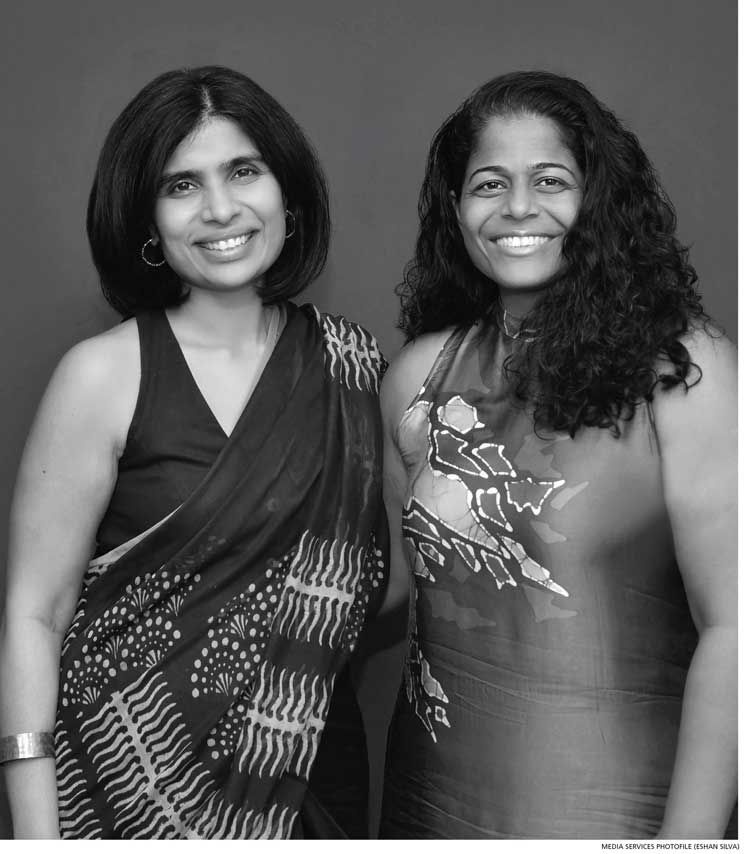
Sapna Seneviratne (left),
with the Group Chief Executive Officer of Rockland Distilleries
Dilmini Weragama (right).
For some, growth begins at the edge of discomfort. And Group Chief Executive Officer of Rockland Distilleries Dilmini Weragama has built a diverse career spanning chemical engineering, supply chain management and corporate leadership – a journey shaped by courage and a willingness to venture beyond the familiar.
This philosophy led her to take on an IRONMAN challenge, despite not considering herself to be a cyclist, runner or athlete. Having watched her husband cycle for years, Weragama understood the physical demands involved and found herself drawn to the very thing that intimidated her.
“I get drawn towards events that make me feel that I don’t have the capability because they push me out of my comfort zone,” she explained, on the inaugural episode of LMD Unscripted.
What appealed to her most was that the challenge was less about competing with others than improving oneself. “It’s not about winning; it’s really about becoming better and beating your personal best,” she explains.
The experience offered lessons that extended well beyond sport. Weragama realised that practice alone does not guarantee improvement if one is repeatedly practising the wrong technique.
She related this to the workplace, observing that “you can work as hard as you want but if you’re not working smart, you’re not really getting where you want to go.”
Teamwork proved equally important. When her bicycle chain broke during the event, her immediate concern was the additional pressure the lost time would put on teammate and Rockland Group Chief Financial Officer Manoj Jayawardena. Thankfully, he reassured her that he’d compensate for the delay.
This demonstrated “the power of working towards uplifting and empowering someone else in your team, rather than focussing on your own advancement,” she noted.
Weragama’s approach to leadership rests on three principles: safeguarding what is precious, challenging what is outdated and building what does not yet exist.
As she said, “our responsibility as leaders is to understand what’s sacred and protect it – and understand what needs changing, challenge it and identify what has not been built… and be fearless enough to start building it.”
Motherhood has also influenced her leadership style, particularly by showing her that individuals cannot be managed in identical manners. Just as no two children respond to the same approach, team members are motivated by different ambitions, personalities and circumstances.
It has taught her to hold seemingly conflicting truths together: “You can be ambitious and wholly present at the same time; you can be compassionate but very demanding; and you can be kind but absolutely accountable.”
Weragama believes that corporate culture must move away from treating employment as a transaction and encourage people to view themselves as contributors. “We need to shift from being an employee to being an architect – an architect of the change you are trying to create, the value you are creating and the culture you want to build,” she urged. While experience reveals where someone has been, she believes that the mindset indicates where that person can go. Curiosity, courage and kindness rank among the qualities she values most, along with “a little bit of rebellious misfit nature.”
She is especially drawn to those who do not fit a conventional mould because differing perspectives strengthen teams. Her greatest satisfaction comes from recognising talent in people before they see it in themselves.
Meanwhile, fear remains even after two decades in corporate life. That said, Weragama’s relationship with fear has changed. “Fear has moved from being a signal to run for your life to information that creates curiosity,” she explained.
And her definition of success extends beyond professional achievements: “A life well lived is one where I am able to become the best version of myself while not letting go of the people and values that matter most to me along the way.”
– Transcript compiled by Tamara Rebeira