LMDtv
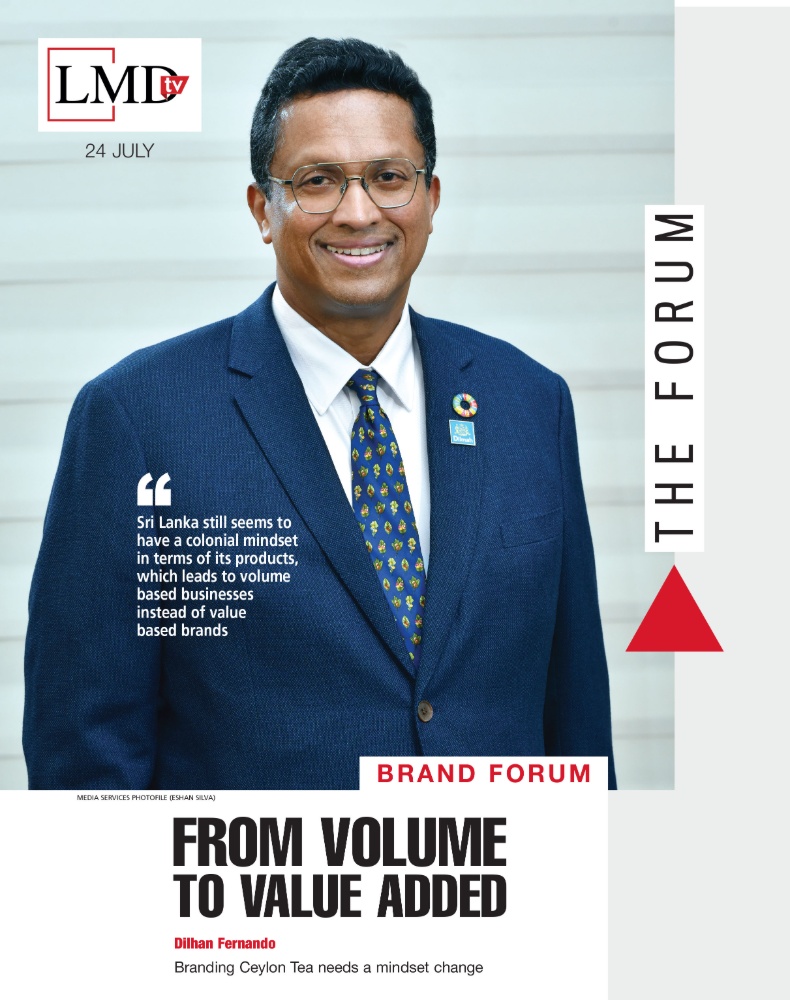
The conversation around branding Ceylon Tea has been ongoing for decades, yet progress continues to lag due to archaic practices, volume based strategies and a lack of collaboration within the industry.
Tea is Sri Lanka’s most renowned export but the nation’s strategy appears to be hindering the industry’s growth rather than supporting it.
Speaking to LMDtv on branding Ceylon Tea, the Chairman and CEO of Dilmah Ceylon Tea Company Dilhan Fernando asserted that the most notable issue lies in shifting focus from volume to value.
He said the island shouldn’t try to emulate the success of Vietnam or China as they have completely different demographics and natural environments. Instead, he explained that Sri Lanka should understand that for a country with limited land mass, relatively small internal market and constraints on natural resources; the focus must be on genuine value creation.
Fernando elaborated: “In colonial times, we were forced to work on volume but the situation is very different today. I don’t mean moving from bulk tea to private label teas; I mean building brands such as Ceylon Tea, Ceylon Cinnamon and Sri Lankan cashew, and selling them at the top-end of the market.”
“We should connect that aspiration with the value that we create for consumers in terms of our heritage, our story and our biodiversity. Sri Lanka has a lot going for it but we need to connect our heritage and cultural factors with our socioeconomic priorities and export marketing,” he added.
Fernando also highlighted that one of the main hindrances to successfully branding Ceylon Tea is the ’lack of unity within the industry’ – many players prefer to sell on price rather than value. And he added: “It’s a lot easier to sell on price but what many fail to understand is that when you do that, ultimately somebody has to pay the cost.”
For instance, the cost might be borne by the environment where producers could potentially be using chemicals that are not sustainable, or it may be in terms of exporting the benefits of cheap labour or packaging.
As he explained, “things are changing as international regulations are forcing environmental and social compliance – so all the aspects that we externalised in the past are no longer possible.”
“Quite soon, we’ll see the EU implementing rules on packaging waste reduction and greenwashing practices, and I don’t believe we’re prepared for those regulations. Yet, this is only the first step in a much more rigorous evaluation of our environmental and social credentials,” he cautioned.
Recognising the value of Sri Lanka and importance of protecting its soil and biodiversity for future generations is of paramount importance, as Fernando posited: “Sri Lanka has the opportunity to convert all these aspects into a competitive advantage but it needs a change of mindset. Unfortunately, that’s where the branding argument falls apart.”
According to him, branding should be an all-consuming passion but we have built a fantasy in our minds about the demographic that enjoys Ceylon Tea and failed to realise that today’s consumers are mostly young people.
He explained that the power of Ceylon Tea remains but Sri Lanka needs to build on and strengthen it. Any brand requires continuous investment but unfortunately, this has not happened with the Ceylon Tea brand. Unlike selling in bulk or to private labels, branding isn’t easy.
Fernando continued: “Sri Lanka still seems to have a colonial mindset in terms of its products, which leads to volume based businesses instead of value based brands. We have the best tea, cinnamon, cashew and pepper, as well as several other high quality products; but we have not created value for them.”
And in summing up, he emphasised that value creation must stem from a natural and an environmental sense, as well as from the people and their social sense. Only when these prerequisites are satisfied will it be possible to make these products profitable.