BRAND FORUM SRI LANKA
LEADERSHIP IN AN ERA OF CONSTANT DISRUPTION
The leadership summit organised by the Sri Lanka Brand Forum (SLBF), held under the theme Resilient Leadership – Thriving Amid Uncertainty, brought together a distinguished gathering of global business leaders, academics, entrepreneurs and corporate executives to discuss one of the defining challenges of the modern era: how organisations and leaders can survive, adapt and grow in a world that is increasingly characterised by uncertainty, disruption and rapid transformation.
At a time when businesses across the globe are facing geopolitical instability, technological disruption, economic volatility, climate risk and changing consumer expectations, the summit created a vital platform for important conversations on leadership resilience, innovation, branding, sustainability, agility and the future of business.
Delivering the welcome address, Founder of Bangladesh Brand Forum (BBF) Shariful Islam welcomed participants and highlighted the importance of building platforms that encourage meaningful dialogue around leadership, innovation and sustainable growth during uncertain times.
He noted that “modern leaders are operating in one of the most complex and unpredictable business environments in history, requiring not only strategic insight and technical expertise but also adaptability, empathy and long-term vision.”
Islam emphasised that the leadership summit was intended to be far more than yet another corporate conference or networking event. Instead, he described it as the beginning of a broader national movement focussed on redefining leadership for a rapidly changing world.
He expressed confidence that Sri Lanka – despite its recent economic and political challenges – possesses the resilience, talent and entrepreneurial spirit necessary to become an example to the world of how nations can recover, reinvent themselves and lead their people out of crisis.
Islam elaborated on the concept of the brittle, anxious, nonlinear and incomprehensible (BANI) world – an increasingly influential framework used to describe the realities of the modern global environment.
He explained that the world today is not merely volatile or uncertain but has become brittle, anxious, nonlinear and incomprehensible. Systems that once appeared strong and stable can collapse suddenly without warning.
Constant disruption and information overload are creating anxiety among individuals, businesses and societies while cause and effect relationships have become increasingly nonlinear.
Referring to the country’s recent hardships, Islam said: “Sri Lanka has experienced extraordinary economic, social and political disruptions over the past several years. However, crises also create opportunities for transformation and renewal.”
“Some of the world’s strongest organisations and most innovative societies have emerged stronger after periods of adversity, and Sri Lanka too has the potential to transform its challenges into a platform for long-term progress and innovation,” he added.
Islam encouraged business leaders, entrepreneurs and policymakers to work together in shaping a more resilient and future ready Sri Lanka. He emphasised that the conversations taking place during the summit should not end within the conference hall but instead inspire long-term action, collaboration and leadership transformation across industries and institutions.
One of the summit’s most anticipated keynote sessions was Leadership in Turbulent Times, delivered by Executive Chairman – L. Catterton India and former President of Unilever South Asia Sanjiv Mehta.
Drawing from decades of experience leading organisations through major global crises, he presented a compelling perspective on leadership in what he described as a ‘perma-crisis’ world.
At the outset, Mehta explained that the world has moved beyond the era of predictable growth, stable supply chains and gradual change into a period dominated by geopolitical conflict, climate risks, technological upheaval and economic uncertainty.
He pointed out that even the lifespan of major corporations has declined significantly because organisations are struggling to adapt to accelerating disruption.
Rather than focussing solely on the dangers created by uncertainty however, Mehta argued that exceptional leaders identify opportunities hidden within crises. He encouraged leaders to remain optimistic and adaptive even during turbulent times.
Using the global energy transition as an example, he explained that current geopolitical and environmental challenges also create opportunities for countries such as Sri Lanka to build resilient green energy systems and replace outdated infrastructure.
A central theme of Mehta’s keynote was the importance of people first leadership. He repeatedly emphasised that empathy, compassion and psychological safety are not soft skills but critical drivers of organisational resilience.
Reflecting on his experiences during the Arab Spring and the COVID-19 pandemic, he shared examples of how organisations supported employees personally, as well as professionally. He maintained that organisations become resilient when employees genuinely feel valued and protected.
Mehta challenged the traditional assumption that leadership is about predicting the future accurately. Instead, he argued that resilient organisations are those capable of sensing change early and adjusting rapidly. Using the metaphor of sailing, Mehta explained that leaders should stop trying to predict the wind and instead focus on adjusting their sails effectively.
He identified three critical dimensions of agility: cognitive agility, which enables organisations to detect change; strategic agility, which supports rapid decision making; and execution agility, which ensures swift implementation. Together, these capabilities allow organisations not merely to survive crises but thrive because of them.
Mehta described artificial intelligence as a transformational shift comparable to earlier industrial revolutions. However, he warned that smaller nations risk becoming data colonies if they fail to develop local innovation ecosystems and digital capabilities.
“The future competitive advantage will come not only from technological capability itself but from combining AI with uniquely human qualities such as creativity, empathy and emotional intelligence,” he predicted.
The keynote presentation on The Future of Purpose Driven Branding, which was delivered by renowned author and Vice Chairman of the consultancy firm Prophet Prof. David Aaker was both insightful and enriching.
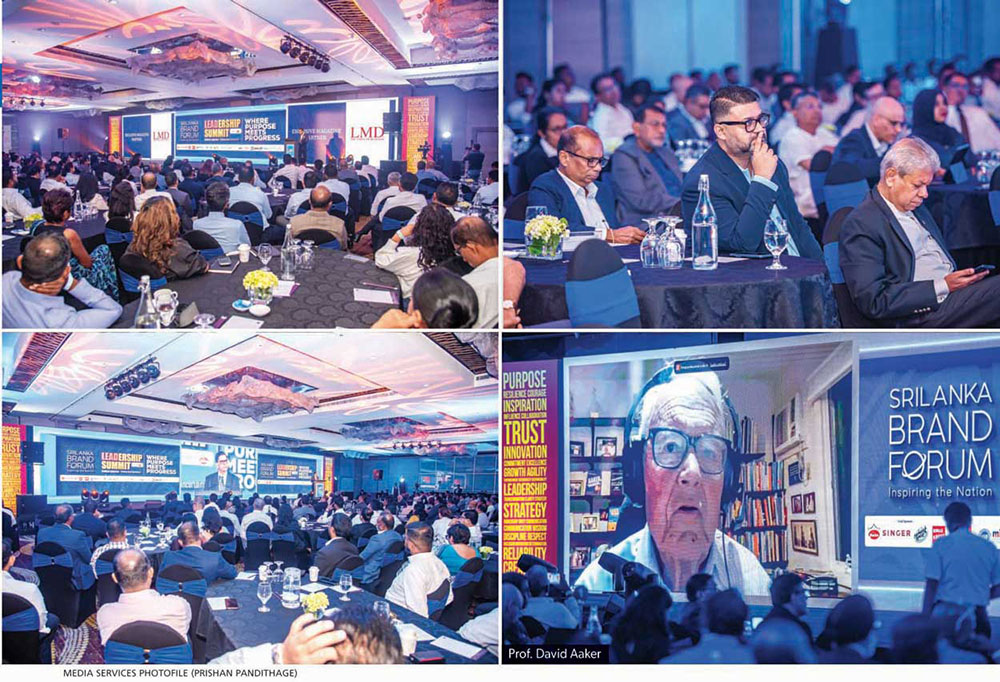
Widely regarded as one of the world’s leading authorities on branding, Aaker explored how brands must evolve in a world where consumers are increasingly sceptical of traditional advertising and remain overloaded with information.
According to Aaker, widely hailed as the father of modern branding, audiences today actively avoid conventional advertising messages by ignoring, forgetting or distrusting them. In this environment, traditional advertising alone is becoming less effective at building emotional connection and brand loyalty.
Instead, he argued that businesses must increasingly rely on alternative brand builders such as sponsorships, events, community engagement and social programmes.
Aaker’s presentation focussed heavily on the concept of signature social programmes – long-term, purpose driven initiatives designed to create both societal impact and strategic business value.
He criticised the fragmented and superficial way many companies currently approach corporate social responsibility, noting that many CSR initiatives lack strategic direction and fail to connect meaningfully with consumers.
Aaker stressed that modern consumers, employees and stakeholders expect organisations to stand for something meaningful beyond profits. Businesses therefore, need to integrate purpose directly into their brand identity and operations rather than treating social responsibility as a separate activity.
He also cited Dove’s Real Beauty campaign as a compelling example. Over time, Dove has evolved into one of the world’s strongest purpose driven brands, demonstrating what Aaker described as the ‘flywheel effect’ – where social impact strengthens the business while business success provides greater momentum for the social mission.
Aaker also discussed how organisations can collaborate with existing social initiatives instead of creating entirely new programmes. Using the example of Habitat for Humanity and its partnership with Thrivent, he explained how strategic partnerships can create value both for society and the brand itself.
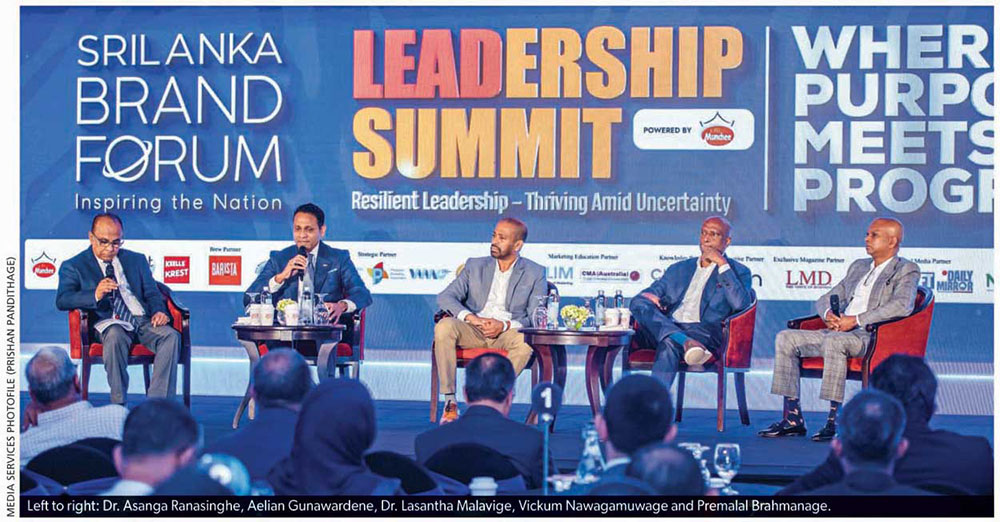
The summit also featured a highly engaging panel discussion titled From Crisis to Catalyst: Reinventing Business Models in Uncertain Times.
Moderated by Director of the Postgraduate Institute of Management (PIM) Dr. Asanga Ranasinghe, the panel brought together Founder and Managing Director of JAT Holdings Aelian Gunawardene; Founder and Chairman of Lassana Group of Companies Dr. Lasantha Malavige; Founder and Chief Executive officer of Santani Wellness Resorts Vickum Nawagamuwage; and Group Chairman of Prime Lands Premalal Brahmanage.
The discussion explored how businesses can transform crises into opportunities for innovation and long-term growth. The panellists agreed that uncertainty has become a permanent feature of the global business environment and traditional business models are increasingly inadequate in the face of rapid change.
The importance of speed and decisiveness was repeatedly emphasised. Several speakers stressed that businesses can no longer wait for perfect conditions or complete certainty before taking action. Instead, organisations must move quickly, experiment continuously and adapt in real time.
Personal examples were shared of businesses reinventing themselves in response to global disruption by diversifying into international markets, embracing e-commerce and AI driven systems, investing in modern agriculture, and prioritising long-term vision and employee retention even during periods of severe economic uncertainty.
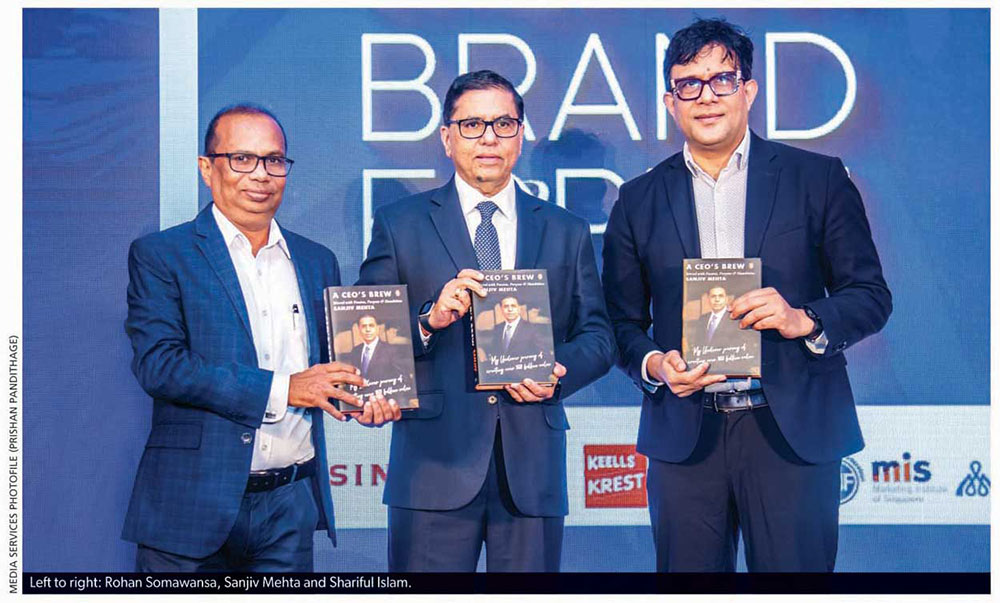
A highlight of the summit was the launch of several major initiatives including the book A CEO’s Brew Stirred by Passion Purpose and Humbition: My Unilever Journey to Creating over $60 Billion Value by Sanjiv Mehta – with the author personally presenting the first copies.
In addition, the SLBF Leadership Academy, Sri Lanka Brand Conference, Sustainability Summit and SDG Brand Champion were launched. These initiatives reflected the summit’s broader commitment to leadership development, sustainability and long-term business transformation.
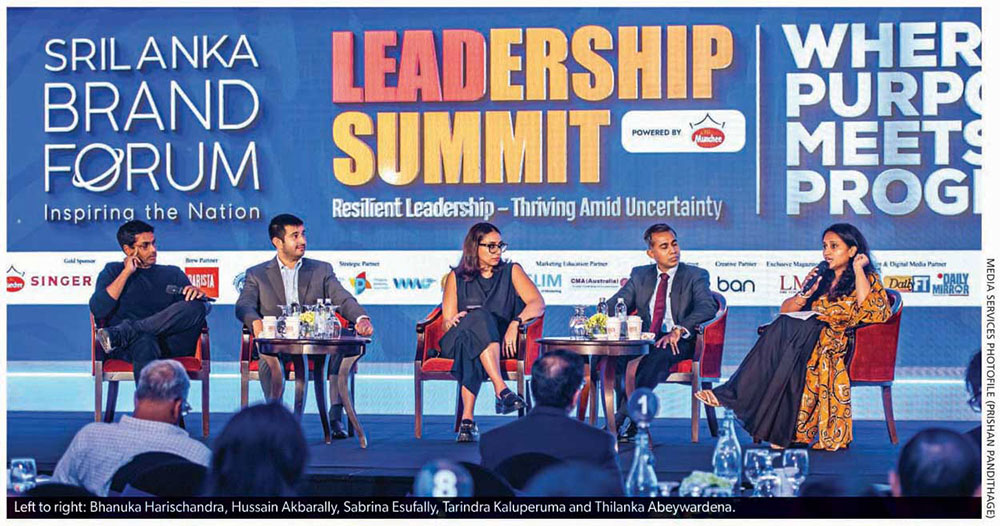
The next session focussed on Purpose Driven Leadership: Why the Next Generation Leads Differently. Moderated by Asia Cloud and AI Integrated Marketing Lead of Microsoft Asia Thilanka Abeywardena, the panel featured CEO and Founder of Surge Global Bhanuka Harischandra; Executive Director of Akbar Brothers Hussain Akbarally; Managing Director of Hemas Consumer Brands Sabrina Esufally; and Executive Director of Stafford Motor Company Tarindra Kaluperuma.
This discussion examined how millennials and Gen Z are reshaping workplace culture and leadership expectations. The panellists argued that younger generations increasingly prioritise purpose, social impact, belonging and work-life balance over purely financial rewards. Businesses that fail to create meaningful and inclusive work environments risk losing both talent and long-term relevance.
In addition, the panel emphasised how leadership itself is evolving. Today’s leaders are expected to be more empathetic, collaborative, technologically fluent and purpose driven. Agility, emotional intelligence (EI) and authenticity are becoming as important as operational expertise and financial performance.
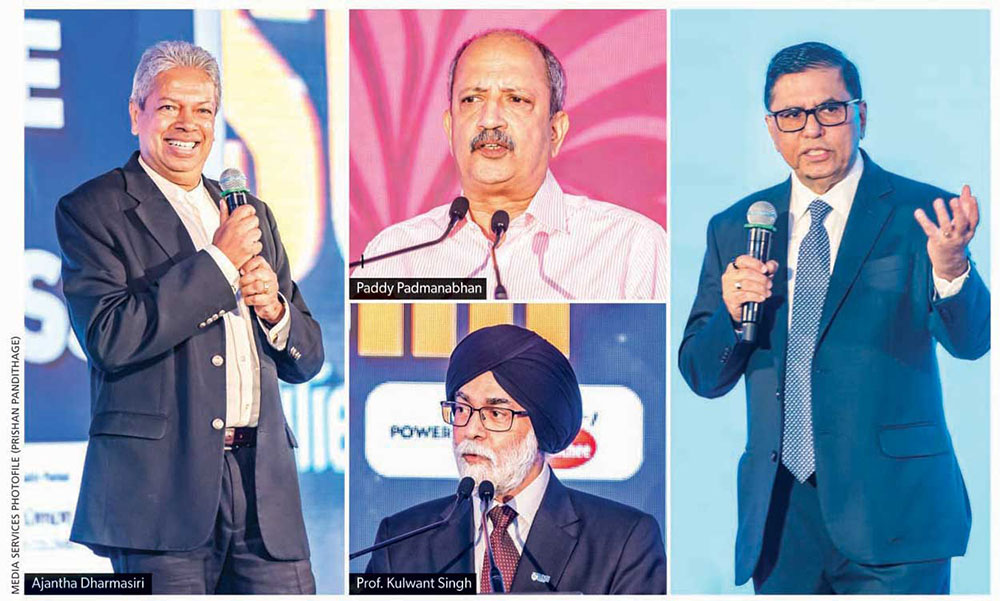
This was followed by an intellectually rich keynote session by Unilever Chaired Professor of Marketing INSEAD Dr. Paddy Padmanabhan. Under the title The Phoenix Mindset: Reinventing Leadership in an Age of Constant Disruption, Padmanabhan explored why many successful organisations struggle to adapt despite possessing strong resources and market positions.
According to Padmanabhan, disruption rarely comes from technology alone. Instead, disruption occurs when organisations use technology to fundamentally rethink how value is created. Using examples such as Amazon, Airbnb, Uber and Nokia, he illustrated how disruptive companies succeed by challenging traditional assumptions and redesigning customer experiences.
Padmanabhan argued that successful organisations often become trapped by the very systems and capabilities that once made them successful. Companies become highly efficient at executing existing business models while losing the curiosity and imagination necessary to prepare for future disruptions.
Most organisations reward operational excellence and short-term execution while marginalising creative thinkers who question assumptions and imagine alternative futures. Over time, this creates vulnerability because organisations become focussed on protecting current success rather than reinventing themselves proactively.
To address this challenge, Padmanabhan introduced the idea of the Phoenix mindset – the willingness to disrupt oneself before competitors do. Leaders, he argued, must actively cultivate experimentation, imagination and curiosity within their organisations. The future will belong not necessarily to the largest companies but to those willing to continuously reinvent themselves.
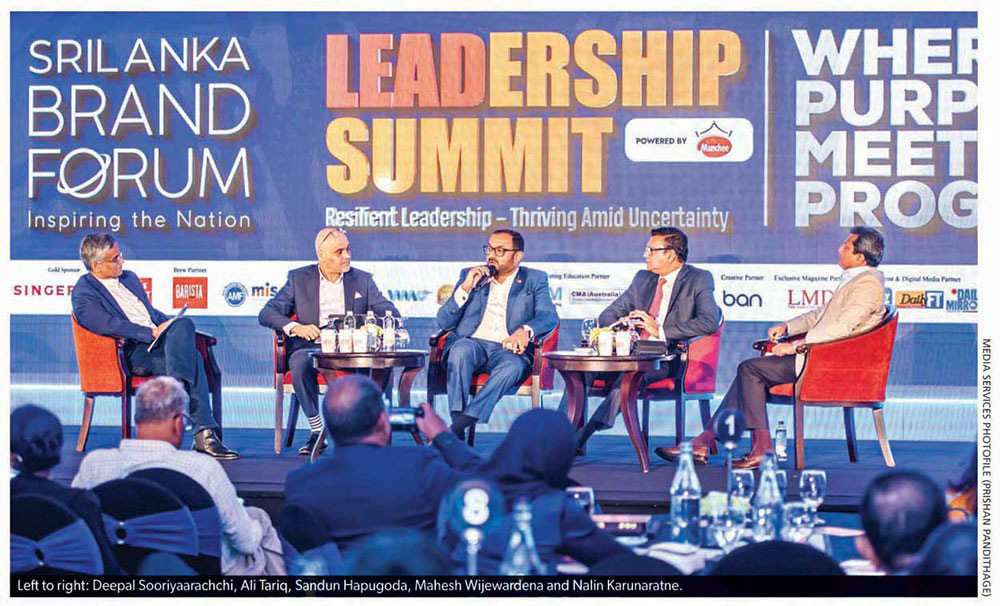
An important panel discussion was conducted on The Future of Leadership: What Will Define Resilience in the Next Decade? moderated by management consultant, author, trainer and Director of AIA Insurance Lanka Deepal Sooriyaarachchi, the panel consisted of Chairman and CEO of Unilever Sri Lanka Ali Tariq; Country Manager – Sri Lanka & Maldives of Mastercard Sandun Hapugoda; Group Managing Director of Singer Sri Lanka Mahesh Wijewardena; and CEO of Ceylon Biscuits Nalin Karunaratne.
The panel explored how resilience itself is evolving in the modern business environment. Traditionally, resilience meant recovering after disruption and returning to normal. However, the panellists argued that modern organisations can no longer expect to return to previous conditions after crises because every disruption permanently changes markets, consumers and industries.
Instead, resilience now means continuously adapting, evolving and emerging stronger after each crisis. Several executives shared examples of how their organisations fundamentally changed operating models during Sri Lanka’s economic crisis by prioritising cash flow management, efficiency, operational discipline and long-term sustainability.
It was pointed out that modern organisations depend not only on employees but also suppliers, distributors, technology partners, financial institutions and broader stakeholder networks. Resilience therefore, depends on how effectively leaders align and support the wider ecosystem.
Panellists repeatedly stressed that trust forms the foundation of organisational resilience. Employees remain committed during difficult periods only when they trust leadership and feel genuinely valued by the organisations.
The summit concluded with a keynote presentation on Strategy for Resilience in Volatile Environments by Professor of Business, Strategy and Policy of NUS Business School, National University of Singapore, Prof. Kulwant Singh. He reinforced the idea that volatility and uncertainty are no longer temporary disruptions but structural realities of the global economy.
Singh explored the growing tension between efficiency and resilience. While businesses traditionally focussed heavily on lean operations and cost optimisation, recent crises demonstrated that excessive efficiency can create vulnerability. Instead, organisations must strike the right balance between operational efficiency and strategic resilience.
Singh encouraged businesses to conduct formal post-crisis reviews and systematically analyse lessons from previous disruptions. Organisations that actively study past crises are better prepared to anticipate future shocks and avoid repeating mistakes.
He also emphasised the importance of long-term strategic thinking, collaboration between business and government, and investment in future facing sectors such as wellness tourism and sustainability.
Referring to countries such as Singapore, Singh argued that resilience is strengthened when governments, businesses and society work together around a shared national vision.
The summit reinforced a powerful message for modern organisations: resilience involves continuously adapting, reinventing and building organisations capable of thriving amid uncertainty. Businesses that combine strategic agility with human-centred leadership, technological innovation and authentic purpose will be best positioned to succeed in an increasingly volatile global environment.