
EY SRI LANKA
EXECUTING THE FINANCE FUNCTION OF THE FUTURE
Driven by cost-benefit analysis (CBA), local and global business rules have quietly but decisively shifted as organisations navigate a landscape of opportunity and volatility.
Digital reporting is deepening among companies and regulators as such processes become the norm with roll outs across government sectors and regulators, underscored by expectations of transparency.
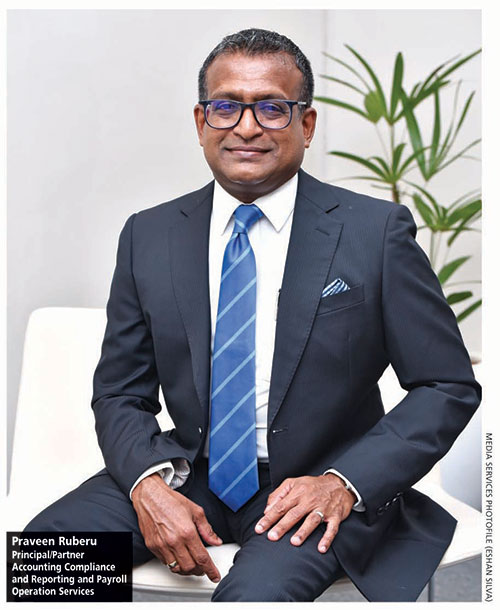
“Against this backdrop, the finance function can no longer stay in the background – ‘back office finance’ is now front and centre. Compliance only reporting no longer cuts it. With low single digit inflation, rapid talent movement and tight margins, balanced books are only the baseline,” says Praveen Ruberu.
“Your finance function should not be a weight dragging you down but an engine that drives toward future triumph,” he declares, pointing out that many businesses still experience accounting as a retrospective exercise – focussed on taxes paid, costs incurred and last month’s results. While essential, this approach is no longer enough in a fast-moving, unpredictable economy.
Ruberu explains further: “The finance function of the future needs forward visibility: a windshield, not a rearview mirror. When Accounting Compliance and Reporting (ACR) is thoughtfully integrated with operational data, it delivers something many organisations struggle to achieve: meaningful visibility.”
“ACR becomes both a discipline and a differentiator, combining the rigour required to protect the business with the insight needed to drive growth,” he adds.
As a result, and supported by structured processes and agile technology, financial reporting evolves from static outputs into decision ready insights while remaining audit ready.
Ruberu avers: “Leaders no longer depend on disconnected spreadsheets; instead, they can work with timely information that helps anticipate risk, respond earlier and identify opportunities for value creation.”
But there’s a practical reality: forward visibility only matters if it’s sustained consistently. That’s where finance talent continuity becomes critical, he notes.
Ruberu asserts: “The outflow of skilled finance talent is a key challenge for Sri Lankan boardrooms. As professionals move abroad, organisations are left in restless hiring cycles. The departure of a senior accountant isn’t only a human resources hurdle; it’s a loss of institutional memory and a heightened compliance risk.”

Here, ACR takes on strategic significance, helping future ready organisations reinforce stability at the core of their finance function. By working with globally backed EY ACR methodologies, businesses can embed reporting and compliance into a model that isn’t dependent on individual tenure.
He elaborates that positioned as a Finance Managed Service (FMS), ACR is a technology enabled operating model for resilience. Instead of relying on a few key individuals, it uses standardised ways of working, skilled global teams and automation to reduce manual effort and errors.
It goes beyond bookkeeping to cover end-to-end finance activities, and it can scale up or down as market conditions change, supporting both mid-sized businesses and multinationals.
The outcome is stable governance, insight and control with a finance backbone that remains consistent even as people leave.
“Institutional credibility is increasingly driven by the quality of accounting and statutory reporting. As local regulatory bodies expand digitised oversight, simply completing ‘routine and regular reporting’ is no longer enough. The structure, traceability and governance of statutory data have become a visible signal of organisational health,” he says.
Ruberu adds: “By applying an ACR framework, your statutory reporting is unified under consistent governance and standards, turning every reporting cycle into an opportunity to strengthen your audit ready position. This builds confidence beyond compliance especially when stakeholders rely on timely, decision grade information.”
By using specific tools such as CaseWare, and having the experience and exposure to use them effectively, the documentation for audit becomes more consistent and financial statements remain audit ready for any required geography, he asserts.
“This makes reporting transparent, defensible and aligned with global expectations. In short, statutory reporting becomes more than an obligation; it becomes a seal of quality,” he affirms.
Moreover, a digital first environment is becoming mandatory. With regulators pushing for real-time transparency, there’s little room for manual workarounds and avoidable errors. For many businesses, this adds day-to-day friction and pressure.
As he points out however, “for ACR backed organisations, this shift becomes an efficiency gain. Automated, standards based compliance ensures regulatory requirements are managed reliably while centralised processes ease the burden on internal teams and allow leaders to stay focussed on the business.”
“Going ahead, the gap between leaders and laggards will increasingly depend on how well organisations use their data. Businesses that still treat accounting as merely a practical necessity will remain further weighed down by inefficiency and ongoing talent pressures,” Ruberu emphasises.
However, “those adopting a modern ACR approach gain more than compliance – they build resilience to economic shocks, improve visibility into performance and risk, and strengthen credibility with all relevant stakeholders,” he avers.
Tomorrow’s finance function doesn’t look back… it guides the way forward. In times of uncertainty, clarity can give a business a sharp competitive edge over others, he opines.
– Compiled by Yamini Sequeira
COMPANY CONTACT DETAILS
Telephone: 2463500 | Email: praveen.ruberu@lk.ey.com | Website: www.ey.com/en_lk