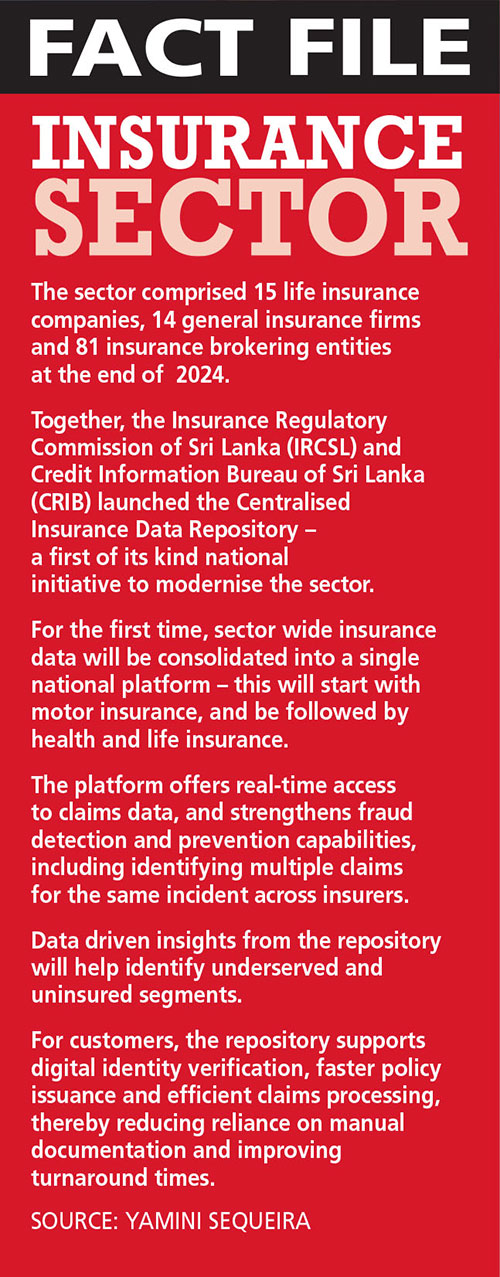
INSURANCE SECTOR

REST ASSURED
Compiled by Yamini Sequeira
THE RELATIONSHIP MODEL
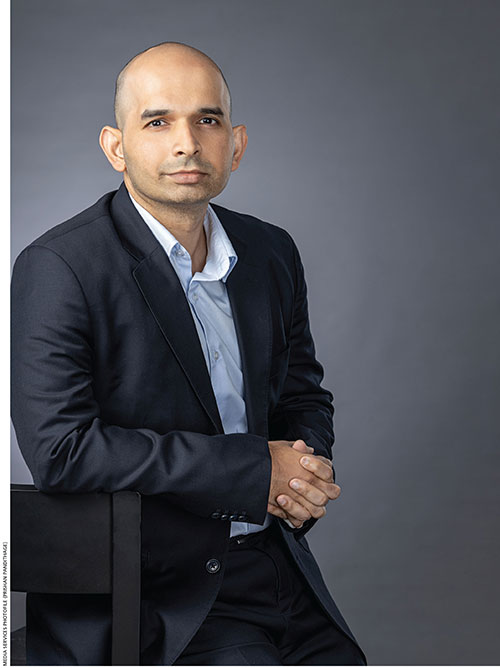
Senath Jayatilake asserts that relationship based distribution remains the cornerstone of Sri Lanka’s insurance ecosystem
Operating against a backdrop of economic volatility for decades, the life insurance sector has had to continually recalibrate its growth strategies and operating models. Over the past five years however, the sector has recorded healthy compound annual growth rates (CAGR).
This was not an accidental development; it was one driven by conscious shifts in business models and customer engagement approaches.
“The resilience demonstrated by the sector has emanated from its ability to be proactive and adaptive during times of adversity,” says Senath Jayatilake.
He continues: “Greater adoption of digital technologies in how companies interact with customers and operate value chains, along with innovations in customer centricity and personalisation of product and service offerings, has enabled the insurance sector to weather multiple storms.”
THE GDP FACTOR Looking ahead, macroeconomic stabilisation is expected to play a defining role in shaping the sector’s next phase of growth.
In his opinion, a stable inflationary and economic environment, driven by strong fiscal reforms, will enable the insurance sector to stimulate sustainable growth. The country continues to present opportunities for expansion when benchmarked against international standards.
“Compared to global benchmarks, life insurance cover in Sri Lanka remains considerably low, reflecting a substantial unmet need. However, I believe that the sector is at the cusp of a transformative journey that will help protect the nation and its citizens,” Jayatilake asserts.
And he emphasises that “it will reduce dependency on government welfare for many households and individuals during times of uncertainty.”
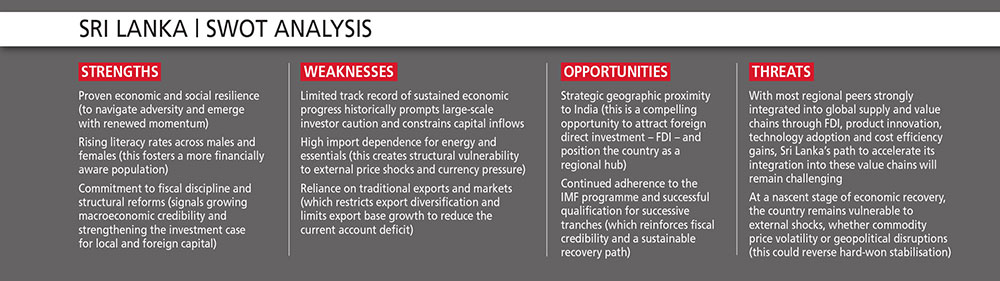
More broadly, sector performance tends to mirror the underlying economic momentum, particularly when growth is driven by structural improvements rather than short-term stimulus.
As in most other business segments, the performance of the life insurance sector closely correlates with GDP growth, particularly when it is achieved on the back of key fundamental improvements and the stimulation of economic activity.
Jayatilake notes that “such growth dynamics have a direct bearing on the ability of households to prioritise long-term financial protection.”
“GDP growth driven by sustainable economic stimulation will result in a greater number of households and individuals having the financial capability to access the right type of life insurance solutions that fully cover their financial protection needs,” he explains.
SCOPE FOR EXPANSION Despite steady expansion, adoption gaps remain a defining feature of the local market.
“While the insurance sector has grown strongly over the years, the country’s market adoption rates – both in terms of population and coverage – remain extremely low. But with sustainable GDP growth and the correlated increase in household income levels, we are confident that this gap can be bridged,” Jayatilake maintains.
He points out that the gross domestic product contribution of insurance is notably lower than in regional markets such as India, Malaysia and Thailand, implying that the sector needs to accelerate at a pace that’s far greater than GDP growth to create a positive and material impact.
“With household disposable incomes under pressure, balancing premium growth with affordability and persistency is a challenge. However, products can be tailored to meet affordability, financial protection versus savings appetite and coverage requirements of customers,” he affirms.
In this context, insurers are increasingly shifting towards more nuanced product design philosophies.
“The ability to drive long-term premium growth in challenging environments will stem from offering financial protection solutions tailored to each customer rather than adopting a one-size-fits-all strategy,” Jayatilake avers.
In this context, he explains that “life insurance is a deeply personal proposition and needs can vary significantly between customers, even within similar socioeconomic and demographic segments.”
Another dimension shaping accessibility is the evolution of distribution models. Distribution diversity also drives pricing efficiency and broadens accessibility.
Digitalisation is also having a measurable impact on cost ratios, claims turnaround times and customer acquisition costs. Increasingly, insurers are viewing digital transformation not merely as an efficiency tool but a strategic enabler of engagement too.
He explains: “Digitalisation is the foundation of value chain efficiency. In addition to improving cost ratios and service standards, digital platforms are also a pivotal ecosystem to meet the evolving needs of more tech native customer segments, who increasingly prefer greater control and engagement in their purchase and service journeys.”

BANKING ON PARTNERSHIPS At the same time, new ecosystem based partnerships are reshaping how insurance reaches customers. There is a clear trend of embedded insurance and bancassurance reshaping traditional agency driven distribution models.
Jayatilake elaborates: “The potential for bancassurance to be a catalyst of the growth and accessibility of insurance is formidable. With consumers increasingly preferring one stop shop service ecosystems, bancassurance provides a strong proposition by offering customers financial protection and empowerment solutions under one umbrella.”
So while banks provide access to financial instruments that enable life ambitions, insurance companies offer financial protection for such ambitions and goals. In combination, bancassurance partnerships offer a comprehensive and all-encompassing financial proposition to customers.
“This is precisely why bancassurance represents a larger share of volume in regional markets – and most global markets. Importantly, the scope of bancassurance continues to expand beyond traditional financial protection offerings,” he says.
Beyond financial protection, which remains a core pillar of bancassurance value creation, a much wider application of the combined value proposition is achieved through embedding financial protection solutions into key banking products.
“This not only enables banks to distinctively differentiate their product offerings but is also an important tool that allows a wider customer segment to access financial protection solutions,” he adds.
Nevertheless, the human advisory channel continues to play a central role in Sri Lanka’s insurance landscape. Meanwhile, Jayatilake reveals that “the traditional agency model still dominates insurance distribution.”
He elaborates: “Today, life insurance is sold not only on the product proposition but also on the basis of the relationship between the insurance adviser and customer. This relationship based distribution remains the cornerstone of the country’s insurance ecosystem.”
On the whole, the life insurance sector continues to present significant potential despite steady growth in recent years.
As economic conditions stabilise, incomes improve and distribution channels evolve, there’s a clear opportunity to expand access to financial protection solutions, which will support sector growth and strengthen the financial security of households over the long term.