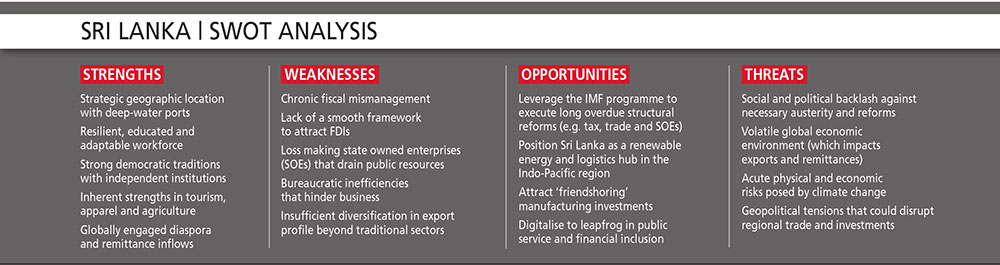
BANKING SECTOR

BANKING PRUDENCE
Compiled by Yamini Sequeira
STRATEGIC INFLECTION POINTS
Banks are pivoting from defensive to selective growth – Sanjaya Gunawardana
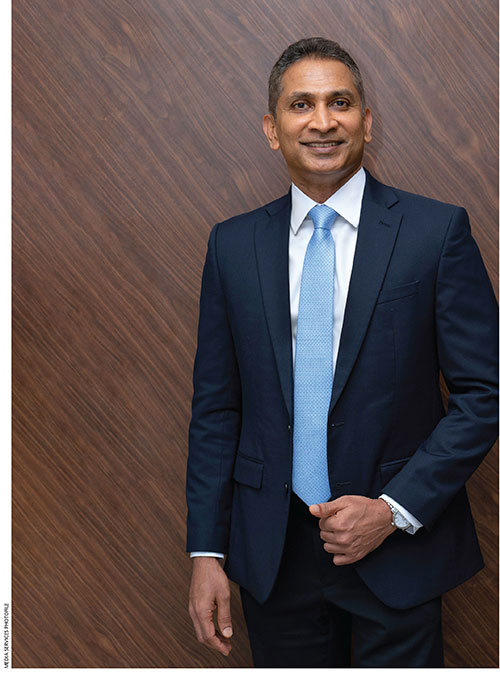
The banking sector is operating in an environment shaped by tighter regulation, stronger capital discipline and enhanced risk governance. The sector’s adaptation and resilience reflect a remarkable achievement, which has been duly noted by multilateral agencies.
Reflecting on how banks navigated the economic crisis, Sanjaya Gunawardana states: “Following the initial defensive response, the focus turned to preserving liquidity, supporting essential imports such as fuel and medicine, prudent provisioning under IFRS 9 (international financial reporting standards) and managing the freeze in external credit lines.”
“As the economy moved into the IMF led stabilisation phase, priorities evolved. The focus shifted to balance sheet repairs and recalibrating our risk models to a new reality. We changed our internal processes and restructured loans for viable businesses,” he adds, noting that the current phase marks a strategic inflection point.
Gunawardana avers: “Now in the recovery phase, we are pivoting from defence to selective growth, channelling liquidity to productive sectors while maintaining stringent capital buffers. The overarching lesson is that adaptability is not just tactical – it is a core strategic competency.”
STABILITY FIRST According to Gunawardana, “key reforms include the full implementation of Basel III standards, particularly the liquidity coverage ratio (LCR) and net stable funding ratio (NSFR), which have fundamentally changed how we manage our books.”
He adds that stronger provisioning requirements under IFRS 9, together with stricter single borrower and sectoral exposure limits, have been pivotal. Their effectiveness, Gunawardana argues, is visible in the banking sector’s enhanced resilience and the strengthened shock absorption capacity speaks for itself.
Yet, these gains have not been without cost. “A side effect has been a temporary constriction in credit flows to the private sector, particularly large groups,” he acknowledges.
That being said, Gunawardana is clear-eyed about the trade-off: “The balance between stability and growth is real; yet in a post-crisis environment, stability must come first to rebuild the foundation for sustainable growth.”
This emphasis on prudence closely aligns with the Central Bank of Sri Lanka’s push for stronger capital adequacy and risk governance. Gunawardana notes that banks are “not just responding; we are fully aligned,” describing regulatory directives as the bedrock of systemic trust. He points out that “almost all banks have capital adequacy ratios well above regulatory minimums.”
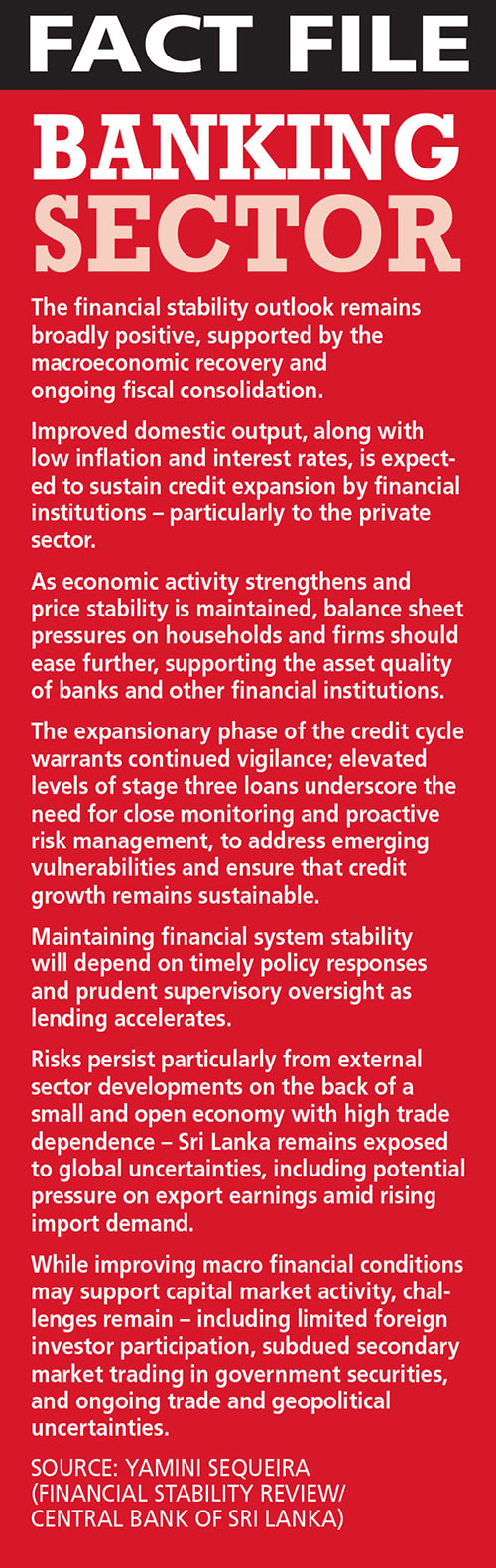
FUTURE PROOFING “Beyond headline metrics, risk management has become deeply embedded. It is now integrated into all strategic decisions, risk committees have expanded mandates and banks run periodic, dynamic stress testing scenarios that go beyond regulatory requirements,” he maintains.
In his view, this represents one of the most crucial investments in future proofing the banking sector. Sector consolidation is another pillar of reform, although progress has been intentionally measured.
Gunawardana describes the Central Bank’s road map as advancing at a deliberate, market led pace, highlighting that “forced mergers were avoided, which was wise.” Instead, economic logic is driving discussions, particularly as institutions grapple with rising compliance costs and the need for sustained tech investments.
“We believe that mergers are necessary to achieve the scale needed to bear these costs and invest in necessary technology,” he says, predicting that consolidations are likely. These moves, he believes, will result in “stronger, more efficient banks that are better equipped to support large-scale infrastructure and export projects.”
Gunawardana describes domestic debt restructuring as a complex but necessary operation, adding that its successful conclusion, alongside external restructuring, removes a massive overhang on growth.
While fiscal consolidation has tightened public spending, he views it as structurally positive.
“It reduces crowding out, gradually freeing up capital for private sector lending, which is happening. We are witnessing improved liquidity, which we’re channelling prudently into credit growth that fuels real economic output,” he explains.
FACILITATORS Within this recalibrated macroeconomic framework, banks are playing an expanded role in reviving key sectors. Gunawardana notes that their role has “evolved from lender to strategic partner in de-risking growth.”
In tourism, he says banks are financing “not just hotels but the entire ecosystem – supply chains, experiential tourism startups and sustainability upgrades.”
Agriculture and industry financing is increasingly climate aligned. “We are pushing climate smart financing, linking credit to climate risk adaptation and mitigation, in line with environmental and social management system (ESMS) requirements,” he reveals.
“We have moved beyond collateral based lending to advanced analytics based cash flow analysis, enabling banks to reach viable businesses previously deemed non-bankable,” Gunawardana notes.
The International Monetary Fund’s Extended Fund Facility (EFF) has been central to this reset. He describes it as “the single most important catalyst for stabilisation of the economy and restoring confidence in the financial sector.”
What’s more, Gunawardana tempers expectations, noting that “confidence is a lagging indicator; it will follow demonstrated, consistent policy implementation.”
As digital adoption accelerates, operational resilience has expanded into cyber and data risk.
To this end, he is unequivocal that banks are investing aggressively: “As digital transaction volumes have soared, so has our investments, which goes well beyond firewalls. The sector has established dedicated 24/7 security operations centres, implemented advanced fraud detection tools, and mandated cybersecurity training and awareness.”
With new data protection legislation, banks are proactively aligning their practices with global standards. In his assessment, “trust in the digital realm is the new cornerstone of banking.”
Now in the recovery phase, we are pivoting from defence to selective growth, channelling liquidity to productive sectors

PARTNERSHIPS Developments in foreign direct investments (FDIs) also reflect an evolving economic structure. Gunawardana observes that “FDIs are returning but its character is changing.” As he notes, there is less emphasis on pure real estate.
Instead, he points to “partnerships in renewable energy projects, acquisitions in logistics and port related services, and venture capital flowing into export oriented tech and SaaS companies.”
Banks, Gunawardana notes, play a critical facilitation role by structuring these deals, providing local insights and managing complex cross border transactions.
Looking ahead, he frames the sector’s priorities as interconnected and strategic. And he emphasises the need to “maintain strong balance sheets while ensuring capital is actively and wisely deployed into growth sectors,” alongside accelerating technology.
He reiterates that “sustainability is no longer peripheral; environmental, social and governance (ESG) criteria must be central to credit decisions to attract green finance, and future proof portfolios.
Equally important are people and governance. We must cultivate a new generation of bankers skilled in digital finance, climate risk and relationship management, underpinned by world-class corporate governance,” he sums up.