THE GENDER SCORECARD
Sri Lanka faces widening gender inequality despite being a regional leader in the past

Two decades ago, Sri Lanka was celebrated as a regional leader in gender equality, ranking 13th globally and ahead of advanced economies such as Australia, Canada and Singapore. Today, the story is starkly different – the country has slipped to 130th out of 148 nations.
From boardrooms to the labour force, Sri Lanka’s gender gap continues to limit economic progress, making urgent and deliberate action essential to close it.
McKinsey & Company’s annual Women in the Workplace report reveals that despite strong commitments to gender diversity, many organisations struggle to turn intent into action. And barriers to women’s advancement remain a persistent challenge across emerging markets such as Sri Lanka.
C-suite representation is below 30 percent while around 42 percent of companies do not track the impact of gender diversity policies and 85 percent of boards fail to ensure accountability for meaningful progress.
Complementing these findings, Deloitte’s ‘Women @ Work 2025: A Global Outlook’ reveals that despite growing awareness, women face obstacles entering the workforce and progressing to leadership positions.
Many report declining mental wellbeing due to the pressures of an ‘always on’ culture while health related issues influence career choices and progression. Financial insecurity, unequal household responsibilities, and concerns over personal safety and non-inclusive behaviours further hinder advancement.
And while flexible and supportive workplace policies remain key, many organisations fail to meet these expectations.
When it comes to Sri Lanka, the World Economic Forum’s (WEF) Global Gender Gap Report 2025 delivers a sobering message that while global gender parity continues to inch forward, the island is the only economy to have slipped backward since 2006, falling 7.5 percentage points in its overall score.
The subindex breakdown highlights challenges across every dimension: economic participation and opportunity (128th), educational attainment (No. 48), health and survival (32nd) and political empowerment (No. 137).
Regionally, Sri Lanka ranks fourth in South Asia behind Bangladesh, Bhutan and Nepal, but ahead of India, the Maldives and Pakistan.
According to the Q1 2025 Labour Force Survey by the Department of Census and Statistics, Sri Lanka’s unemployment rate stood at 3.8 percent – the lowest in recent years. However, marked gender disparities persist – for example, female unemployment stood at 6.3 percent, compared with 2.5 percent for men.
Labour force participation further highlights the gender gap. Overall, 49.7 percent of the population is engaged in the workforce but the figures diverge sharply by gender – 70.1 percent of men are active, compared with 32 percent of women.
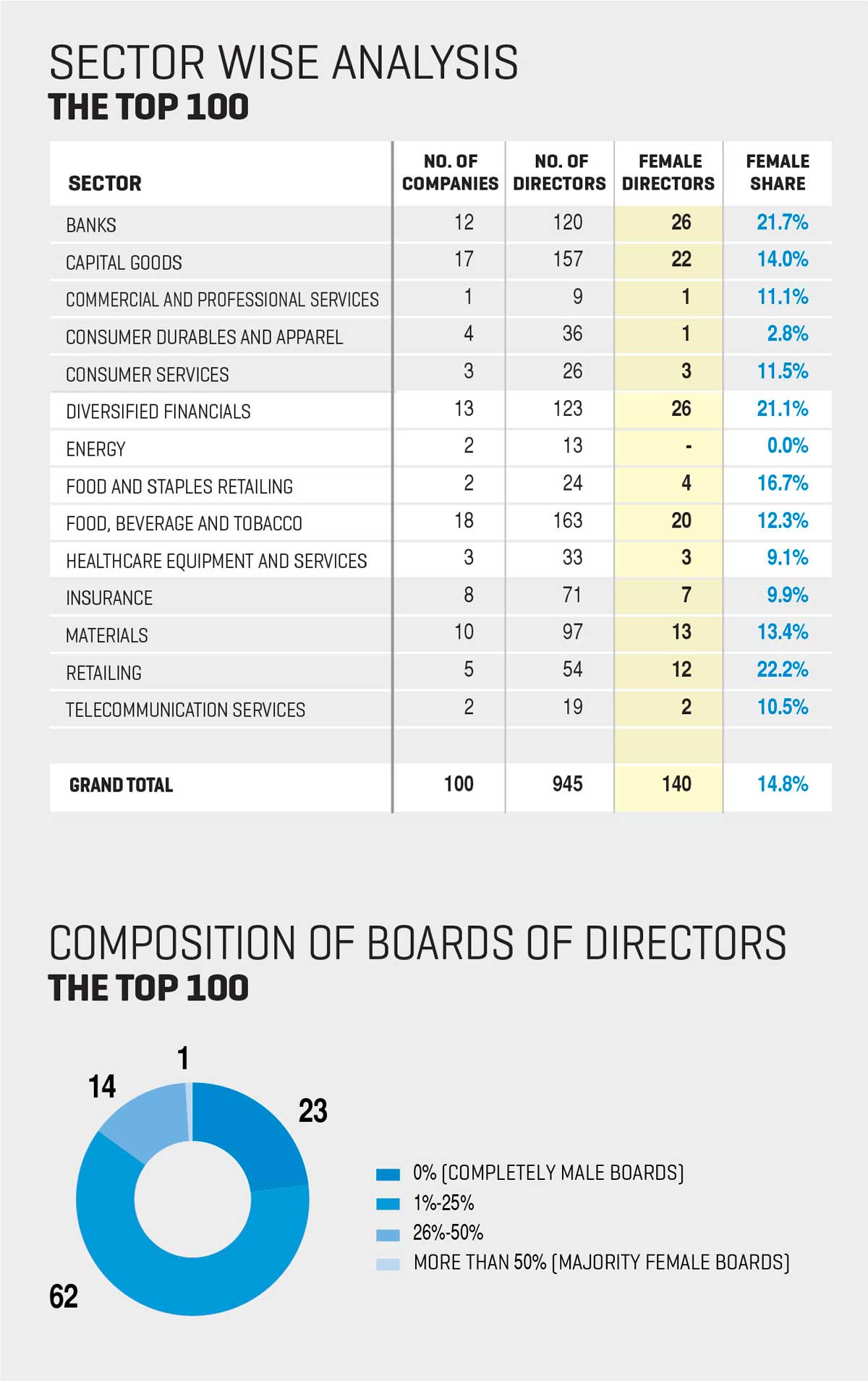
This gender gap in the workforce is reflected at the top of Sri Lanka Inc. as well with only one LMD 100 company currently featuring a majority female board, down from two corporates that reached this mark last year.
While 14 companies feature women in 26 to 50 percent of board seats, the number of all male boards has decreased from 26 to 23 – a small but welcome shift towards gender balance.
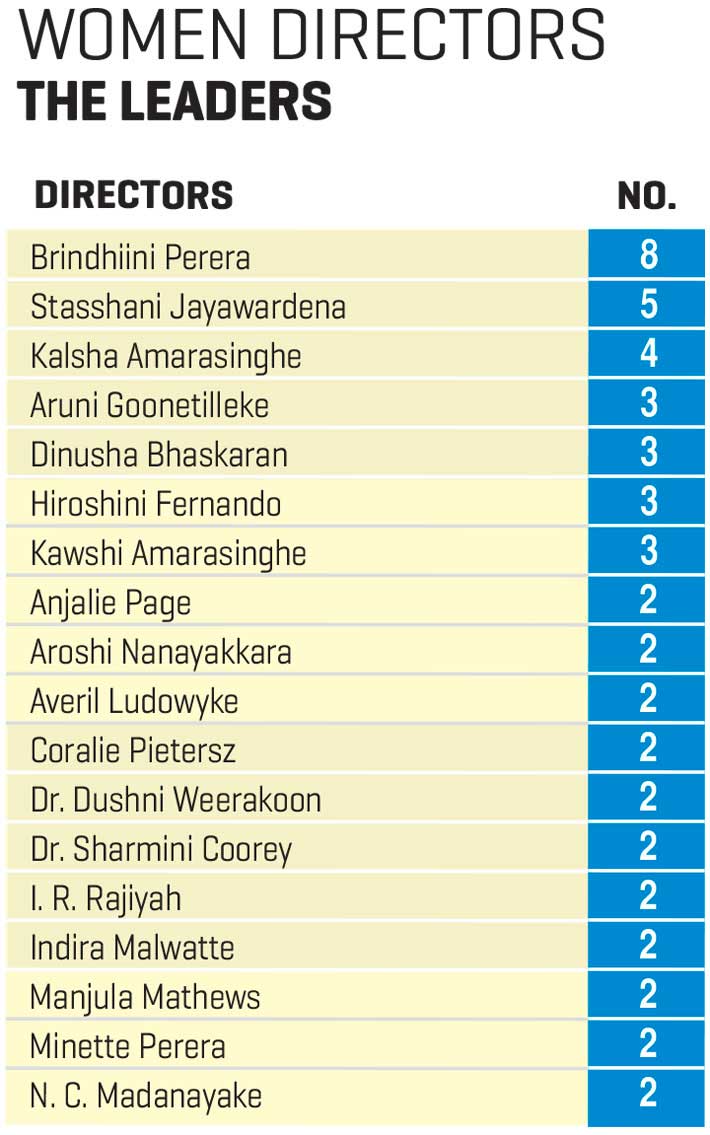
An analysis within the LMD 100 framework for financial year 2024/25 examined 945 directorships across 100 listed companies spanning 14 sectors, from banking and insurance to retail and consumer services. Women now hold 140 of these seats, accounting for 14.8 percent of all directorships – a marginal improvement from 14.7 percent the previous year.
Sector wise, retailing (22.2%), banking (21.7%) and diversified financials (21.1%) lead in female board representation while the energy sector remains entirely male dominated.
So while progress has been incremental, these findings highlight a clear opportunity for Sri Lanka’s corporates to strengthen gender diversity at the highest level. Achieving a genuine balance will require a commitment to inclusive leadership, equitable HR practices, and a corporate culture that empowers women to lead and shape the future of business.